Find YouTube influencers: sort by reach, not subscribers
On September 2, 2026 I scanned one coffee niche. The biggest channel had 10 times the subscribers of a rival and only 3 times the views. Subscriber count is how shortlists get built and how brands overpay. The same pattern held across the reach ratio benchmarks for 166 channels in 7 niches.
Updated September 18, 2026





Used by partnership, influencer, and brand teams
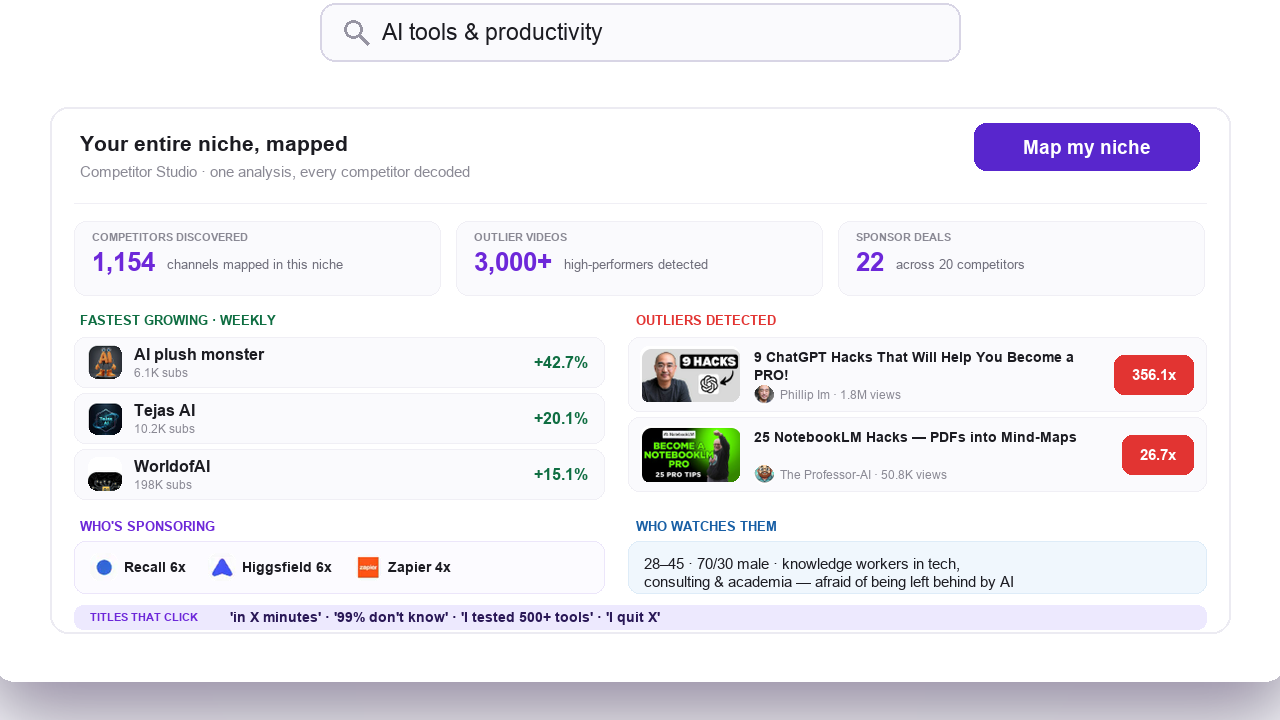
What does one niche scan return?
The table below is real output. I ran the sentence home espresso machine reviews and coffee gear through the OutlierKit channel index on September 2, 2026. It returned 16 channels. The last column is the reach ratio: average views per video divided by subscribers.
| Channel | Subscribers | Avg views per video | Audience market | Reach ratio |
|---|---|---|---|---|
| Home Coffee SolutionsBrand channel | 2,020 | 16,199 | United States | 8.02x |
| More GeorgeCreator | 21.8K | 57,518 | Global | 2.64x |
| CafeMaxPagesCreator | 29.6K | 44,473 | Global | 1.50x |
| Liz HappybeansCreator | 28.3K | 23,670 | Global | 0.84x |
| Home Cafe by CharlieCreator | 51.1K | 40,205 | United Kingdom | 0.79x |
| every coffeeCreator | 33.7K | 21,509 | Japan | 0.64x |
| ARAMSECreator | 60.9K | 32,345 | Global | 0.53x |
| Namja CoffeeCreator | 307K | 145,072 | Korea | 0.47x |
| Tom's Coffee CornerCreator | 208K | 97,657 | Global | 0.47x |
| Coffee by HendyCreator | 110K | 48,646 | Indonesia | 0.44x |
| Clive CoffeeBrand channel | 84.6K | 26,776 | United States | 0.32x |
| PerfettoCreator | 182K | 45,390 | Russia | 0.25x |
Source: OutlierKit channel index, retrieved September 2, 2026. Four of the 16 results are cut for length. Subscriber counts are rounded by YouTube.
Read the table the way a media buyer would
- The biggest channel is not the best buy. Namja Coffee has 10.4 times the subscribers of CafeMaxPages and 3.3 times the views. Priced on subscribers, you pay a 10x premium for a 3x result.
- Three of the top five by size are unbuyable for a United States brand. They publish for Korean, Russian, and Indonesian audiences. Sorting by subscribers puts them at the top anyway.
- The best reach ratio belongs to a 2,020-subscriber channel. Home Coffee Solutions averages 16,199 views per video, eight times its subscriber count, because it is a retailer channel living on search and recommendations.
- Half the list beats 0.44x. That is the working benchmark in this niche. Below it, you are paying for subscribers who stopped watching.
How do you find YouTube influencers in five steps?
To find YouTube influencers, describe the video your customer watches right before buying, scan the niche for every channel doing that job, re-rank the results by reach ratio, drop the channels whose audience sits outside your market, then vet the top ten on growth pattern and sponsor history. Search-first workflows skip steps three and four, which is where the money leaks.
- 1
Describe the job, not the category
A dropdown labelled Technology holds a soldering channel and a smartphone reviewer. A sentence does not. Write the video, not the vertical.
- 2
Scan the niche once
One sentence should return every channel doing that job, including creators no influencer database has listed yet. That long tail is where the underpriced deals are.
- 3
Re-rank by reach ratio
Divide average views per video by subscribers. This one division reorders almost every shortlist, and it takes seconds.
- 4
Filter by audience market
Where the audience is beats where the creator lives. A global channel is not a local buy, and a big foreign channel is not a buy at all.
- 5
Vet before you send the first email
Steady growth or one viral spike? Do sponsored videos still hit the channel average? Are there repeat sponsors? Ten minutes here saves a quarter of budget.
Where to find YouTube influencers: five routes compared
| Route | Cost | What it is good at | The honest catch |
|---|---|---|---|
| YouTube search and the sidebar | Free | Confirming names you already suspect. Fast for a first sanity check. | Search ranks by relevance to the query, not fit for your brand. You see the channels everyone else sees, and no view averages. |
| Competitor sponsor teardown | Free, but slow | Finding creators who already accept sponsorships in your category. | Watching enough videos to map a category by hand takes days per brand, and you only find who your rivals already booked. |
| Influencer marketplaces | Free to browse, paid to book | Creators who opted in, with rate cards attached. | You only see creators who signed up. The best performers in most niches never do. |
| Influencer databases | $59 to $500 a month | Filtering millions of channels by subscribers, country, and category. | Rows are sorted by audience size, and email deliverability varies. Size is the weakest predictor of a campaign result. |
| Semantic niche scan | $49 to $399 a month | One plain-English description returns every channel that matches the job, ranked by momentum. | It maps and vets creators. It does not send outreach, hold contracts, or process payments. |
How do you find YouTube influencers in your niche?
To find YouTube influencers by niche, search on a description of the content rather than a category label. Category filters are the weakest part of every influencer database, because YouTube's own categories are broad by design and creators pick them carelessly.
The espresso scan above is the proof. None of those 16 channels sit in a category called espresso. They sit under Howto & Style, Science & Technology, and People & Blogs. A category filter would have buried every one of them, and a keyword filter on "espresso" would have missed the grinder reviewers who never say the word in a title.
This is why jargon-heavy niches are the hardest to search and the most rewarding to map. Crypto and NFT, home automation, and B2B software all move vocabulary faster than the tagging catches up. A semantic scan matches on meaning, so it returns the channel that covers your topic under a name nobody has standardised yet.
Try these scan sentences
- Crypto: plain-English explainers of new crypto protocols for retail investors
- B2B software: walkthroughs of CRM and automation tools for small agencies
- Fitness: home gym equipment reviews for people training in a garage
Each returns a different cohort than the matching category dropdown does. Compare the two once and you will stop using the dropdown.
How do you find YouTube influencers by location?
To find YouTube influencers by location, filter on the audience market, not the creator's home country. These are different numbers and only one of them affects your campaign. A creator in Manchester whose audience is 70 percent American is a United States buy, and a creator down the road from your office whose audience is global is not a local buy at all.
In the September 2026 espresso scan, 3 of 16 channels served a United States audience, 1 served the United Kingdom, and 9 were global. The rest served Korea, Japan, Indonesia, and Russia. A United States coffee brand sorting that list by subscriber count would have spent its first three outreach emails on channels it cannot use.
For genuinely local work, add the place to the scan sentence ("coffee shop tours in Chicago") rather than reaching for a country checkbox. Local intent lives in the content, so the content is what you should search.
How do you find micro and nano influencers on YouTube?
To find micro-influencers on YouTube, cap subscribers at 100,000 and then sort what remains by reach ratio. Micro-influencers are worth hunting for a specific structural reason: rates track subscriber count closely, but views do not. That gap is the whole opportunity.
| Band | Subscribers | Why brands buy here |
|---|---|---|
| Nano | 1,000 to 10,000 | Cheapest tests and the highest comment engagement. Expect to book many to reach scale. |
| Micro | 10,000 to 100,000 | The band where reach ratio varies most, so research pays the biggest dividend. |
| Mid-tier | 100,000 to 500,000 | Predictable delivery and production quality, with rate cards that assume it. |
| Macro | 500,000 and up | Reach and brand halo. Usually the worst cost per view in the set. |
The full seven-method version of this, with the vetting framework and 2026 rate context, lives in the micro-influencer discovery guide. For what those creators actually charge, see nano-influencer sponsorship rates.
Who already sponsors your category?
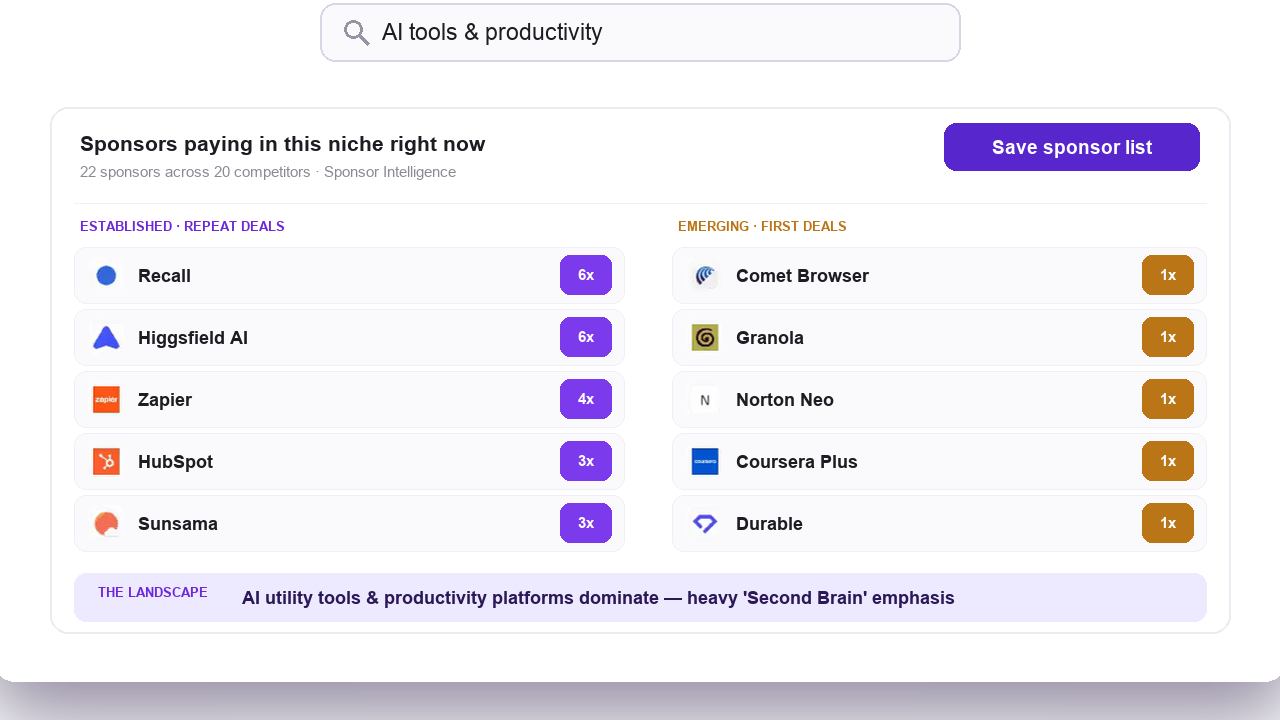
Your competitors' creator strategy sits in public on YouTube. Nobody reads it, because reading it by hand means watching hundreds of videos. Sponsor intelligence does that pass for you and returns which channels in a niche run paid promotions, and from which brands.
Creators who already say yes
A channel with sponsor history has proven its audience tolerates promotion. That is a different risk profile from a first-time placement.
Repeat bookings are the strongest signal
A brand that comes back three times saw results. You cannot get that read from a media kit.
Share of voice in your category
See which rival owns the creator layer in your niche, and which nearby niches nobody has bought yet.
Sponsored video performance
Check whether the sponsored uploads still hit the channel average. When they crater, the audience is rejecting the ads.
What to check before you send the first email
Finding influencers is the easy half. The expensive mistakes happen between the shortlist and the contract, and all four of them are visible in public data before a call is booked.
- One video at 2 million views lifts a channel average for a year, so use the median of the last ten uploads, not the average of all of them.
- Compare the last five uploads to the channel's own normal numbers. A channel trending down still charges yesterday's rate.
- Check the audience against your buyer. A hobbyist audience and a buying audience can watch the same videos, so read the comments for what they want.
- Check brand safety in the community. Skim two hundred comments before you attach your logo to the channel.
The formal version is the 7-point creator vetting checklist, and the signal-by-signal breakdown is in YouTube influencer analytics.
Which tools find YouTube influencers?
The best tool to find YouTube influencers depends on which half of the job you are short on. If you need a large filtered export with contact emails, buy a database. If you need to know which of those rows is worth the money, buy the evidence layer. Prices below are United States list prices, checked September 2, 2026.
| Tool | Price | What it finds | The honest catch |
|---|---|---|---|
| OutlierKit | $49 Hobby, $99 Pro, $399 Max. Free trial, no card. | Every channel matching a plain-English niche description, with view averages, sponsor history, and audience read attached. | No outreach inbox, no contracts, no payments. |
| ChannelCrawler | $99 a month billed monthly, $59 a month billed annually. Power is $195 monthly. | 35M+ channel database with country, subscriber, and keyword filters, plus email credits (50 a month on Starter). | Search credits and email credits are metered separately, and lists are sorted by size. |
| HypeAuditor | Demo-led sales, no public plan pricing. | Cross-platform influencer discovery with audience authenticity scoring for enterprise teams. | You cannot price it without a sales call, and it is built for multi-platform programs. |
| CreatorIQ, Grin, Aspire | Enterprise contracts, quoted per seat. | End-to-end campaign management: discovery, outreach, contracts, shipping, and payments. | The discovery database is one module in a workflow suite, not the sharp part of the product. |
| YouTube search | Free | Channels ranked by relevance to a query string. | No view averages, no filters, no export, and no way to see who already sponsors them. |
Sources: ChannelCrawler pricing, checked September 2, 2026. HypeAuditor publishes no plan pricing; see our OutlierKit vs HypeAuditor comparison for the figures its sales team quotes and where they came from. Six more options, priced and split by which job they replace, are in ChannelCrawler alternatives.
My honest read as the person who built one of these: OutlierKit is $49 a month against $59 for the cheapest annual database plan, and it answers a different question. It will not hand you a 40,000-row export or a verified email. It will tell you which twelve channels in your category matter and which of them is worth what they are asking. Plenty of teams run both, and that is the right call when the campaign is large enough.
OutlierKit is built for experts, consultants and coaches who share what they know on YouTube, and brand teams vet creators with the same channel data. On Pro and Max, the MCP connector at outlierkit.com/mcp lets Claude search similar channels and pull channel and video data, transcripts and comments, with Google sign-in and no API key. For your own channel, the packaging and script tools write 16 titles ranked against real breakout videos, the description and hashtags, and chapter titles, then review your script before you record.
How to find YouTube influencers free
You can find YouTube influencers free, and for a first campaign you probably should. Three methods cost nothing and will get you to roughly twenty names in an afternoon.
- 1. Search the way your customer would. Type the question a buyer asks before purchasing, then note who ranks. Not who has the most subscribers. Who YouTube chose to show.
- 2. Ride the sidebar. Open the best result and work the recommended column. YouTube's own similarity model is free, and it knows which channels share an audience.
- 3. Read your competitors' sponsored videos. Search your rival's brand name plus the product category. Sponsored videos surface fast, and each one names a creator who already takes deals in your space.
What free methods cannot give you is average views per video across recent uploads, which is the number that decides whether a rate is fair. That is the wall every free workflow hits, usually right when a creator sends a price. OutlierKit's free trial includes 30 credits and no card, which covers a first scan and a few channel lookups.
What users say
Rated 5.0/5 by 13 reviewers on Product Hunt.
Great addition to my stack and simple to use. Hit an issue and the team worked hard to fix it. Great product, hardworking team.
Been creating for years, running multiple YouTube channels. OutlierKit is the first tool that actually improved our view counts almost instantly. The competition analysis revealed gaps we never knew existed.
OutlierKit has drastically reduced my time to plan content for my SaaS YouTube channel. The deep research feature revealed insights I'd overlooked earlier. A must-have if you're serious about YouTube as an acquisition channel.
I find it very helpful for identifying trends in DevOps and Cloud topics, comparing video performance, and understanding what worked and what didn't. Highly recommend it.
The Channel Analysis feature makes it easy to dive into performance and audience insights without drowning in raw data. The interface is super clean and user friendly.
I was completely new to YouTube with zero strategy — just random view counts. OutlierKit changed everything. I went from random results to predictable traffic. The data-driven approach is awesome.
How much does OutlierKit cost for influencer discovery?
Hobby
$49 a month
One-off campaigns. Niche scans and channel lookups for a single shortlist.
Pro
$99 a month
Full Competitor Studio with sponsor intelligence for one category, plus API access.
Max
$399 a month
Always-on programs across several niches, monitoring for 50+ channels, on-demand refresh.
Every plan starts with a free trial: 30 credits, no card. See the full pricing page for credit allowances and seat limits.
Frequently asked questions
How do you find YouTube influencers for your business?
How do you find YouTube influencers in your area?
Can you find YouTube influencers for free?
How do you find micro-influencers on YouTube?
How do you find niche YouTube influencers, including crypto or NFT?
What is the best tool to find YouTube influencers by niche?
How do you find YouTube influencers for partnerships rather than one-off ads?
Does OutlierKit give you creator contact emails?
How is this different from an influencer marketing platform?
How current is the channel data?
Related reading
Seven discovery tools with verified pricing, and why follower rank is not performance rank.
Seven discovery methods and the vetting framework for the 10K to 100K band.
The 7-point framework to run before a contract is signed.
The signals that predict campaign results, and the ones that do not.
What creators charge in 2026, by size band and by niche.
Reach ratio for the 50 most subscribed channels, from 0.03% to 91%.
Benchmarks across 7 niches and 166 channels, with the calculation.
The niche with the lowest median reach ratio, scanned end to end.
Seven discovery tools on verified US pricing, split by the job they do.
Authenticity scoring against audience psychology and sponsor history.
For teams building creator discovery into their own product.
Sponsorship-heavy channels, broken down
Full breakdowns of creators with mature sponsorship businesses across tech, coffee, autos, and beauty. Useful for calibrating what a healthy sponsored channel looks like:
OutlierKit Channel Analysis

Marques Brownlee
Consumer Technology & Hardware Reviews
- Subscribers
- 21.1M
- Avg views
- 3.0M
- Total views
- 5.5B
OutlierKit Channel Analysis

BoBeats
Hardware Synthesizer & Dawless Music Production
- Subscribers
- 143.0K
- Avg views
- 50.1K
- Total views
- 28.4M
OutlierKit Channel Analysis

Doug DeMuro
Car reviews
- Subscribers
- 5.1M
- Avg views
- 957.8K
- Total views
- 2.4B
OutlierKit Channel Analysis

mikaylanogueira makeup
Beauty & Lifestyle Vlogging
- Subscribers
- 172.0K
- Avg views
- 2.6K
- Total views
- 999.3K
Stats are from our most recent snapshot of each channel. For live numbers, outlier videos, and up-to-date revenue estimates, run a fresh analysis on OutlierKit →
Sources and method
The coffee niche table comes from one OutlierKit channel index scan on September 2, 2026, run on the sentence "home espresso machine reviews and coffee gear". Channel figures move daily, so rerun the scan before you quote anyone.
Tool descriptions use each vendor's public pricing and product pages, not a paid test of every seat.
Sources
- OutlierKit reach ratio benchmarks: 166 channels across 7 niches, retrieved September 2, 2026
- ChannelCrawler pricing: checked September 2, 2026
- OutlierKit vs HypeAuditor: where the HypeAuditor figures come from

Scan your category before your next shortlist
Book a 30-minute demo. We will scan your category live, re-rank the results by reach ratio, and vet one creator from your current shortlist against their real numbers.
Book a demo