


One real run, start to finish
I recorded this run on 18 September 2026 with the brief "how to start a podcast with no audience". I only cropped the screenshots. These three screens are the whole workflow.
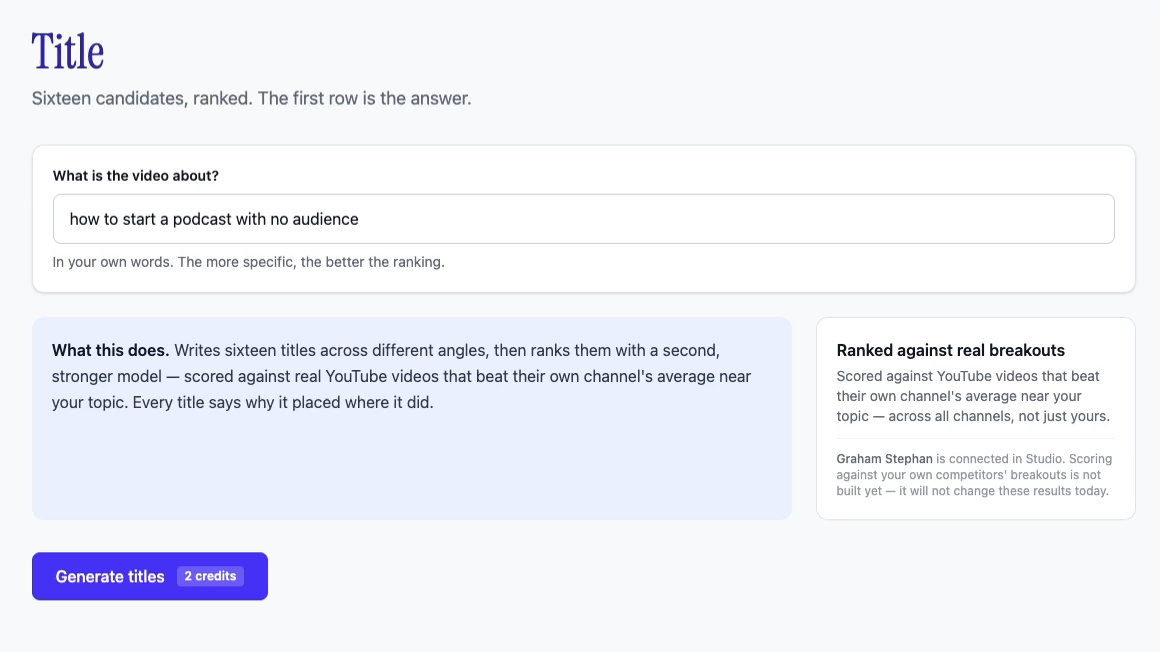
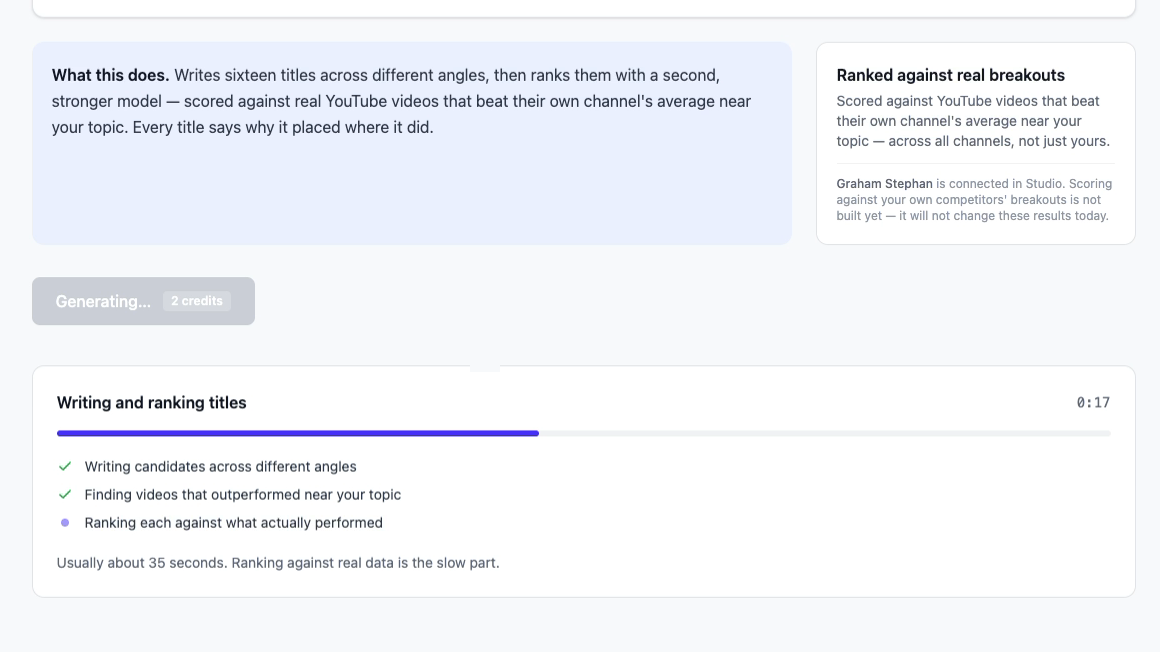
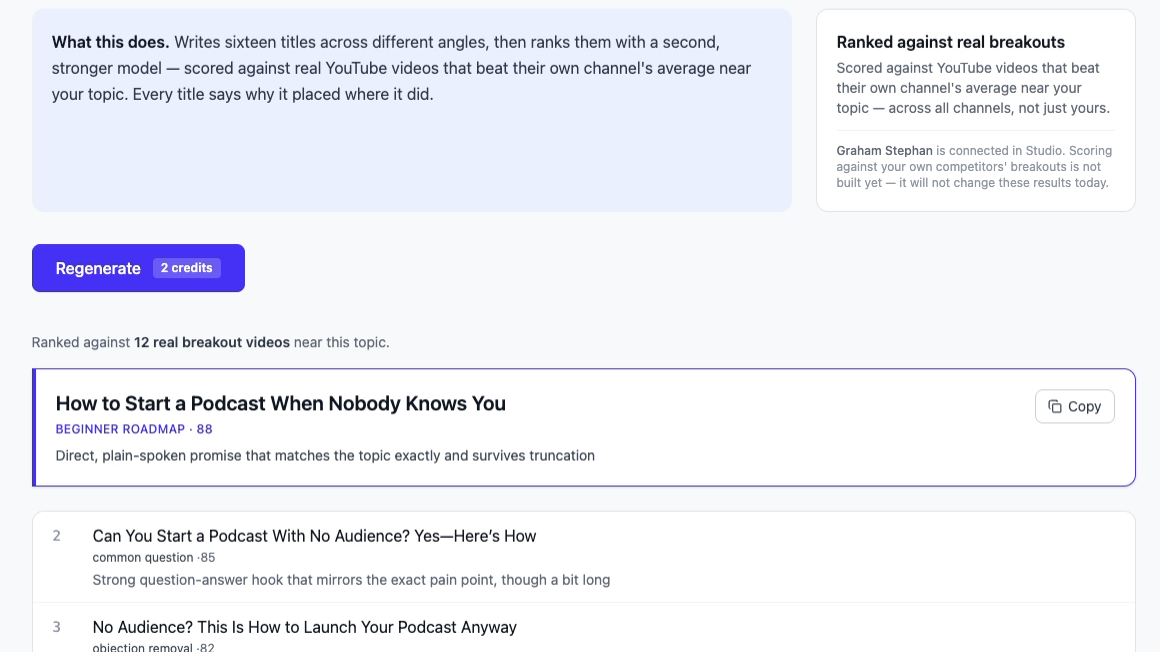
The top title was "How to Start a Podcast When Nobody Knows You". The app labelled it a beginner roadmap and scored it 88. The reason it gave was that the title matched the topic exactly and would not get cut off. Second place scored 85 for a question-and-answer hook that ran a bit long. Third was an objection removal at 82. So you are not choosing between sixteen equals. You get a ranking, and you can read why each one landed where it did.
Why the ranking step matters
A language model has read millions of YouTube titles, but it has no idea which ones worked. View counts are not in the text. So a plain AI title generator gives you the average of every title it has seen. That average is fine, and every other channel in your niche is publishing it this week.
I built OutlierKit around one number: how far a video beat its own channel's average. The title tool uses that number as the judge. One model writes sixteen titles. A second model scores each one against real videos near your topic that beat their channel average, from any channel. Titles that look like those videos rank higher, and the reason line tells you why.
If you want to see how that number is calculated, read the guide to finding outlier videos. The write-up on what outlier videos have in common takes six real titles apart to show the shape behind each one.
The free title generator vs the one in the app
We have two title tools and they do different jobs. The free YouTube title generator needs no account. It turns a topic into 16 titles from fixed formulas and shows a character count on each. Use it when you want ideas in the next thirty seconds. The app version is for the title you publish. It ranks the sixteen against real breakouts and tells you why the top one won.
| Question | Free generator | AI generator in the app |
|---|---|---|
| Account needed | No | Free trial, 30 credits, no card |
| Cost per run | Free | 2 credits |
| Titles per run | 16, from fixed formulas | 16, written from different angles |
| Ranked | No | Yes, against real breakout videos |
| Reason shown | Character count only | Pattern, score out of 100, one-line reason |
| Use it for | Quick ideas | The title you publish |
How to get a YouTube SEO title out of it
A YouTube SEO title has to carry the phrase people type and still win the click next to other results. Most SEO title generators only do the first part, so the video ranks and nobody clicks. This is how I would do both inside the app.
- 1
Pick the search term first
Run the term through Keyword Research. You want real demand and low saturation. The top angles list shows which framing already ranks. Keyword Research.
- 2
Look at the outliers for the same term
Outlier Finder shows which videos on that topic beat their channel average. The title ranker uses the same pool, so this tells you what a high score means. Outlier Finder.
- 3
Generate with the term in the brief
Describe the video with the search phrase in it. Take the top title, or the highest-scoring one that keeps the phrase in the first half. Open the app.
- 4
Write the rest of the upload
Write the description, tags and chapters from the same brief in the app, so they match what the title promised. Description template.
Keep the main idea inside about 60 characters. YouTube cuts longer titles on mobile, in search and in the suggested sidebar, and that is where most clicks come from. The ranker marks long titles down and says so in the reason line. For thumbnails, tags and the rest of the packaging, see the YouTube SEO guide. If you would rather read weekly title teardowns than use a generator, the Creator Hooks alternatives page compares those.
What it does not do
- It does not rank against your own competitor list yet. The ranker uses breakout videos near your topic from any channel. Scoring against the channels you track in Competitor Studio is not built, and the app says so on the page.
- It does not write the video. Script review gives feedback on a draft you wrote. Nothing in the app writes a script from scratch or makes thumbnails. The script template is the closest thing to a starting point.
- It does not A/B test live titles. TubeBuddy's Legend plan does that after you publish. OutlierKit works before you publish.
- It cannot fix a weak idea. If few videos near your topic have broken out, the ranker has less to score against. Run Outlier Finder first and pick the idea from the data as well.