


One real run, start to finish
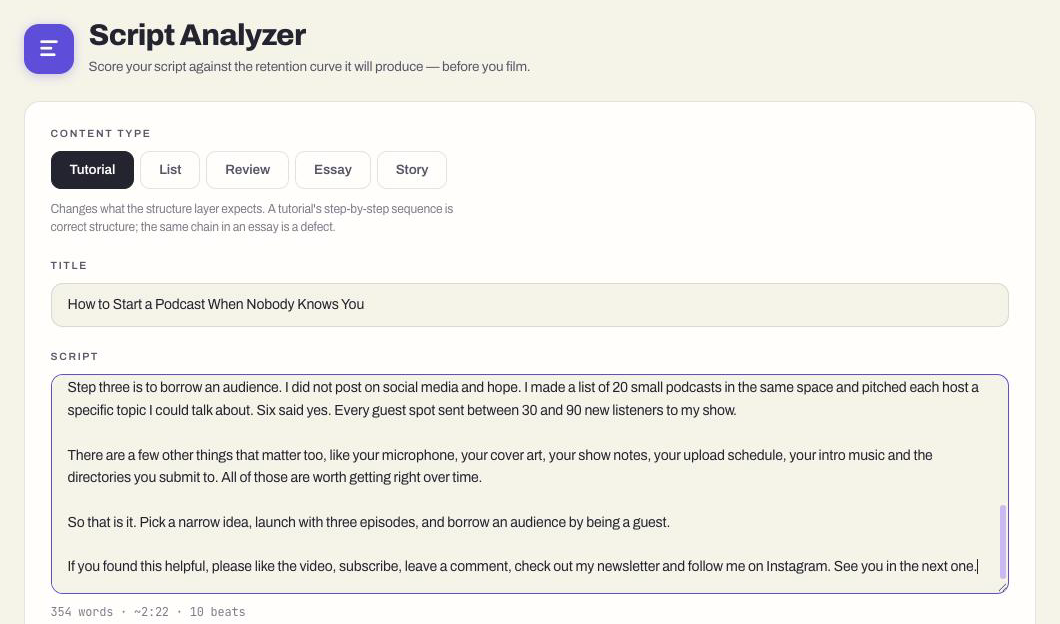
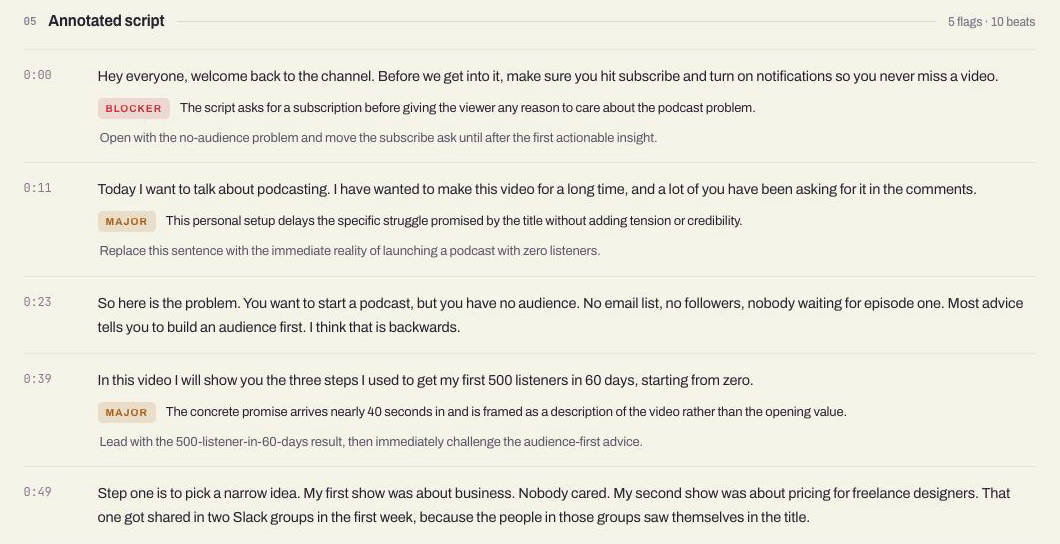
I ran this on 6 October 2026. I wrote a 354-word tutorial script with a weak opening on purpose: a greeting, a subscribe ask, then the topic. The title was "How to Start a Podcast When Nobody Knows You". The diagram below uses the exact scores, flags and fixes the app returned.
1The verdict and the four scores behind it
7.0 / 10
- Hook 20%3.5
- Spine 40%6.5
- Voice 20%10.0
- Risk 20%Low
5 flags across 10 beats: 1 blocker, 3 major, 1 minor. Three of the five sit in the first 40 seconds.
2Your opening, flagged line by line
- 0:00
Hey everyone, welcome back to the channel. Before we get into it, make sure you hit subscribe and turn on notifications.
Blocker. Fix: Open with the no-audience problem and move the subscribe ask until after the first actionable insight.
- 0:11
Today I want to talk about podcasting. I have wanted to make this video for a long time.
Major. Fix: Replace this sentence with the immediate reality of launching a podcast with zero listeners.
- 0:23
So here is the problem. You want to start a podcast, but you have no audience.
No flag. This line stays.
- 0:39
In this video I will show you the three steps I used to get my first 500 listeners in 60 days.
Major. Fix: Lead with the 500-listener-in-60-days result, then immediately challenge the audience-first advice.
The verdict was 7.0. The voice scored 10.0, so the writing was fine. The hook scored 3.5, and the app said why. It marked the subscribe ask in the first line as a blocker. It marked two more lines as major, because the promise of the video did not arrive until about 40 seconds in. Under each one it wrote the fix: open with the no-audience problem, lead with the 500-listener result, and move the subscribe ask later.
That is three edits to the first four lines. On the page it took me a few minutes. After filming it would have meant recording the intro again.
Why check a script before you record?
A script is the cheapest place to fix a video. A slow opening takes ten minutes to rewrite on the page. Once it is filmed, the same fix means a reshoot or a hard cut in the edit. After you publish, you cannot fix it at all. You can only read the retention graph and do better next time.
Most script tools sit at the wrong end of that line. They break down a video that is already live. Script review reads the draft you have not recorded yet.
How is Script review different from Video Script Analysis?
OutlierKit has two script tools and they do different jobs. Script review checks your own unpublished draft. Video Script Analysis breaks down the script of a video that is already on YouTube. I use the second to study a winner and the first to check my own work.
| Question | Script review | Video Script Analysis |
|---|---|---|
| What you give it | A script you wrote | A published YouTube video |
| When you use it | Before you record | While you research |
| What you get | A verdict out of 10, flags on each weak beat and a fix for each | The hook, structure, pacing and call to action of that video |
| Plans | Every plan and the free trial | Every plan, 10 credits a run |
The Video Analyzer page covers the published-video side. If you are comparing tools, the list of the best YouTube script analysis tools ranks them by job.
What should you check in a YouTube script before recording?
These five checks are mine. I run them by hand on every draft, and they are a good start if you have no tool open. Script review runs its own scoring in the app, as the run above shows.
- 1
The first two sentences
Read them alone. They should say what the viewer gets and why it is worth staying. Cut any greeting, channel intro or backstory that comes before that.
- 2
The promise in the title
Find the line where the script pays off the title. If it comes late, add a line early that tells the viewer it is coming.
- 3
Every section earns its place
Ask what the viewer loses if you delete each section. If the answer is nothing, delete it.
- 4
Something new every minute or so
Long stretches of one idea are where people leave. Add an example, a number or a change of scene.
- 5
One call to action
Ask for one thing, after you have delivered the value. Three asks in the outro means none of them land.
If you have not written the draft yet, start from the YouTube script template. The guide to YouTube script writing walks through each part, and the ChatGPT prompts for YouTube scripts help if you draft with AI.
What does the script checker not do?
- It does not write the script. OutlierKit does not write scripts from scratch. You bring the draft.
- It does not show retention. Only YouTube Studio has that, and only after the video is live.
- It cannot fix a weak idea. Pick the topic from videos that already broke out, using Outlier Finder, before you write a word.
- It does not check your delivery. A good script read flat still loses viewers. That part is practice.
When the script is fixed, write the title with the AI YouTube title generator and the description and hashtags with the YouTube description generator.