YouTube Sponsorship Rates 2026: What to Charge by Niche, Subscriber Count, and CPM
YouTube sponsorship rates in 2026 cluster around $15-$80 CPM with niche-specific multipliers from 0.7x to 2.5x. This page is the screenshot-ready rate card. It gives concrete dollar amounts by niche, subscriber tier, and format, plus the CPM math you need to defend the number in a negotiation.
Sponsor CPMs run well above what AdSense pays for the same views. Compare them with our RPM benchmarks by niche, then check who is buying in the list of 60 YouTube sponsors and the niche-by-niche sponsor frequency data.
What do sponsors pay at each subscriber tier?
| Tier | Integration | Dedicated | Shorts | Monthly Retainer |
|---|---|---|---|---|
| Nano (1K-10K) | $50-$250 | $100-$500 | $25-$150 | $200-$1,500 |
| Micro (10K-100K) | $200-$1,500 | $1,000-$5,000 | $100-$1,000 | $1,500-$15,000 |
| Mid (100K-500K) | $1,500-$10,000 | $5,000-$25,000 | $500-$5,000 | $10,000-$60,000 |
| Macro (500K-1M) | $5,000-$25,000 | $20,000-$80,000 | $2,500-$15,000 | $50,000-$200,000 |
| Mega (1M+) | $15,000+ | $50,000-$250,000+ | $10,000+ | $150,000+ |
Numbers are baseline. Apply niche modifiers below for accurate pricing.
How do you calculate a YouTube sponsorship rate?
Every YouTube sponsorship rate reduces to recent average views × niche CPM × format multiplier. Get those three numbers right and you have a rate you can defend in any negotiation.
1. Recent average views. Use your last 90 days, not your all-time average. Brands pay for what your channel does now, not what it did at peak. Calculate: total views in last 90 days ÷ number of videos in last 90 days.
2. Niche CPM. The CPM you can charge depends on what your audience is worth to a brand, not on subscriber count. The 2026 niche table is below.
3. Format multiplier. Dedicated videos earn 1.3-1.5x the integration CPM. Integrations are the baseline (1.0x). Short integrations under 60 seconds discount to 0.7-0.9x. Shorts as a standalone format pay roughly 0.4-0.6x of long-form CPM.
What CPM does each niche pay in 2026?
| Niche | Integration CPM | Notes |
|---|---|---|
| B2B SaaS / Developer Tools | $40-$80 | Highest CPM bracket; small audiences but high LTV |
| Personal Finance / Investing | $30-$60 | High purchasing power, conversion-ready audience |
| AI Tools / Productivity | $28-$55 | Surging in 2026; emerging-sponsor budget is flooding the niche |
| Tech / Reviews | $25-$45 | Stable; hardware brands often add product to cash |
| Education / Self-Improvement | $20-$40 | High volume, strong CPA performance |
| Gaming | $15-$30 | Mobile UA campaigns dominate, lower CPM but huge volume |
| Beauty / Skincare | $18-$35 | DTC brands, frequent product+cash hybrid deals |
| Lifestyle / Vlog | $15-$25 | Lowest CPM but highest sponsor variety |
| Cooking / Food | $18-$30 | Meal kits and cookware dominate |
What if your niche is not in the CPM table?
If your niche isn't on the CPM list above, multiply the education baseline ($20-$40) by these modifiers:
What does the math look like for a real channel?
Finance creator, 80K subs, US audience, dedicated video
Average views (90 day) 60,000 × CPM $50 = $3,000 base × 1.4 dedicated premium = $4,200 → quote $4,000-$5,500
AI creator, 25K subs, integration
Average views 18,000 × CPM $35 = $630 × 0.8 (integration discount) = $500 → quote $450-$700
Lifestyle nano, 6K subs, dedicated video
Average views 4,500 × CPM $20 = $90 × 1.4 = $126 → realistic floor $125 + product bundle
Gaming creator, 200K subs, monthly retainer
4 integrations / month × $4,500 average = $18,000/month → typical retainer $15,000-$22,000
Which extras raise or lower the rate?
| Extra | Change to the base rate | When it applies |
|---|---|---|
| Usage rights | +25% to +100% | The brand reuses the video as a paid ad on Meta, TikTok, or LinkedIn |
| Category exclusivity | +25% to +50% | You lock out competing sponsors for 30 to 90 days |
| Multi-video package | -20% to -30% | The brand commits to 3 or more videos |
| Performance bonus | CPA tier on top of the base | Common with finance and DTC sponsors |
| Rush turnaround | +25% to +50% | Delivery in under 7 days |
| Whitelisting or dark posts | +25% per 30 days | The brand runs the content from your handle as a paid ad |
How does a brand's sponsor history lift your rate?
The fastest rate negotiation is the one where the brand has no CPM ammunition to push back. If you walk into a deal already knowing which competitor channels the brand has sponsored, what format they use, and what their typical creator cohort size is, you can pin a number that reflects market reality, not the brand's opening offer.
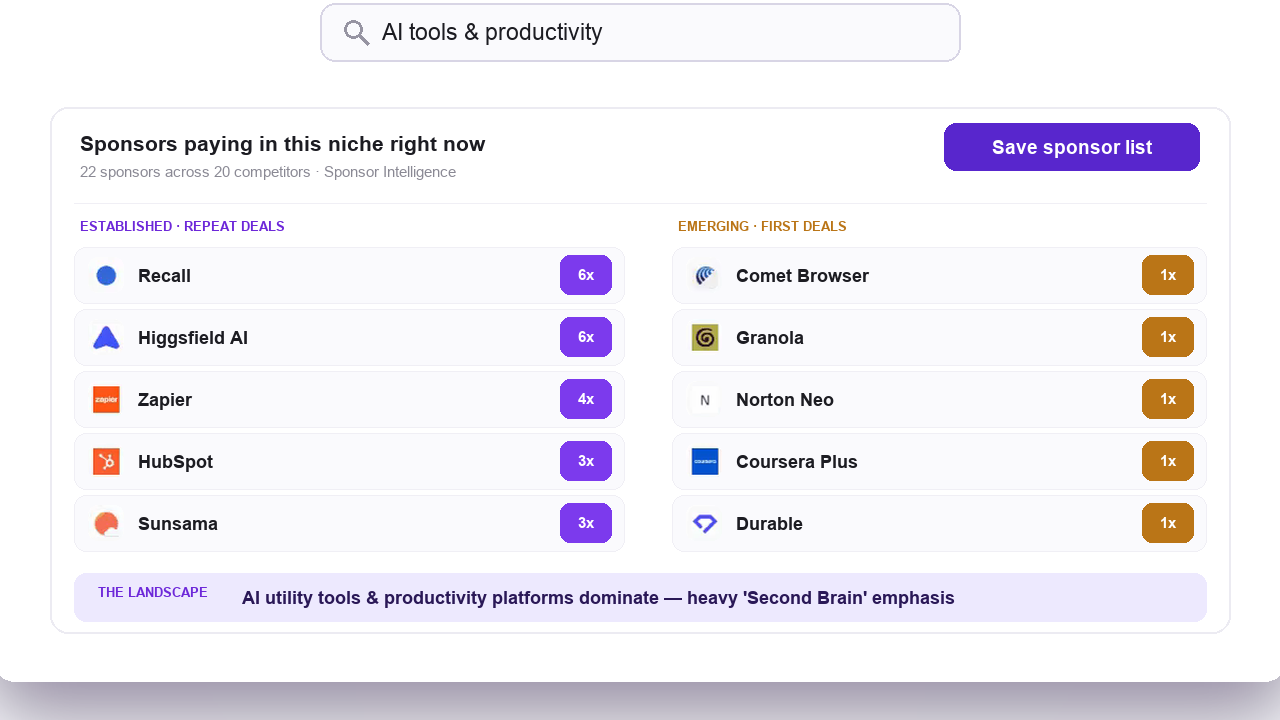
Sponsor Intelligence shows competitor coverage, meaning which competitors a brand sponsored. That lets you anchor your rate against real comparable deals.
Frequently Asked Questions
How much do YouTube sponsorships pay in 2026?
YouTube sponsorships in 2026 pay $15-$80 CPM (cost per 1,000 views) for integrations, with wide variance by niche. The standard rate card: nano-influencers (1K-10K subs) charge $50-$500 per video; micro (10K-100K) charge $200-$5,000; mid-tier (100K-500K) charge $1,500-$25,000; macro (500K-1M) charge $5,000-$80,000; mega (1M+) charge $15,000-$250,000+. Niche modifiers apply: B2B SaaS pays 1.8-2.5x baseline, finance pays 1.5-2.0x, lifestyle pays 0.7-0.9x.
What is the YouTube sponsorship rate per subscriber?
There is no single ‘rate per subscriber’ on YouTube. Rates are calculated against views, not subs. Rough rules of thumb: $0.01-$0.03 per subscriber for an integration in lifestyle niches, $0.05-$0.10 per subscriber for finance and tech niches, $0.10-$0.20+ per subscriber for B2B SaaS sponsorships. The right way to price a deal is recent average views × niche CPM × format multiplier, not a per-subscriber multiplier.
What CPM should I charge for a YouTube sponsorship in 2026?
Standard YouTube sponsorship CPMs in 2026 are: $40-$80 for B2B SaaS and developer tools, $30-$60 for personal finance, $28-$55 for AI and productivity, $25-$45 for tech reviews, $20-$40 for education, $18-$35 for beauty, $18-$30 for cooking, $15-$30 for gaming, and $15-$25 for lifestyle. Apply a 1.3-1.5x premium for dedicated videos and a 30-50% discount for short integrations.
How do I calculate a YouTube sponsorship rate?
Calculate a YouTube sponsorship rate in three steps: (1) take your average views over the last 90 days (recent matters more than all-time), (2) multiply by your niche CPM (e.g., $25 for tech), (3) apply format multipliers. Use 1.3-1.5x for dedicated videos, 0.7-0.9x for short integrations, and 0.5x for Shorts. Example: a tech creator averaging 40,000 views with a $30 CPM doing a dedicated video would charge 40,000 × $30 / 1,000 × 1.4 = $1,680, quoted as a range of $1,500-$2,000.
What are YouTube sponsorship rates per 1,000 views?
YouTube sponsorship rates per 1,000 views (CPM) in 2026 range from $15 to $80 depending on niche and format. The lowest CPMs are in lifestyle and gaming ($15-$25); the highest are in B2B SaaS and finance ($40-$80). Dedicated videos pay 1.3-1.5x the integration CPM. Sponsored Shorts typically pay $5-$15 CPM, half the long-form rate, because Shorts views convert at a lower rate.
How much do small YouTube channels charge for sponsorships?
Small YouTube channels (under 10K subs) charge $50-$500 per sponsored video in 2026. Specifically: $50-$250 for an integration, $100-$500 for a dedicated video, $25-$150 for a Short, and $75-$400 for a product review. The full nano-influencer rate breakdown, by sub bracket and content format, is in our nano-influencer sponsorship rates guide.
Are YouTube sponsorship rates negotiable?
Yes, YouTube sponsorship rates are nearly always negotiable. First offers from brands typically come in 20-40% below market. Counter with a CPM-grounded rate card, not a single number. Quote a range, not a price, to give both sides room to land. Common levers beyond price: usage rights uplift (25-100% for ad reuse), exclusivity premium (25-50% for category lock), package discounts (20-30% for 3+ video commitments), and CPA bonuses tied to conversions.
Are Reddit-reported sponsorship rates accurate?
Reddit threads on r/NewTubers, r/PartneredYoutube, and r/InfluencerMarketing report 2026 sponsorship rates clustering around $15-$25 CPM for general lifestyle and $30-$60 CPM for tech and finance. That is broadly aligned with industry data. Reddit reports tend to underweight emerging sponsor deals and over-weight Audible/Skillshare-style affiliate offers because creators discuss those programs more openly. Treat Reddit data as a floor reference, not a ceiling.
How this rate card was made
The tier and CPM ranges are planning estimates for quoting a deal. They follow the formula on this page: recent average views × niche CPM × format multiplier. They are not the result of a creator survey or a brand's private deal sheet, so check every figure against your own last 90 days before you quote.
Sponsor names and competitor coverage come from OutlierKit's Sponsor Intelligence reports, which the frequency page below lists niche by niche.
Sources
- OutlierKit YouTube RPM benchmarks: what AdSense pays per 1,000 views, by niche
- Most common YouTube sponsors by niche: Sponsor Intelligence reports across 8 niches
- List of YouTube sponsors: 60 brands with minimum channel size and payout model
Related reading
- Nano-influencer sponsorship rates: the 1K to 10K subscriber rate card by format
- List of YouTube sponsors: 60 brands you can filter by category and minimum channel size
- Most common YouTube sponsors by niche: who pays creators in 8 niches, from Sponsor Intelligence reports
- How to get YouTube sponsorships: the pitch and outreach playbook
- YouTube sponsorship platforms: marketplaces, agencies and BrandConnect
- How to spot fake YouTube sponsorships: red flags before you sign
- The complete YouTube sponsorships guide: deal types, contracts and FTC rules

Anchor your rate against real competitor data
OutlierKit Competitor Studio shows you exactly which sponsors are paying creators near your size, and which competitors they sponsored, so you can defend your rate with comparable-deal data.
Try OutlierKit Free