YouTube Monetization Strategies (2026): All 11 Ways Channels Make Money
YouTube channels in 2026 monetize across 11 distinct revenue streams. These are AdSense, sponsorships, affiliates, own digital products, services, lead generation, channel memberships, off-platform memberships, courses, merch, and a mixed Super Chat / licensing line. AdSense is almost never the largest stream. Sponsorships and owned products typically outearn it at any meaningful scale.
This is the encyclopedia. It covers each revenue stream, what it actually pays, the eligibility requirements, and when to add it. It also shows how top creators stack them together. And it covers the FTC disclosure rules that apply to every monetized channel, regardless of size.
Quick Reference
- 11 revenue streams across three categories: platform-paid, performance, owned.
- Largest line at scale: sponsorships (30-60% of total revenue for 100K+ creators).
- Highest margin: own digital products (95%+ margin).
- Highest LTV: services and B2B courses ($1K-$30K+ per customer).
- Most passive: AdSense and content licensing.
- Pre-YPP options: see making money without monetization.
- Speed-run YPP: see how to get YouTube monetization fast.
How a Typical 500K-Sub Creator Earns
Self-reported 12-month revenue mix from creators in the 250K-1M subscriber range, blended across niches. The headline finding: ads are the smallest meaningful line.
Based on creator-economy income breakdowns published by Backlinko and the Influencer Marketing Hub creator economy report (2025-2026 editions). Mix varies widely by niche.
See How Creators in Your Niche Actually Monetize
The fastest way to design your own monetization stack is to see what already works in your niche. OutlierKit Competitor Studio's Sponsor Intelligence and Funnels & Monetization modules reverse-engineer every revenue stream the top creators are running. That includes sponsors, courses, lead magnets, affiliates, and products. So you can pattern-match instead of guess.
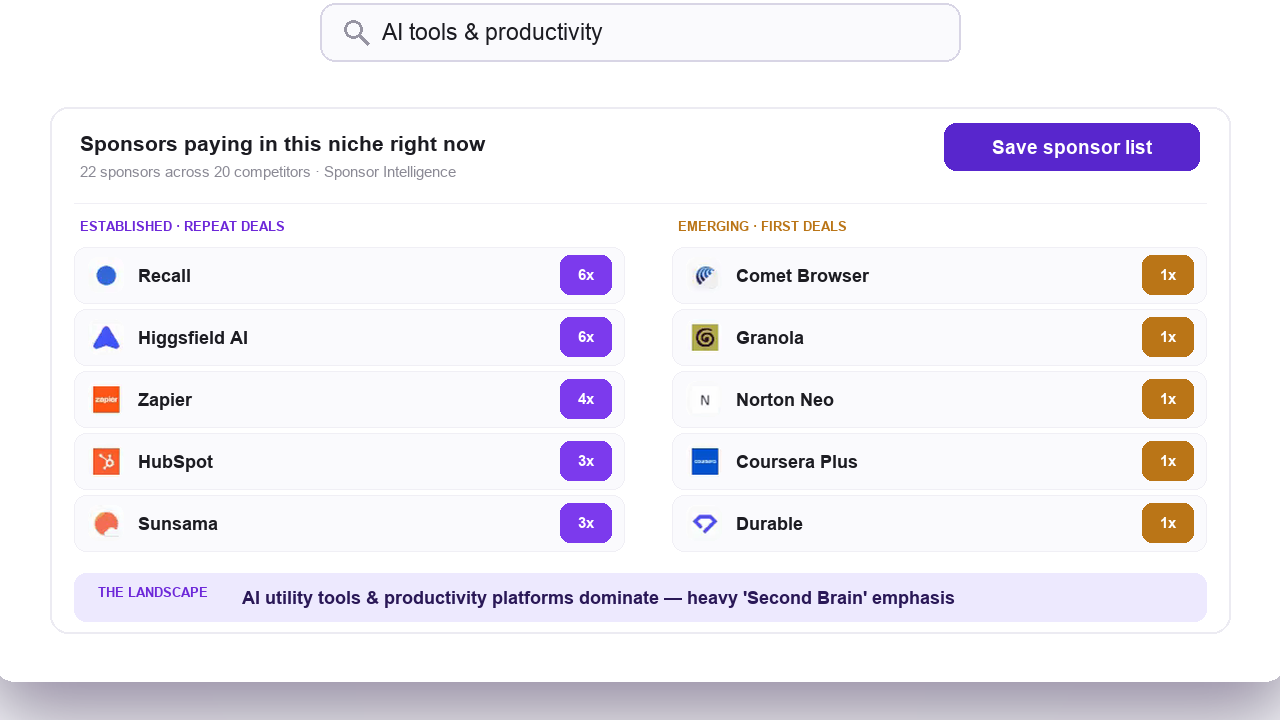
Sponsor Intelligence: every brand sponsoring creators in your niche, with frequency. The foundation of an outbound sponsorship strategy.
See the full feature set on the Competitor Studio page.
The 11 YouTube Monetization Streams at a Glance
| # | Stream | Type | Requirement | Typical Pay |
|---|---|---|---|---|
| 1 | AdSense (YouTube Partner Program) | Platform-paid | 1K subs + 4K watch hrs | $1-$8 RPM, niche-dependent |
| 2 | Brand Sponsorships | Direct deal | 1K+ subs (nano-tier) | $15-$40 CPM, $500-$250K flat |
| 3 | Affiliate Marketing | Performance | 0 subs | 3-50% commission per sale |
| 4 | Own Digital Products | Owned | 0 subs | 95%+ margin, $19-$2,000 price |
| 5 | Services & Consulting | Owned | 0 subs | $200-$30K per engagement |
| 6 | Lead Generation | Owned (indirect) | 0 subs | 10-50x cheaper than paid ads |
| 7 | Channel Memberships | Platform-paid | 500 subs + YPP | $0.99-$49.99/mo per member |
| 8 | Patreon / Off-Platform Memberships | Owned | 0 subs | $3-$25/mo per member |
| 9 | Online Courses & Cohorts | Owned | 1K+ subs ideal | $97-$5,000 per seat |
| 10 | Merch & Physical Products | Owned | 10K+ subs ideal | $5-$25 margin per unit |
| 11 | Super Chat, Super Thanks & Licensing | Mixed | YPP for Super; 0 for licensing | Variable |
Each of the 11 Streams, in Detail
1. AdSense (YouTube Partner Program)
AdSense pays creators a 55% share of ad revenue served on their videos. Eligibility requires YouTube Partner Program approval: 1,000 subscribers plus 4,000 watch hours in 12 months, or 10 million Shorts views in 90 days.
Realistic RPM (revenue per 1K views): $1-$3 for gaming, lifestyle, vlogs; $3-$8 for tech, tutorials, education; $8-$25 for finance, B2B SaaS, legal, real estate. Country mix matters. US/UK/Canada audiences earn 3-5x what Tier-3 country audiences earn.
When to prioritize: only after the channel has a sponsorship and product/affiliate stack producing more than AdSense alone. AdSense compounds passively over years; it rarely justifies content decisions on its own.
2. Brand Sponsorships
Sponsorships are the largest single line for most established creators. A sponsorship is a direct contract between creator and brand, independent of YPP. Deal types include dedicated videos, mid-roll integrations, affiliate partnerships, product seeding, BrandConnect deals, and long-term ambassadorships.
Typical pricing: $15-$40 CPM for integrations, $50-$150+ CPM for dedicated videos, $50-$500 flat for nano-influencer (1K-10K) deals, $250,000+ for top-tier creators. See the full YouTube sponsorships guide and current sponsorship rates.
FTC disclosure is mandatory for every sponsorship. Toggle the “includes paid promotion” checkbox plus on-camera disclosure. See the FTC influencer disclosure guide.
3. Affiliate Marketing
Performance-based commissions from product sales tracked through your unique link. Two starter networks every creator should join: Amazon Associates (1-10%, universal coverage) and direct merchant programs (20-50%, found in software/SaaS footers).
No subscriber threshold and no monetization gate. Affiliate links are the single most underused income stream on YouTube. A 5,000-sub finance or SaaS channel running direct affiliates routinely outearns its own AdSense by 5-20x.
4. Own Digital Products
Templates, presets, eBooks, prompt packs, Notion docs, LUTs, stock packs. 95%+ margin. Sold via Gumroad, Stripe Payment Links, or Lemon Squeezy. The channel is the funnel; the checkout is the cash register.
A $29 digital product converting at 1% of a 10,000-sub audience is $2,900. That compares to roughly $20-$80 in AdSense across the same view count.
5. Services & Consulting
Coaching, freelance, agency retainers, done-for-you services. The highest-dollar conversion path for B2B and skill-based niches. A 2,000-sub channel closing one $5,000 client per month typically outearns most 200K entertainment channels.
Common pricing: consulting calls $200-$2,000/hour; project work $2,000-$50,000; retainer agency work $3,000-$30,000/month.
6. Lead Generation
If you already run a business, YouTube is content marketing for the top of your funnel. Each subscriber is a lead, not a view. Track value as “cost per qualified lead avoided vs. paid ads”. That is typically 10-50x cheaper than equivalent leads bought via Meta or Google Ads.
Build a lead magnet (free template, 5-day email course, free audit), capture with ConvertKit or Beehiiv, nurture with weekly emails. Owned audience is the only audience an algorithm cannot take from you.
Agencies running client channels: the same loop works across a roster. OutlierKit's Sponsor Intelligence and Funnels & Monetization modules show which lead magnets, funnels, and paid offers each niche actually responds to, so you can standardize a lead-gen stack per client instead of rebuilding the research from zero for every account.
7. YouTube Channel Memberships
YouTube's native membership system pays creators 70% of membership revenue. Eligibility requires 500+ subscribers and YPP approval (official requirements).
Tiers range $0.99-$49.99/month. Best for community-driven channels with super-fans, like gaming, podcasts, and education cohorts. Lower friction than Patreon (already inside YouTube) but lower revenue share.
8. Patreon & Off-Platform Memberships
Patreon, Substack paid tiers, Buy Me a Coffee, Ko-fi. No subscriber threshold, higher revenue share than YouTube's native memberships, full ownership of subscriber data.
Most pre-monetized creators run a 3-tier Patreon ($3 / $10 / $25). Long-form podcasters typically run paid Substack or Patreon as their primary revenue line.
9. Online Courses & Cohorts
Self-serve courses ($97-$497) and live cohorts ($500-$5,000+). Highest single-payment LTV available to most creators. Requires authority. Your audience must believe you can teach the outcome.
Realistic numbers: a $497 course converting at 1% of 5,000 subscribers is $24,850 per launch. Two launches per year clears $50K from a channel size most creators consider too small to monetize.
10. Merch & Physical Products
Print-on-demand (Spring, Fourthwall, Teespring) for low effort; custom-built brand merch for higher margin and brand equity. YouTube Shopping integration available for YPP creators (10K+ subs ideal). See YouTube Shopping requirements.
Best for personality-led entertainment, gaming, lifestyle, and sports channels. Requires meaningful brand equity to sell consistently. Most channels under 50K subs find merch a low-ROI line versus digital products.
11. Super Chat, Super Thanks & Licensing
Super Chat / Super Thanks: live-stream and video tipping inside YouTube. Requires YPP. Best for live streamers in gaming, music, talk-show formats.
Content licensing: selling clips to news outlets via Jukin Media or Storyful ($500-$5,000 per viral clip), or stock footage via Pond5/Artgrid (passive after upload). It is YPP-independent, so it works on any channel that produces licensable content.
How to Pattern-Match a Niche's Monetization Stack
Before designing your stack, look at what already works. OutlierKit Competitor Studio's Funnels & Monetization view shows the exact split (course / product / affiliate / lead magnet) used by the top creators in any niche. It maps their funnel entry points end-to-end.
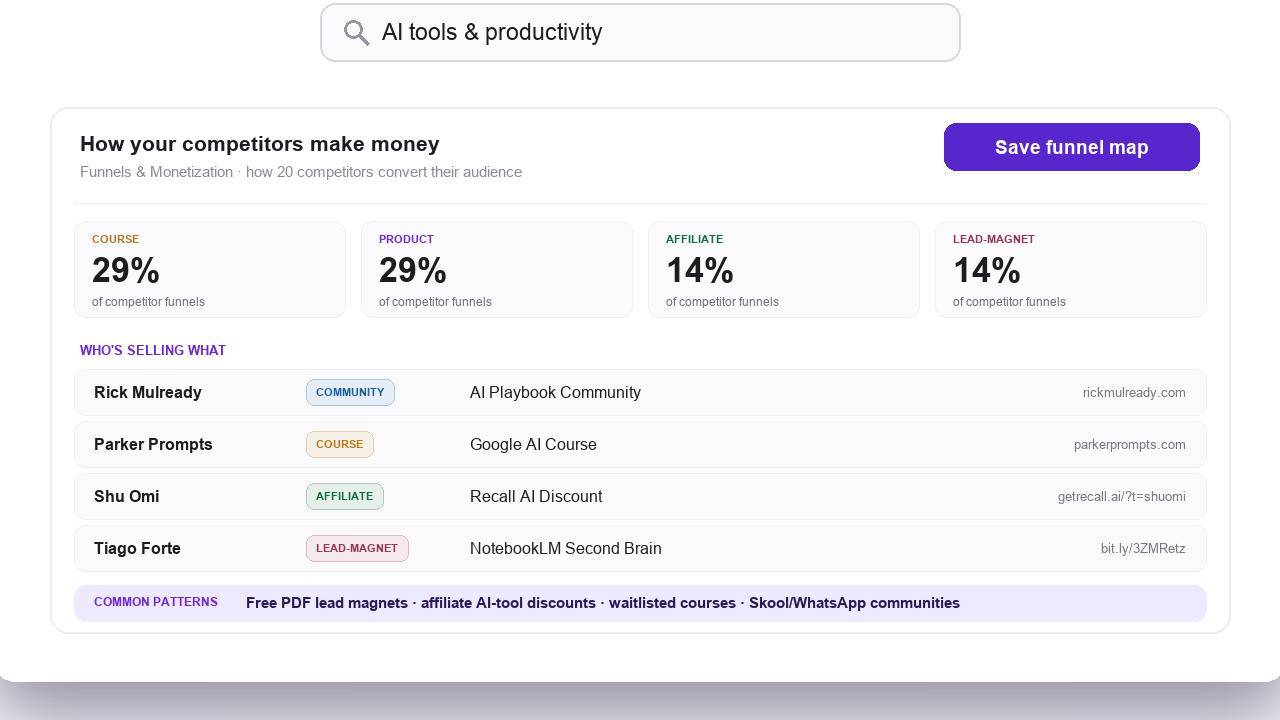
Funnels & Monetization: pattern-match the revenue split of the top 50 creators in any niche before you build your own.
Decision Tree: Which Streams to Stack First
If you sell services or run a B2B offer
Stack services and lead generation first, then sponsorships. Each subscriber is a lead, not a view, so lead magnets and email capture matter more than ad revenue from day one.
If you are a consumer creator
Stack affiliates first, then brand sponsorships, then your own digital products. Affiliate links work from video #1, sponsorships get realistic around 1K subs, and products compound once you know which topics convert.
If the channel is faceless
Stack AdSense and affiliates first. Faceless niches (finance explainers, meditation, compilations) over-index on evergreen search traffic, which compounds both streams over time.
If you are under 1,000 subscribers
Affiliate links, one lead magnet, and one small digital product are the only streams worth setting up. YPP eligibility comes later; everything else distracts from publishing.
Disclosure & Compliance Across Every Stream
Every monetization stream that involves a third party (sponsors, affiliates, gifted product, equity arrangements) falls under the FTC endorsement guides. Disclosure must be clear, conspicuous, and made before the endorsement, regardless of channel size.
- ✓Toggle YouTube Studio's “includes paid promotion” checkbox on every sponsored upload.
- ✓Verbal on-camera disclosure within the first 30 seconds for sponsored content.
- ✓Disclose every affiliate relationship in the description (“affiliate links” or “I earn a commission”).
- ✓UK ASA, EU DSA, Canadian Competition Bureau, Australian ACCC enforce equivalent rules for global audiences.
Continue Reading
- How to Make Money on YouTube Without Monetization · 8 ways to earn before YPP eligibility.
- How to Get YouTube Monetization Fast · speedrun playbook for the YPP threshold.
- YouTube Sponsorships Guide · definitions, deal types, contracts, FTC, discovery.
- OutlierKit Competitor Studio · Sponsor Intelligence + Funnels & Monetization mapping.
Frequently Asked Questions
How do YouTubers make money in 2026?
YouTubers make money in 2026 through 11 distinct revenue streams. Most established creators earn across at least four. The first six streams are AdSense (YouTube Partner Program), brand sponsorships, affiliate marketing, their own digital products, services and consulting, and lead generation. The rest are YouTube channel memberships, off-platform memberships (Patreon, Substack), online courses, merch and physical products, and a mixed category. That last one covers Super Chat, Super Thanks, and content licensing. AdSense is rarely the largest line. Sponsorships, affiliates, and owned products usually outearn ad revenue at any scale above 50,000 subscribers.
How do YouTubers make money besides ads?
YouTubers make money besides ads through nine other major revenue streams. The first four are brand sponsorships (typically the largest line at scale), affiliate marketing, selling their own digital products, and services and consulting. The rest are lead generation for an existing business, channel memberships (both YouTube-native and off-platform like Patreon), online courses, merch, and content licensing. At the 1M+ subscriber tier, ads typically account for 15-30% of total income. The remaining 70-85% comes from the off-AdSense streams. See the full breakdown of how to make money on YouTube without monetization for sub-1K-subscriber options.
What is the most profitable way to monetize a YouTube channel?
The most profitable way to monetize a YouTube channel depends on audience type. B2B and skill-based niches earn the most through services and high-ticket courses ($1,000-$30,000 per customer). Consumer and product-review niches earn the most through affiliate marketing and brand sponsorships. Entertainment channels earn the most through ad revenue, sponsorships, and merch combined. The single most profitable revenue line across creators 100K+ subs is brand sponsorships. Sponsorships typically deliver 30-60% of total income for that tier.
How much do YouTubers make per 1,000 views?
YouTubers earn $1-$8 in AdSense revenue per 1,000 views (RPM), depending on niche, audience geography, and content category. Finance, B2B SaaS, and legal niches command $5-$25+ RPM. Entertainment, gaming, and lifestyle niches typically earn $1-$3 RPM. However, AdSense RPM is misleading as a metric. Add in sponsorships, affiliate revenue, and owned products, and the picture changes. Total channel RPM often exceeds $30-$100 per 1,000 views for well-monetized channels. Total RPM is a better business metric than AdSense RPM.
Do you need 1,000 subscribers to monetize YouTube?
You need 1,000 subscribers to join the YouTube Partner Program. You also need 4,000 watch hours in 12 months, or 10M Shorts views in 90 days. The program unlocks AdSense, Super Chat, and channel memberships at 500 subs. You do not need 1,000 subscribers to make money on YouTube in other ways. Sponsorships, affiliates, your own products, services, lead generation, off-platform memberships, courses, and content licensing all work without it. See the official YouTube Partner Program requirements at support.google.com/youtube/answer/72857.
What's the difference between RPM and CPM on YouTube?
CPM (cost per mille) is what advertisers pay YouTube per 1,000 ad impressions. RPM (revenue per mille) is what the creator actually receives per 1,000 video views. RPM accounts for YouTube's revenue share and for views without ads. CPM is typically $4-$30. RPM is typically $1-$8, because YouTube takes a 45% cut and many views don't trigger ads. RPM is the metric creators care about. CPM is what advertisers see.
How do YouTube channel memberships work?
YouTube channel memberships are recurring monthly payments ($0.99-$49.99) from viewers. In exchange, viewers get tier-based perks. These perks include custom emoji, members-only content, early access, and badges. To enable memberships, a channel needs 500+ subscribers and YPP eligibility. Creators typically earn 70% of membership revenue. See official channel memberships eligibility at support.google.com/youtube/answer/7636690. Many creators run memberships off-platform via Patreon instead, which has no subscriber threshold and offers higher revenue share.
Can you make money on YouTube without showing your face?
Yes, faceless YouTube channels make money through every revenue stream available to face-led channels: AdSense, sponsorships, affiliates, products, courses, and lead generation. Faceless niches like meditation, finance explainers, AI tutorials, and compilation channels often outperform face-led channels in evergreen search traffic. That compounds AdSense and affiliate revenue over time.
What is the FTC disclosure rule for YouTube monetization?
The FTC requires creators to clearly and conspicuously disclose any material connection with a brand. This includes paid sponsorships, affiliate links, free products with expectation of coverage, and equity arrangements. Disclosure must be on-camera (verbal) or a clear text overlay. Add it in the description too. Also turn on YouTube's built-in 'includes paid promotion' toggle for sponsored uploads. Affiliate links require their own disclosure ('I earn a commission'). Rules apply regardless of channel size and to all creators reaching US audiences. See ftc.gov/business-guidance/resources/disclosures-101-social-media-influencers.
How do top YouTubers structure their revenue mix?
Top YouTubers typically run a 4-stream stack. The primary line delivers 40-60% of revenue, usually sponsorships at scale, or services for B2B niches. A strong secondary line adds 20-30%, from affiliates or own products. AdSense sits as a passive line at 10-25%. A recurring revenue layer adds 5-15%, from memberships, Patreon, or course subscriptions. Diversification is the #1 protection against YouTube algorithm volatility and demonetization risk.

Map any niche's monetization stack in minutes
OutlierKit Competitor Studio shows you Sponsor Intelligence, Funnels & Monetization, and outlier video patterns across every top creator in your niche.
Try OutlierKit Free