How to Make Money on YouTube Without Monetization (2026)
You make money on YouTube without monetization by earning outside the YouTube Partner Program: through affiliate links, direct sponsorships, your own products, services, lead generation, memberships, courses, and content licensing. None of these require 1,000 subscribers, 4,000 watch hours, or AdSense approval. Established creators typically report earning 70-85% of their revenue this way, not from ads.
This guide covers the eight income streams that work from your first video, with concrete examples, realistic earning windows, and the FTC disclosure rules you must follow.
Quick Answer
- YPP is one revenue stream, not the whole business. Most pro creators earn most of their income off AdSense.
- Affiliates, products, services, lead gen, and licensing earn from day one. Nano-tier sponsorships, Patreon, and off-platform memberships work under 1K subs.
- FTC disclosure is mandatory for any paid promotion or affiliate link, regardless of channel size.
- Bigger picture: see the full YouTube monetization strategies pillar: 11 ways channels make money in 2026.
Why the YouTube Partner Program Isn't the Goal
The YouTube Partner Program requires 1,000 subscribers plus 4,000 watch hours in 12 months (or 10 million Shorts views in 90 days). Once approved, you get AdSense revenue, Super Chat, and channel memberships at 500+ subs.
The trap is treating YPP as the finish line. AdSense pays roughly $1-$8 RPM in most niches, meaning a channel with 100,000 monthly views earns $100-$800 from ads. The same channel can earn 10-50x that from a single sponsorship deal, a $97 digital product launch, or one consulting client. Treat YPP as a small passive line in a much larger revenue stack.
What a Creator Revenue Mix Looks Like Without Relying on Ads
Directional, not a verified survey: an aggregate of self-reported creator revenue breakdowns in the 50K-500K subscriber band, across multiple niches. Treat the shape (sponsorships largest, ads smallest) as the takeaway, not the exact percentages.
The 8 Ways to Make Money on YouTube Without Monetization
| # | Income Stream | Min. Subs | First Earnings | Leverage |
|---|---|---|---|---|
| 1 | Affiliate Marketing | 0 subs | Day 1 | High |
| 2 | Direct Brand Sponsorships | 1K+ (nano-tier) | Week 1 of pitching | Very high |
| 3 | Sell Your Own Digital Product | 0 subs | Day 1 | Highest margin |
| 4 | Services / Consulting / Done-For-You | 0 subs | Day 1 | Highest dollar value |
| 5 | Lead Generation for Your Business | 0 subs | Week 1 | Compounds with funnel |
| 6 | Patreon & Direct Memberships | 0 subs | Month 1 | Recurring revenue |
| 7 | Online Courses & Cohorts | 1K+ | Month 2-6 | Highest single-payment LTV |
| 8 | Content Licensing & UGC | 0 subs | Per-clip | Passive after upload |
1. Affiliate Marketing: Day-One Income, No Subs Required
Affiliate marketing is the single most underused income stream on YouTube. You recommend products you genuinely use, link them in the description with a tracked URL, and earn a commission on every tracked sale. There is no subscriber threshold, no monetization gate, and no application process for most affiliate programs.
The two starter networks every creator should join:
- ✓Amazon Associates · universal coverage, 1-10% commission, 24-hour cookie. Best for product-review and tutorial channels.
- ✓Direct merchant programs (Shopify, ConvertKit, Notion, software brands): 20-50% commission, 30-90 day cookies. Always check the merchant's footer for “Affiliate” or “Partners” link.
Realistic earnings: a 5,000-sub tutorial channel with three Amazon links per video typically earns $80-$400 per month from Associates alone. A 5,000-sub finance or SaaS channel with high-commission direct affiliates frequently clears $1,500 per month at the same view count.
2. Direct Brand Sponsorships: Pre-YPP and Beyond
Brand sponsorships have nothing to do with the YouTube Partner Program. A sponsorship is a contract between you and a brand. YouTube is just the distribution channel. Channels with as few as 1,000 subscribers (the nano-influencer tier) regularly earn $50-$500 per integration.
The fastest way to land your first sponsorship is outbound pitching: finding brands that already sponsor creators in your niche and pitching them directly. The hardest part is the research: identifying which brands actually buy creator placements (versus running display ads).
OutlierKit Competitor Studio's Sponsor Intelligence module solves this by reverse-engineering every sponsor across the top creators in any niche, including the “emerging” sponsors who are actively buying right now and are most likely to respond to a cold pitch.
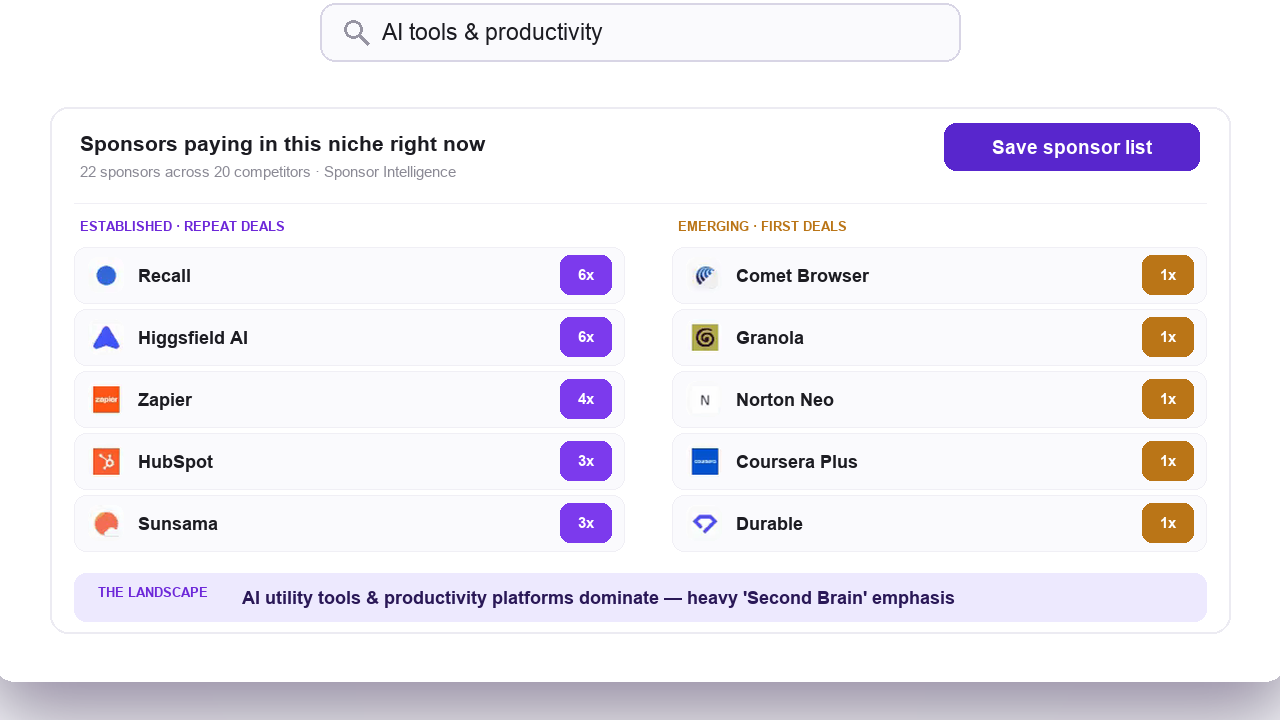
Sponsor Intelligence: see every brand sponsoring creators in your niche, with frequency counts. Emerging sponsors (right column) are the highest-reply-rate cold-pitch targets.
For deeper guides see the complete YouTube sponsorships guide and nano-influencer sponsorship rates.
3. Sell Your Own Digital Product
The highest-margin, fastest-to-ship income stream. Digital products take many forms:
- ✓Templates & presets: Notion templates, Lightroom presets, video LUTs, Premiere project files
- ✓Prompt packs & AI playbooks: a 2026 category that didn't exist 18 months ago
- ✓eBooks & guides: $19-$49, sold via Gumroad or Stripe Payment Links
- ✓Stock assets: sound packs, 3D models, branded social templates
A $29 digital product sold to 1% of a 10,000-sub audience is $2,900. The same audience watching pre-rolls earns roughly $20-$80 per 10,000 views. Margin per buyer is the variable that separates serious creator businesses from ad-revenue lottery tickets.
4. Services, Coaching & Done-For-You
For B2B and skill-based niches, YouTube is the most effective lead generator on the internet, and services are the highest-dollar way to convert that audience. A single video about “how I built [X]” can generate $50,000 in agency contracts within 30 days for the right operator.
What sells: consulting calls ($200-$2,000/hour), done-for-you services (web design, SEO audits, video editing), coaching cohorts ($500-$10,000 per seat), retainer agency work ($3,000-$30,000/month).
The structural advantage of services is that you don't need scale. A 2,000-subscriber channel with five high-intent viewers per month closing one $5,000 client outearns most 200K entertainment channels.
5. Lead Generation for Your Existing Business
If you already run a business, YouTube is a content-marketing top of funnel. Each subscriber is a qualified lead, not a view to monetize. Track value as “cost per qualified lead avoided (vs. paid ads)”, typically 10-50x cheaper than the same lead bought via Meta or Google Ads.
Build a lead magnet (free template, free audit, free 5-day email course) and put the link in every description and every video's first comment. Use a tool like ConvertKit or Beehiiv to capture and nurture. No YPP, no AdSense, just owned-audience lead flow.
6. Patreon & Off-Platform Memberships
YouTube's native channel memberships require 500+ subscribers and YPP eligibility (official requirements). Off-platform alternatives have no such gates:
- ✓Patreon · recurring memberships, tier-based perks. Most established pre-monetized creators run a 3-tier Patreon ($3 / $10 / $25).
- ✓Substack paid tiers: pair a YouTube channel with a paid newsletter at $5-$15/month.
- ✓Buy Me a Coffee / Ko-fi: one-time and recurring tipping, lower friction than Patreon.
7. Online Courses & Cohorts
The single highest-LTV product a creator can sell. Courses range from $97 self-serve products to $5,000+ live cohorts. The prerequisite is authority: your audience must believe you can teach the outcome.
Realistic numbers: a $497 course converting at 1% of a 5,000-sub audience is $24,850 per launch. Two launches a year clear $50,000 from a channel many creators consider “too small to monetize.” Compare that to ad revenue at the same channel size: typically $1,000-$3,000 per year.
8. Content Licensing & UGC Packages
If you produce footage that has news value, viral utility, or brand-friendly aesthetic, you can license it directly:
- ✓News-clip licensing via Jukin Media or Storyful: $500-$5,000 per viral clip
- ✓Stock footage via Pond5, Shutterstock, Artgrid: passive after upload
- ✓UGC packages: produce 3-5 vertical clips for a brand at $300-$2,000 per package, separate from any YouTube upload
- ✓YouTube Shopping & merch shelf: once YPP-eligible, see YouTube Shopping requirements
Which Stream Should You Start With?
Pick by audience type and channel maturity. Most creators start with one and add a second within 90 days. Situation by situation:
- ✓Run a B2B service business (consulting, agency, SaaS)? Start with lead gen: a free audit or template in every description turns the channel into a demo-booking machine. Add done-for-you services (stream 4) as the paid layer.
- ✓Review or tutorial channel with a shopping audience? Affiliates from day one, then nano-tier sponsorships once you clear roughly 1,000 engaged subs.
- ✓Teach a skill or hobby? Ship one digital product first (template, preset pack), and hold the course until about 5K subs proves the authority.
- ✓Entertainment channel with no obvious product fit? Nano-sponsorships at 1K+ subs and off-platform memberships; licensing if your footage has news value.
- ✓Whichever you pick, add the free lead magnet and email list from day one. It compounds across every other stream.
How Top Channels in Your Niche Already Monetize
Before you pick a stream, look at what already works in your niche. OutlierKit Competitor Studio's Funnels & Monetization view breaks down exactly how the top creators in any niche split revenue across courses, products, affiliates, and lead magnets, so you can pattern-match the highest-converting stack instead of guessing.
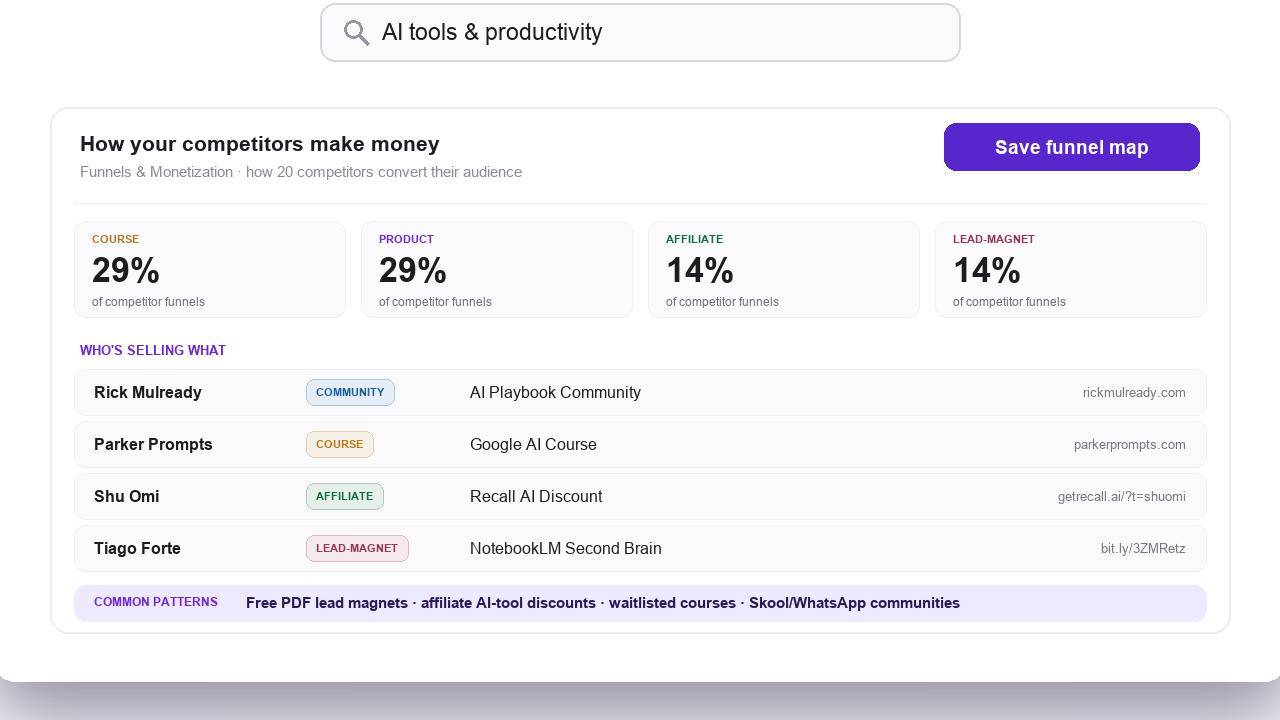
Funnels & Monetization: see the exact revenue stack used by the top 50 creators in any niche before you build your own.
Disclosure Rules You Cannot Skip
Earning outside YPP doesn't exempt you from disclosure rules. The FTC endorsement guides apply to every creator regardless of size, location, or monetization status. Fines apply to both creator and brand.
- ✓Affiliate links: disclose the relationship (“I earn a commission”) verbally and in the description.
- ✓Sponsored content: toggle the “includes paid promotion” checkbox in YouTube Studio plus on-camera disclosure.
- ✓Free product / gifting: disclose if there is any expectation of coverage.
- ✓Your own products: no FTC disclosure required, but transparency about ownership is best practice.
Related Reading
- YouTube Monetization Strategies · the full pillar covering all 11 ways YouTube channels make money.
- How to Get YouTube Monetization Fast · if you do want to hit YPP, the speedrun playbook.
- YouTube Sponsorships Guide · definitions, deal types, contracts, FTC rules, discovery.
- OutlierKit Competitor Studio · Sponsor Intelligence and Funnels & Monetization modules.
Frequently Asked Questions
How do you make money on YouTube without monetization?
You make money on YouTube without monetization by earning outside the YouTube Partner Program: through affiliate links, direct brand sponsorships, your own digital products, services, lead generation, off-platform memberships (Patreon, Substack), courses, and content licensing. None of these require the 1,000 subscribers and 4,000 watch hours that the YouTube Partner Program requires. Established creators typically report earning 70-85% of their revenue from these sources, not from AdSense.
Can you make money on YouTube without 1,000 subscribers?
Yes, you can make money on YouTube without 1,000 subscribers. The 1,000-subscriber threshold only applies to the YouTube Partner Program (AdSense, Super Chat, channel memberships). Affiliate marketing, direct sponsorships, selling your own products, freelance services, lead generation, Patreon, and content licensing all work from your first video. Channels under 1K subs routinely earn $500-$5,000 per month through affiliate links and small brand deals, often more than equivalent-sized channels earn from ads alone.
How do you make money on YouTube without ads?
To make money on YouTube without ads, replace ad revenue with the eight income streams creators actually rely on: affiliate commissions, brand sponsorships, your own digital products, services, lead generation, memberships, courses, and content licensing. Top creators with 1M+ subscribers typically earn less than 30% of total revenue from ads, with the rest coming from off-AdSense sources. A subscriber-monetization-disabled channel can be more profitable than a fully monetized one if the audience is well-matched to a paid offer.
How do you earn from YouTube before being monetized?
You earn from YouTube before being monetized by treating each video as a sales asset, not an ad inventory unit. Add affiliate links to every product mention. Pitch one micro-sponsorship per month. Even $200 deals compound. Build a free newsletter or lead magnet linked in every description. Sell one digital product (template, course, preset pack) priced at $20-$100. By the time you cross the YPP threshold, ads will be the smallest line in your revenue stack.
What is the YouTube Partner Program and do I need it?
The YouTube Partner Program (YPP) is YouTube's official monetization program, requiring 1,000 subscribers plus 4,000 watch hours in 12 months (or 10M Shorts views in 90 days). YPP provides AdSense revenue, channel memberships at 500+ subs, Super Chat, and YouTube Shopping. You don't need YPP to earn money: sponsorships, affiliates, products, and services all work without it. YPP is best understood as one revenue stream among many, not a prerequisite. See YouTube's official YPP requirements at support.google.com/youtube/answer/72857.
How much can a small YouTube channel make without monetization?
A focused small YouTube channel (under 10,000 subs) can make $1,000-$10,000 per month without monetization, depending on niche and offer fit. Finance, B2B SaaS, and high-ticket service niches frequently exceed this with under 5,000 subs. Entertainment and lifestyle niches earn less per subscriber but compound faster. The key variable is offer-audience fit: a 2,000-sub channel selling a $497 course to right-fit viewers can outearn a 100K entertainment channel running pre-rolls.
Do YouTube affiliate links require monetization to be enabled?
No, YouTube affiliate links do not require monetization. You can post Amazon Associates, ClickBank, ShareASale, or direct merchant affiliate links in any video description regardless of YPP status. The only requirements are FTC disclosure (state that links are affiliate) and the affiliate program's own terms (Amazon Associates requires you to disclose affiliate status on every video featuring their links).
Can a brand sponsor a YouTube channel that isn't monetized?
Yes, brands sponsor non-monetized YouTube channels routinely. Brand sponsorships are creator-to-brand contracts that have nothing to do with YouTube's ad system. The brand cares about audience relevance, engagement rate, and trust, not YPP status. Nano-influencers (1K-10K subs) with strong engagement often earn $50-$500 per sponsored integration and frequently aren't even YPP-eligible yet.
Is it legal to make money on YouTube without monetization?
Yes, making money on YouTube without monetization is fully legal and complies with YouTube's Terms of Service. Affiliate links, sponsored content, product mentions, and external promotion are all permitted. The legal requirements are: (1) FTC disclosure for any paid promotion or affiliate relationship, (2) accurate income reporting to your tax authority, (3) compliance with platform-specific rules for things like Amazon Associates or sponsored content (toggle YouTube's 'includes paid promotion' checkbox on uploads).

Find sponsors who already pay creators in your niche
Run a Sponsor Intelligence report in OutlierKit Competitor Studio to see every brand actively buying creator placements at your channel size, and pitch them with proof.
Try OutlierKit Free