The YouTube Creator Vetting Checklist: 7 Points Every Brand Should Check Before Sponsorship
According to the Influencer Marketing Hub Benchmark Report, brand spend on influencer marketing crossed $32B in 2025 and is still climbing. The same report shows that measuring ROI remains the single hardest part of the job for roughly three out of four marketers. Most of that ROI pain doesn't start after the campaign. It starts the moment a creator gets signed without being properly vetted.
Picture a DTC skincare brand approving a $20K dedicated-video deal with a 480K-subscriber beauty creator. The pitch deck looked clean: real audience, 70% female, US-skewed, 25-34. The integration shipped. CTR was a third of forecast and the promo code pulled 41 sales. Post-mortem surfaced what the demographic deck hid: the audience's dominant psychographic was "low-budget drugstore hauls," and the brand was a $90 serum. Same demographics. Wrong audience. The $20K was burned before the brief was even written.
That kind of failure is preventable. Below is the 7-point checklist brand and agency teams use to vet a YouTube creator before signing. Each point has the exact question to answer, the data layer that answers it, the pass/fail threshold, and the red-flag pattern to watch for. Use it on every finalist before a contract goes out.
Download the vetting checklist as a Google Sheet
Get the full 7-point checklist as a copy-ready Google Sheet. Pass/fail thresholds, red-flag patterns, and a scoring column you can run on every finalist. Free, no login required.
Open the Google Sheet →The cost of skipping creator vetting
The skincare vignette above is a composite, but the pattern is real and well-documented. Independent industry surveys consistently put roughly one in four influencer campaigns in the "did not meet ROI expectations" bucket, with audience misfit and creative misalignment cited as the top two failure modes. Both are vetting problems, not negotiation problems.
The fix is not more tools. It's a structured pre-signature workflow. The seven checks below are the layers brand and agency teams run before a contract goes out. Three of them (checks 1, 2, and 7) are hard gates: a fail means drop the creator. The other four are negotiation inputs that shape the brief, the deal structure, and the price.
The whole thing is meant to take 60-90 minutes per finalist. Less than the time you already spend writing the contract.
The 7-point vetting flow. Hard gates fail the deal outright. Amber checks reshape the brief, the price, or the deal structure.
The 7-point creator vetting checklist
Run the checks in order. Stop at any hard-gate failure (checks 1, 2, 7). For amber-check failures, decide whether you can fix the issue with a sharper creative angle or a different deal structure before continuing.
Audience authenticity check
The question: Is at least 85% of this creator's audience real, engaged humans?
Data layer that answers it: Fake-follower and bot-detection scan. HypeAuditor, Modash, and similar verification tools score audience credibility on a 0-100 scale and surface suspicious subscriber spikes.
Pass threshold
Real-audience score 85% or higher. Bot share under 10%. No unexplained subscriber spike of more than 25% in a single month over the trailing 12 months.
Red-flag pattern
Real-audience score below 80%. Two or more sub-spikes that don't line up with a viral video. Engagement rate below 1.5% of average views.
How to run it: Pull the credibility score from HypeAuditor or Modash. Cross-check the monthly subscriber chart on Social Blade for spikes. If the deal is over $10K, do both.
Audience psychographic fit
The question: Does the creator's audience map to your buyer persona, not just your demographic target?
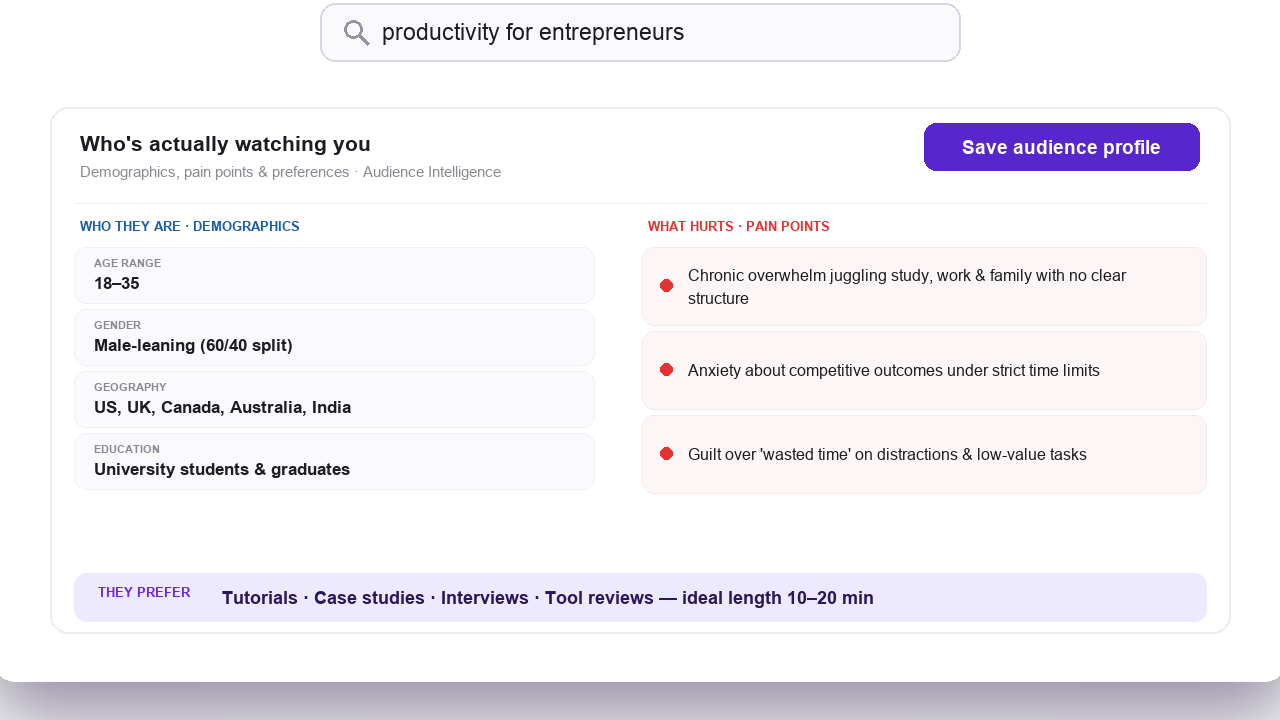
OutlierKit Competitor Studio: deep audience psychographic profile showing the dominant viewer motivation segment
Data layer that answers it: Psychographic audience profile. OutlierKit Competitor Studio surfaces viewer motivations, identities, and jobs-to-be-done across the channel and the broader niche.
Pass threshold
At least one core audience segment in the psychographic profile matches your ICP's primary job-to-be-done. The match should be the dominant segment, not a long-tail one.
Red-flag pattern
The audience splits across three or more equally-weighted segments with no clear primary motivation. The top segment is adjacent to your category but not inside it (for example, "hobbyist day-traders" when you sell long-term portfolio software).
How to run it: Open Competitor Studio, run the channel, scroll to the audience psychographic panel. Compare the top three segments against your written buyer persona.
Sponsor category overlap
The question: Is your category already saturated by direct competitors in this creator's recent sponsorships?
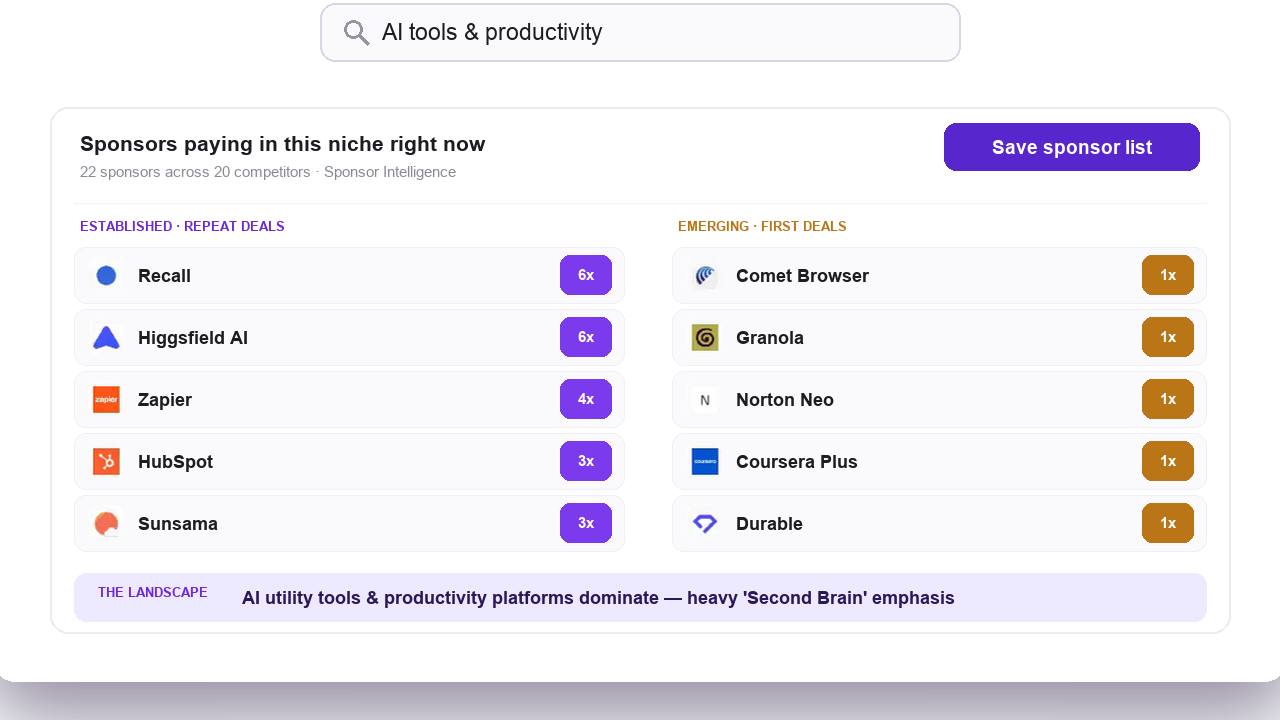
OutlierKit Competitor Studio sponsor intelligence: brands already sponsoring creators in the niche over the last 90 days
Data layer that answers it: Niche-wide sponsor map. Competitor Studio shows which brands sponsor which creators across the niche in the last 30, 60, and 90 days, and which categories are saturated.
Pass threshold
Zero direct competitors in the creator's last 90 days of sponsored videos. At most one category-adjacent brand. Niche-level saturation in your category under 30%.
Red-flag pattern
Three or more competing brands ran integrations on this creator or close peer creators in the last 90 days. Audience comments mention sponsor fatigue ("another VPN ad").
How to run it: Run Competitor Studio's sponsor intelligence view on the creator's niche. Filter to your category. Count the unique brand logos and dates.
Outlier video format match
The question: Does the creator's outlier content format support the integration you're proposing?
OutlierKit Outlier Finder identifying videos performing 3-10x above the creator's own baseline
Data layer that answers it: Outlier video patterns. OutlierKit's Outlier Finder surfaces the videos performing 3-10x above the channel's baseline, with their format, hook, and topic signature.
Pass threshold
At least 3 of the creator's last 10 outliers share the format you're briefing (tutorial, deep-dive, vlog, listicle, reaction, build). The outlier hook archetype aligns with the message you want to land.
Red-flag pattern
The creator's outliers are vlogs and personal-story formats, but you're briefing a feature-led tutorial. Outliers are all reactions and roasts, but your brief asks for a sincere testimonial.
How to run it: Open the Outlier Finder, pull the channel's last 12 months of outliers, scan the thumbnails and titles for format pattern. Map to your brief.
Engagement quality
The question: Are this creator's comments real conversations or surface-level bot patterns?
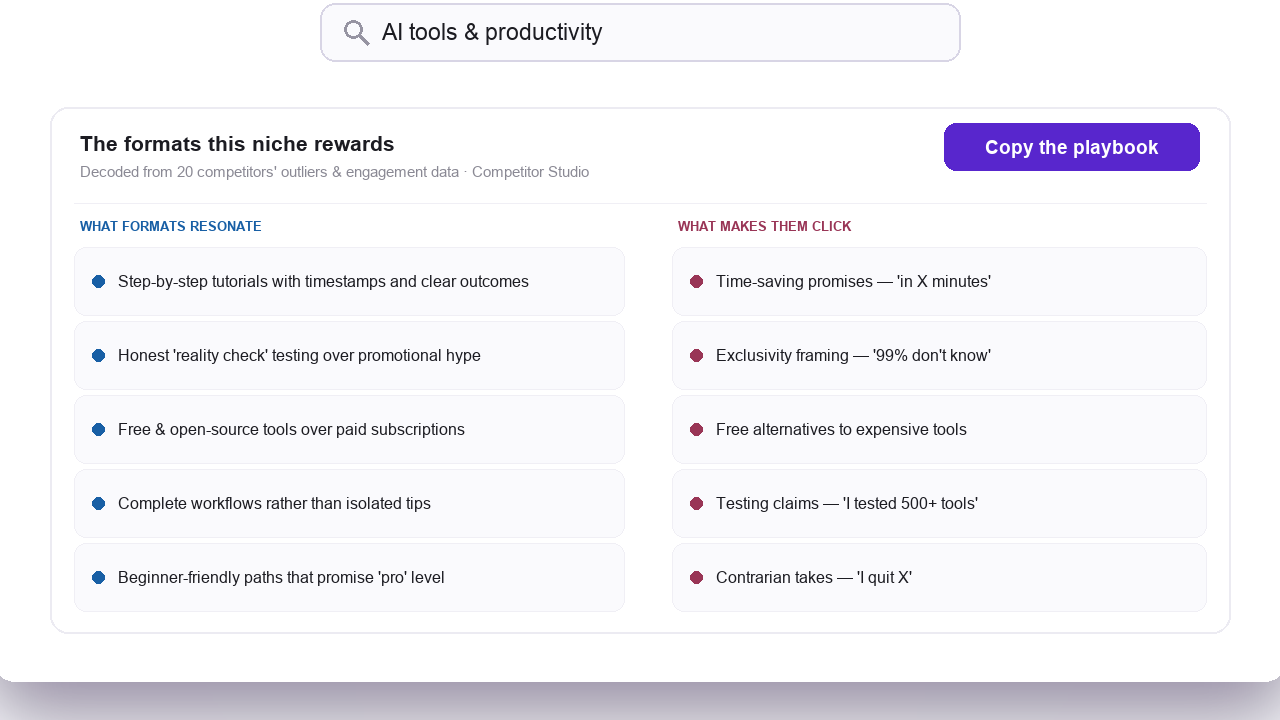
OutlierKit Competitor Studio comment intelligence: recurring questions and themes across a creator's audience
Data layer that answers it: Comment intelligence. OutlierKit's niche comment analysis surfaces themes, recurring questions, and audience-name callouts. Manual sampling of the last 20 videos is also a fine fallback.
Pass threshold
Top-comment sample includes specific questions, references to earlier videos on the channel, and audience-name callouts. Comment-to-view ratio at or above 0.3% on average.
Red-flag pattern
Comments are dominated by single-emoji replies, generic "great video" patterns, or repetitive multi-account praise. Comment-to-view ratio below 0.1%. No threading or back-and-forth.
How to run it: Pull the comment intelligence panel in Competitor Studio. Then open the top 5 comments on the creator's last 10 videos and read them. Trust your eyes for bot patterns.
Monetization model alignment
The question: Does the creator's typical deal structure match the one you're proposing?
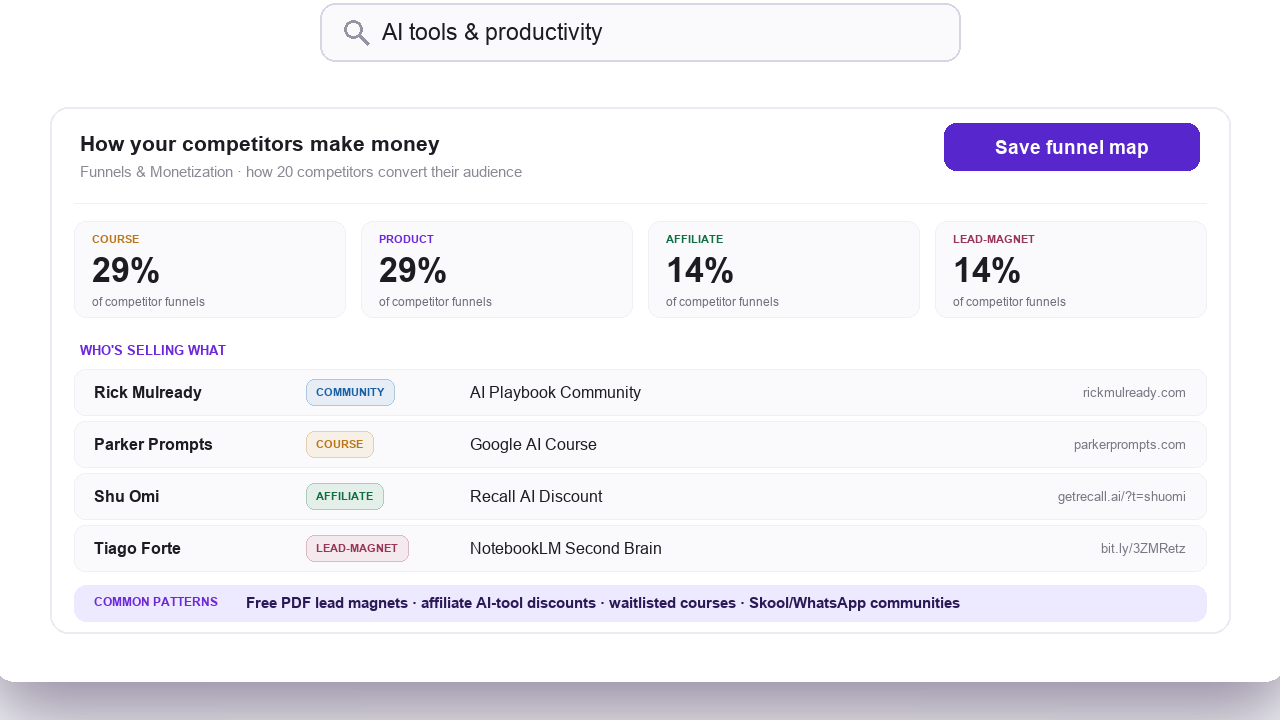
OutlierKit Funnels and Monetisation view: how a creator and their niche actually earn
Data layer that answers it: Monetization mapping. OutlierKit's Funnels view shows whether a creator and niche skew toward dedicated videos, integrations, affiliates, or their own product partnerships.
Pass threshold
At least 60% of the creator's recent sponsorships use the deal structure you're proposing. If you're pitching a dedicated video, they regularly publish dedicated videos. If you're pitching an affiliate split, affiliate links appear in the description.
Red-flag pattern
The creator monetizes primarily through their own course or product funnel, and you're proposing a flat-fee integration that competes with their revenue. They take affiliates only, and you're pitching a flat CPM.
How to run it: Check the Funnels and Monetisation view in Competitor Studio. Confirm with a manual scan of the last 10 description boxes.
Growth trajectory check
The question: Is this creator on an upward curve, a flat plateau, or quiet decline?
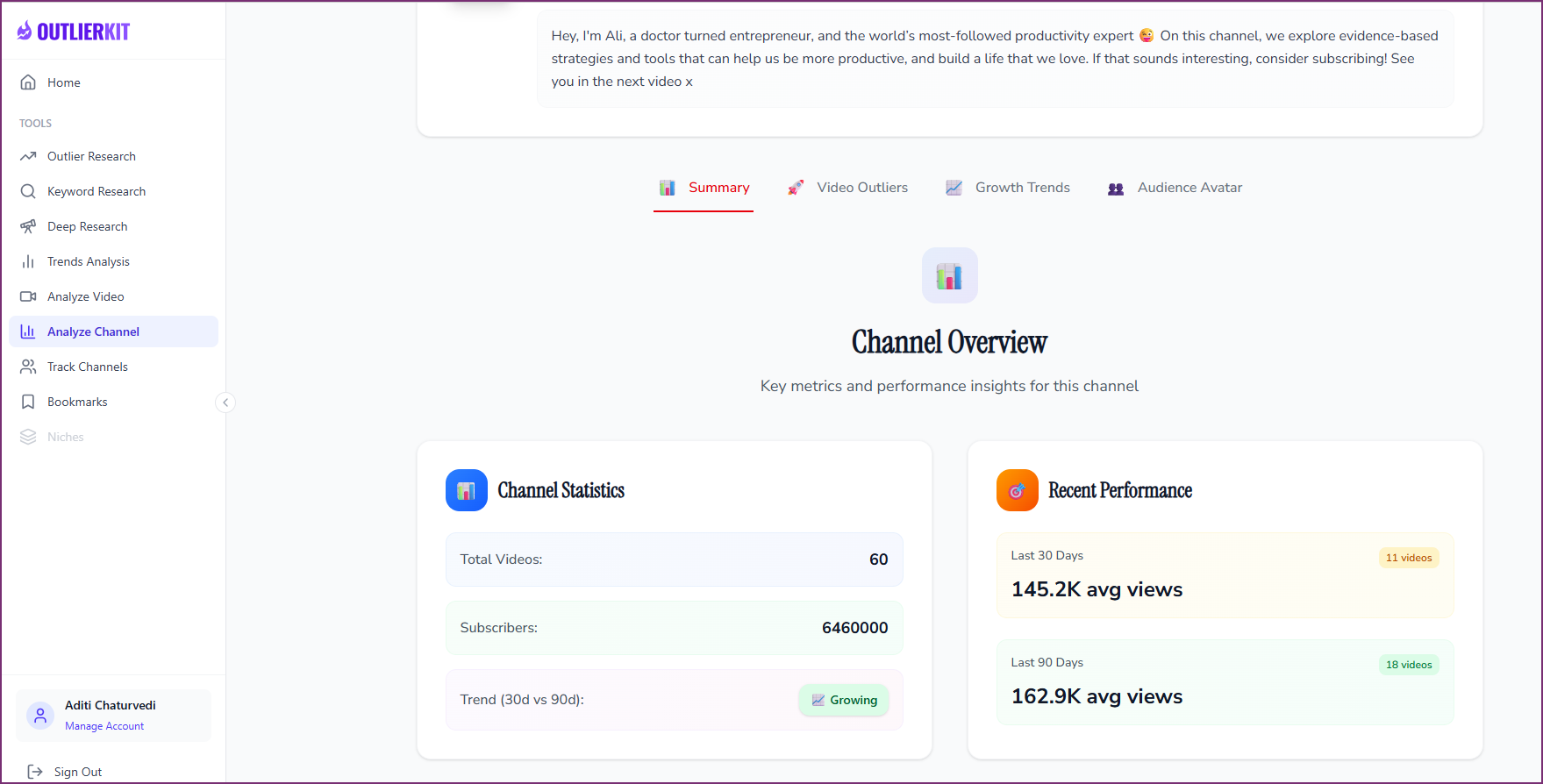
OutlierKit channel growth trend chart showing view-rate trajectory over the trailing 90 days
Data layer that answers it: Channel growth trend. OutlierKit's channel analysis charts view-rate over the trailing 90 days, normalized for video count. Viewstats and Social Blade work as cross-checks.
Pass threshold
Trailing-30-day average view rate is flat or up versus the prior 60 days. Subscriber growth positive but not a stat alone. Trend line on view-rate, not subscribers, is your scoring metric.
Red-flag pattern
Trailing-30-day view rate is down more than 20% versus the prior 60 days. Subscriber count flat or rising while view rate falls (a classic plateau pattern that subscriber-only tools hide).
How to run it: Open the channel growth trend chart in OutlierKit. Eyeball the trailing 90 days. Price the deal on view-rate, not subscriber count.
Run checks 2-6 in a single scan
Five of the seven checks (psychographic fit, sponsor overlap, outlier format, engagement quality, monetization) come out of a single Competitor Studio niche scan. The clip below shows a live run on a finance creator and their peers.
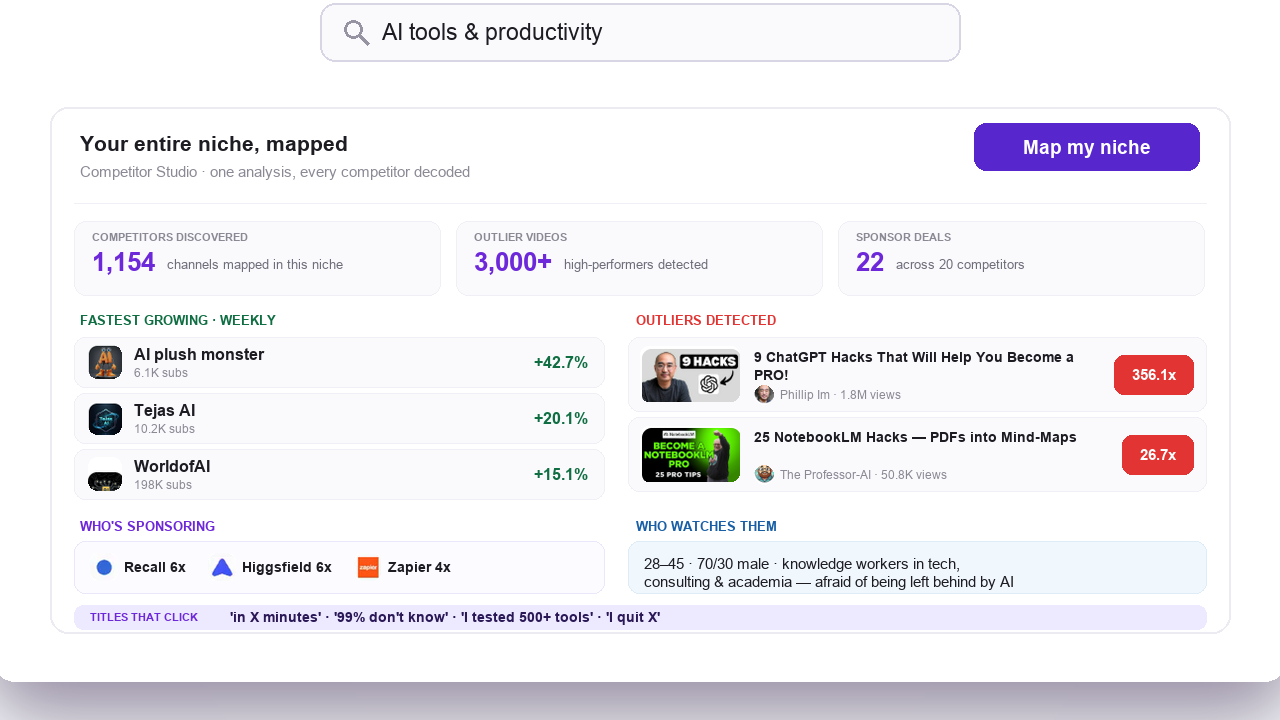
Competitor Studio niche scan, recorded May 14, 2026.
Pre-signature final sanity check
The creator passed the 7-point checklist. Before the contract goes out, answer these three questions in writing. If any answer is "not sure," the deal isn't ready.
- 1
Can I write one sentence describing why this creator's audience will buy this product?
If the sentence requires hedging ("some of their audience might..."), the psychographic fit isn't there. Drop the deal or renegotiate the price down.
- 2
Have I priced this deal on trailing-30-day view rate, not subscriber count?
A 500K-subscriber creator getting 30K views is a different investment from one getting 250K. Pricing on subscribers is the single most common over-spend in the category.
- 3
Have I briefed the integration against the creator's outlier format, not my own template?
Sponsored videos briefed against a creator's outlier patterns consistently outperform brand-template scripts. If your brief overrides their proven format, you're paying for reach you won't convert.
Common vetting mistakes that cost brands money
Five recurring failure patterns, each tied back to the checklist point that catches them. If a deal is underperforming and you don't know why, one of these is almost always involved.
1. Pricing on subscriber count instead of trailing view rate
Caught by Check 7A 500K-subscriber creator getting 30K views per video is not the same investment as one getting 250K. Brands that price on the subscriber number routinely overpay by 5-10x. Always price on trailing-30-day view rate.
2. Confusing demographics with audience fit
Caught by Check 2Two creators tagged "Finance, 25-34, US-skewed male" can have psychographically opposite audiences: retirement-focused dividend investors vs. crypto day-trading hobbyists. The demographics match. The product fit is night and day.
3. Skipping niche-level sponsor mapping
Caught by Check 3Looking at the creator's solo sponsor list shows you what they accept. Looking at the niche shows you whether your category is already saturated across the cohort. Brands who skip the niche scan keep walking into oversaturated lanes.
4. Briefing creators against generic ad templates instead of their outliers
Caught by Check 4The creator's outlier videos are the format their audience actively rewards. Briefing a sponsored integration against a generic brand template regresses performance to the channel's baseline (and usually below).
5. Trusting subscriber-count growth as a proxy for reach
Caught by Check 7Subscriber count is a stock metric. It rarely decreases. View rate is a flow metric and is the leading indicator of decline. Many channels plateau on reach 6-12 months before their subscriber growth visibly slows.
What OutlierKit users say
“Great addition to my stack and simple to use. Hit an issue and the team worked hard to fix it. Great product, hardworking team.”
“Been creating for years, running multiple YouTube channels. OutlierKit is the first tool that actually improved our view counts almost instantly. The competition analysis revealed gaps we never knew existed.”
“OutlierKit has drastically reduced my time to plan content for my SaaS YouTube channel. The deep research feature revealed insights I'd overlooked earlier. A must-have if you're serious about YouTube as an acquisition channel.”
Frequently asked questions
Basics
What is YouTube creator vetting?
YouTube creator vetting is the structured process of validating that a creator's audience, content patterns, sponsor history, and growth trajectory match the goals of your sponsorship deal before you sign a contract. It's the diligence step that prevents overpaying for misfit audiences or briefing against the wrong format.
How long should creator vetting take per deal?
For a sub-$5K integration, 20-30 minutes per finalist is reasonable. For a $20K+ dedicated video, plan 60-90 minutes per finalist plus a separate niche scan that covers 5-15 creators at once. Most of the time savings come from running the whole shortlist through a single Competitor Studio scan instead of opening 10 separate dashboards.
Who on the team should own creator vetting?
On agency side, partnerships leads or strategists run it before pitching the client. On brand side, the influencer marketing manager owns it, often with paid-social or growth weighing in on persona alignment. The checklist is the same; only the approver changes.
Process
What's the right pass/fail bar across the 7 checks?
Treat the 7 checks as a gating series, not a weighted score. A creator who fails check 1 (audience authenticity) shouldn't proceed regardless of how they score elsewhere. A creator who fails check 3 (sponsor overlap) can sometimes still work with a sharper creative angle. Checks 1, 2, and 7 are hard gates. Checks 3, 4, 5, and 6 are negotiation inputs.
What should I do if a creator fails one of the 7 checks?
If they fail check 1 or check 7, drop them. If they fail check 2 (psychographic fit), the audience won't convert and no creative fix will rescue it. If they fail check 3 (sponsor saturation), you can sometimes salvage with a sharply differentiated angle. If they fail check 4 (outlier format), rewrite the brief to match their proven format instead of imposing yours.
How is this checklist different from a discovery shortlist?
Discovery shortlisting is volume work: take a niche, score creators on size, language, and surface-level audience fit, and produce a list of 20-50 candidates. Vetting is the depth work that happens on the finalists, usually 3-5 creators you're seriously considering. The checklist runs at the finalist stage, not the shortlist stage.
Tools
Which tools cover the full 7-point vetting checklist?
No single tool covers all seven. Most brand teams pair a verification platform (HypeAuditor or Modash) for check 1 with an audience intelligence platform (OutlierKit) for checks 2-7. The verification layer screens out fraud at the shortlist stage; the intelligence layer goes deep on finalists.
Can I run this checklist without any paid tools?
Yes, partially. Social Blade gives you the growth trend (check 7) for free. The creator's own video descriptions reveal monetization model (check 6). Reading 20 top comments by hand covers check 5. Audience psychographics (check 2) and niche-wide sponsor mapping (check 3) are the two layers that genuinely require a paid intelligence tool. For a $5K+ deal, the math almost always favors paying for the intelligence layer.
Where does HypeAuditor fit in this checklist?
HypeAuditor is the category leader for check 1 (audience authenticity / fraud detection) and a useful input for demographic verification. It is not built for psychographic fit, sponsor saturation, or outlier-pattern analysis. See our full OutlierKit vs HypeAuditor comparison for the head-to-head.
Pricing
How much should I budget for vetting tools?
Solo brand running 1-2 deals/year: under $200/year total (free HypeAuditor lookup plus OutlierKit Hobby at $16.6/mo billed annually). Agency running 10-50 deals/year: $500-2,000/month across a verification tool plus an intelligence tool. Tooling cost is rounding-error against one prevented misfit sponsorship.
Is OutlierKit's API available for agencies and platforms?
Yes. The OutlierKit API is live as of May 2026 on Pro and Max plans (still alpha, with endpoints stable in v1 and rate limits being tuned). It exposes outlier video search, semantic channel search and similarity, channel and video lookups with AI metadata, recent uploads, transcripts, live comments, and keyword research. Read the API docs to wire the vetting checks directly into your own dashboards, or upgrade to Pro or Max.
Get the checklist as a Google Sheet
Run the 7 checks on every finalist with a copy-ready Google Sheet. Includes the pass/fail thresholds, red-flag patterns, and a scoring column. Free, no login.
Dig deeper
- → YouTube influencer analytics. The analytics keystone this checklist is built on. Same intelligence layers, with the "what data to look at" framing.
- → Find YouTube micro-influencers. How to build the shortlist that feeds this checklist.
- → Find YouTube influencers. The discovery workflow across every size band, with a live niche scan showing why subscriber sorting misprices a shortlist.
- → OutlierKit vs HypeAuditor. The verification vs intelligence stack head-to-head.
- → HypeAuditor alternatives. Seven vetting tools with verified pricing and linked ratings, plus the four number check that catches a channel coasting on one old hit.
- → Favikon alternatives. What a discovery credit really costs, and why follower rank is not performance rank.
- → Competitor Studio. The niche-scan tool that covers checks 2-6 in a single pass.
Disclaimer: Tool descriptions and category positioning are based on publicly available information as of May 14, 2026. Pricing for third-party tools (HypeAuditor, Modash, CreatorIQ) is based on public listings and third-party reports. Verify directly with each vendor.

Run the 7-point vetting checklist on your next shortlist
Cover checks 2-6 in one Competitor Studio scan: psychographic fit, sponsor overlap, outlier format, engagement quality, monetization. Start with a free trial. No credit card required.
Start Free Trial