The Best Influencer Marketing Platforms With a Developer API (2026)
You have been told to "wire influencer data into our app." You need to know which platforms have a real influencer marketing API and which ones route you to a sales call when you ask for the docs. This comparison is for the engineer or RevOps person doing that job.
It covers the six platforms people ask about most: Modash, Aspire, Upfluence, GRIN, CreatorIQ and Influencers.club. Each gets the same template: intro, features, pros, cons, pricing, user reviews, best for. A platform is only said to lack something when its own documentation says so.
OutlierKit sits next to these platforms as a YouTube data layer. If you vet YouTube creators, our top 1% subscriber lines for 20 niches show why a raw follower count misleads: the top 1% line runs from 1 million subscribers in real estate to 5.9 million in fitness.
For context on why this category matters: the global influencer marketing industry was valued at roughly $24 billion in 2024 and is projected to keep compounding, per the Influencer Marketing Hub Benchmark Report. That growth is why engineering teams now get asked "does this platform have an API?"
Influencer marketing by the numbers
Context for why APIs in this category are getting more attention from engineering and RevOps teams. Figures are from the cited industry sources; verify against the latest reports before quoting in a deck.
- Industry size (2024)
- ~$24B
- Global influencer marketing spend, per the Influencer Marketing Hub Benchmark Report.
- Brands using it
- ~85%
- Share of marketers that report running influencer campaigns, per the IMH 2024 Benchmark.
- Enterprise customers (CreatorIQ)
- 1,000+
- Brands and agencies cited by CreatorIQ, including Disney, Unilever, and Sephora.
TL;DR: which API for which team?
- Pick Modash for a documented REST API you can build on this quarter, with creator discovery and audience data at the core.
- Pick Aspire to run end-to-end DTC creator campaigns in one platform, using the API mainly to sync with Shopify, Klaviyo or Salesforce.
- Pick Upfluence when your best creators are already your customers and you want commerce-native creator ops with affiliate tracking.
- Pick GRIN when you already know your creators and need a serious CRM for the relationship, content and payments.
- Pick CreatorIQ if you are a large brand or holding-company agency that needs governance, integrations and roll-up reporting at scale.
- Pick Influencers.club for the widest platform coverage on this list (340M+ profiles, 47 networks), contact info, cross-platform identity, and a self-serve API with per-call pricing.
- Add OutlierKit for YouTube outlier detection, channel similarity, and keyword and transcript data as JSON on top of any of the above.
Which platforms have a self-serve API?
The phrase "influencer marketing platform API" covers two very different things. Some platforms (Modash and Influencers.club being the clearest examples) publish a REST API with documentation you can read without talking to anyone. Others (Aspire, Upfluence, GRIN, CreatorIQ) do have APIs, but access and documentation are scoped through their sales or solutions teams, often as part of an enterprise contract.
Neither model is wrong, but they are wildly different to build against. If you need to prototype this quarter without a procurement cycle, that narrows the list very quickly. If you are standardizing on one creator system of record for a large brand, the calculus flips.
One near miss worth naming: HypeAuditor also offers an API, and it is the strongest option when your only job is vetting follower quality and audience credibility. It is not a discovery database or a campaign system, so it does not compete for the six slots below, but it belongs on your shortlist when fake-follower verification is the core requirement.
Every pricing note below is current to publication; verify on each vendor's own page before quoting anything to your finance team. Vendors quietly move tier names and credit allowances around all the time.
Comparing these APIs for your platform?
Book a 30-minute demo with the founder. We'll show what the OutlierKit API returns against your use case and cover volume and platform-integration pricing.
How do the six platforms compare?
| Platform | API access | Best for |
|---|---|---|
| Modash | Public, self-serve REST API with readable docs | Embedding creator discovery and audience analysis into your own app |
| Aspire | Scoped through their sales/partnerships team | DTC brands running end-to-end creator campaigns in one platform |
| Upfluence | Scoped through their sales team | E-commerce brands turning existing customers into creators and affiliates |
| GRIN | Scoped through their sales/solutions team | DTC brands that know their creators and need a relationship CRM |
| CreatorIQ | Enterprise motion: sales, security review, solutions team | Large brands and holding-company agencies needing governance and roll-up reporting |
| Influencers.club | Public, self-serve REST API with docs and free starter credits | Cross-platform enrichment, identity resolution, and batch lookup at volume |
| HypeAuditor* | API available | Vetting follower quality and audience credibility of specific influencers |
*Not covered in the full reviews below. HypeAuditor is the nearest competitor on follower-quality vetting, so it earns a row here for teams whose primary job is audience verification.
Modash: Best for embedding creator discovery into your own product
API docs: docs.modash.io
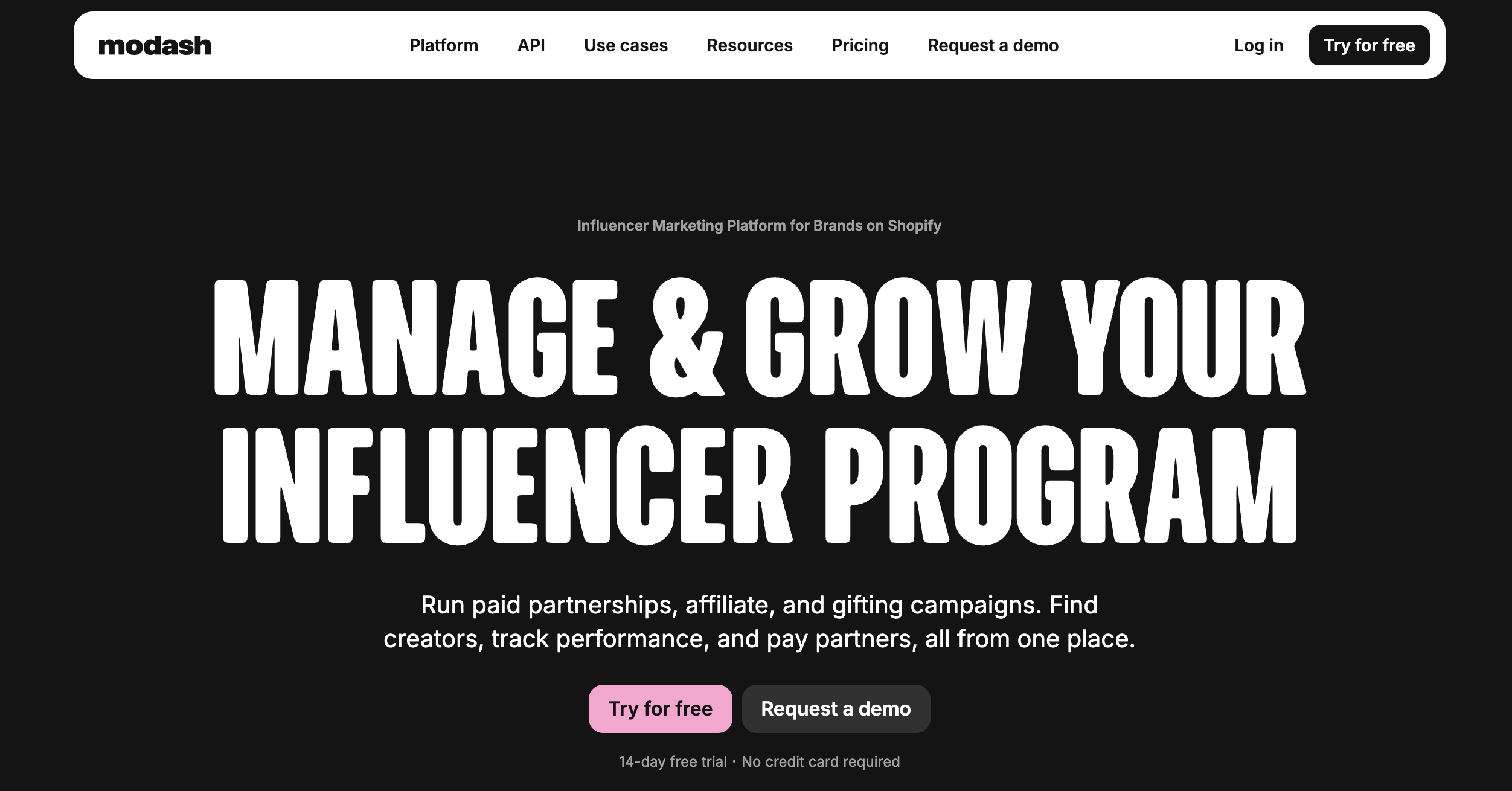
Modash is the platform that engineers actually want to integrate with. It was built like an API product first and a dashboard second. The search surface covers more than 250 million creator profiles across Instagram, TikTok, and YouTube. The REST API exposes most of what the UI does. That means discovery, profile lookups, audience reports, and performance data.
Maybe you have tried to wire up a "find creators that match this brief" feature inside your own product. Maybe you ended up scraping public pages until you got rate-limited into oblivion. If so, Modash is the boring, sensible answer. It does not pretend to manage your campaigns, send emails, or run your payments. It hands you structured creator data and gets out of the way.
API & Platform Features
- REST API covering creator discovery, profile lookups, audience demographics, and performance metrics across Instagram, TikTok, and YouTube.
- Filtering by audience location, age, gender, interests, language, engagement rate, follower count, and growth.
- Audience overlap and credibility/fake-follower signals, available in the API as well as the UI.
- Content search to find posts, Reels, and videos that mention a keyword or hashtag.
- Webhook and reporting endpoints to pull campaign performance for tracked creators.
Pros
- +Public API documentation you can actually read before talking to a salesperson.
- +Pricing is published on the site, so engineering can budget without an NDA.
- +Coverage runs deep into nano- and micro-influencers instead of stopping at the top 1%.
Cons
- −It is a discovery and analytics layer, with no CRM, outreach, contracts, or payments.
- −Per-result and per-report credit usage can climb fast if you build a noisy product on top of it.
- −TikTok and YouTube data, while solid, is still strongest on Instagram.
Pricing
Modash publishes plan tiers and credit allowances on their pricing page. The Essentials tier is the entry point. Performance and Advanced add more credits, seats, and report volume. API access is included on paid plans rather than gated as an enterprise add-on. Check the live page at modash.io/pricing for current numbers before quoting anything internally. They have adjusted credit allowances more than once.
What Users Actually Say
G2 and Capterra reviewers consistently call out two things. The first is the depth of the discovery filters. The second is how responsive support is when something in the API behaves unexpectedly. The recurring complaints are about credit math, since people misjudge how many a workflow will burn. Reviewers also note the occasional stale profile when a creator changes handles.
Best For
Product and data teams who want to embed creator discovery, audience analysis, or vetting. They can drop it inside their own app, agency tooling, or internal dashboards.
Aspire: Best for end-to-end DTC creator campaigns in one system of record
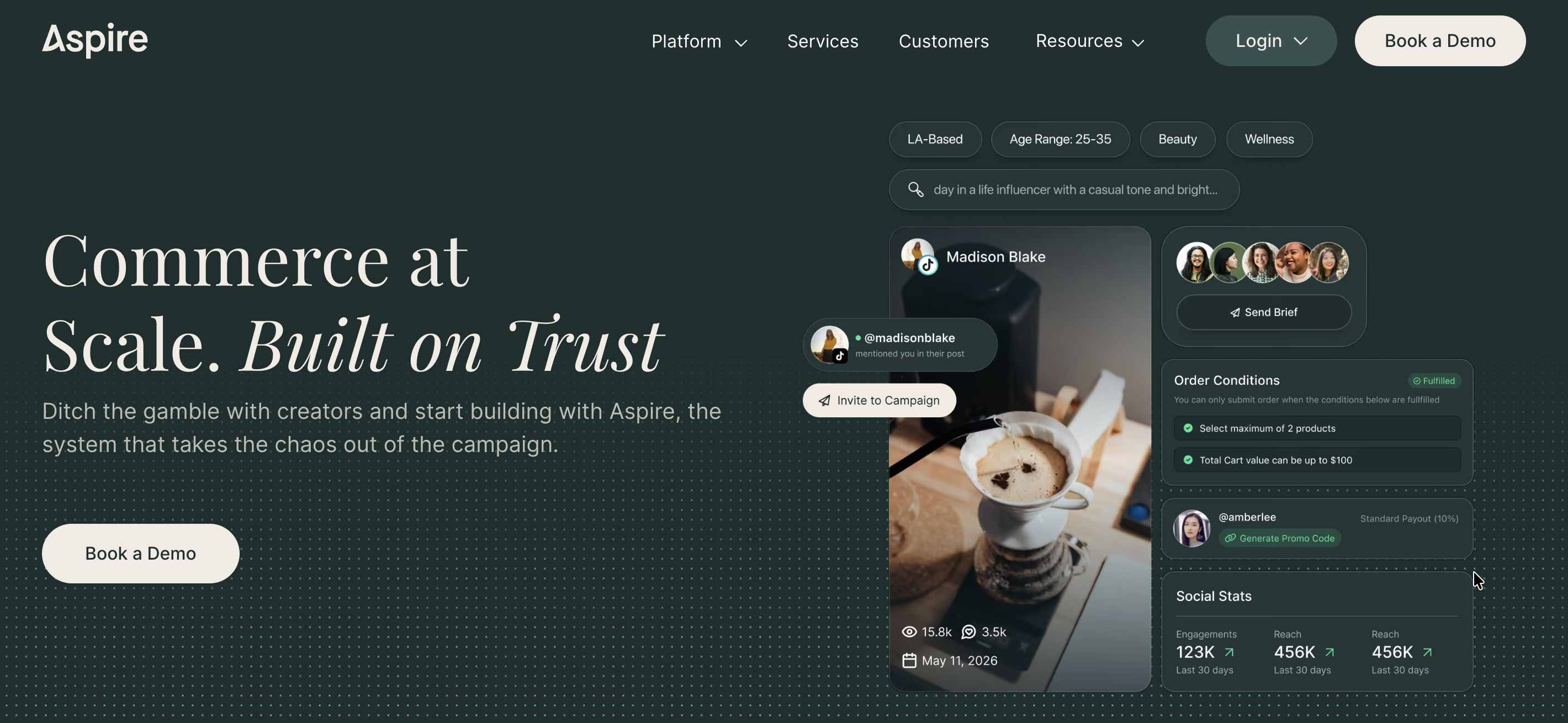
Aspire (formerly AspireIQ) is a full-stack influencer marketing platform. It covers discovery, outreach, contracts, content review, product seeding, affiliate links, and reporting all in one. It is less of an "API you build on" and more of a "system of record" that happens to expose integrations for the teams that need them.
Say your team is running dozens of ongoing creator campaigns. You want a single place where briefs, deliverables, usage rights, and payouts all live. Aspire is one of the obvious choices. Treat the API as a way to push and pull data between Aspire and the rest of your stack. It is not a developer playground.
API & Platform Features
- Integrations with Shopify, Klaviyo, Salesforce, and other commerce/CRM systems to sync creators, orders, and revenue.
- Workflow tooling for recruitment, contracts, content approvals, product gifting, and creator payments inside one platform.
- Affiliate links and discount codes with attribution back to individual creators.
- Reporting on earned media value, sales, and content performance across active campaigns.
- Programmatic access for partners and enterprise customers; the surface and scope are scoped through their team.
Pros
- +End-to-end coverage means fewer SaaS tools and fewer hand-offs in the campaign lifecycle.
- +Strong commerce integrations make it a natural fit for DTC and Shopify-heavy brands.
- +Creator-facing experience is polished, which improves response and acceptance rates.
Cons
- −API access and documentation are not publicly self-serve. You go through their team to scope it.
- −Overkill if you only need discovery or vetting and do not run end-to-end campaigns inside the tool.
- −Like every all-in-one, you trade flexibility for integration. Replacing one module with a best-of-breed alternative is awkward.
Pricing
Aspire does not publish pricing publicly. Plans are quoted based on seats, the number of active creator relationships, and which modules (discovery, payments, affiliate, etc.) you turn on. Expect a sales conversation and an annual contract; budget accordingly.
What Users Actually Say
Reviewers on G2 and TrustRadius generally praise the breadth of the platform and the quality of customer success support. The most common complaint is onboarding time. There is a lot of surface area to learn before the platform starts paying for itself.
Best For
DTC and consumer brands running always-on creator programs who want one platform to manage discovery, briefs, content, payments, and attribution.
Upfluence: Best for converting existing customers into creators and affiliates
API docs: upfluence.com (API access via sales)
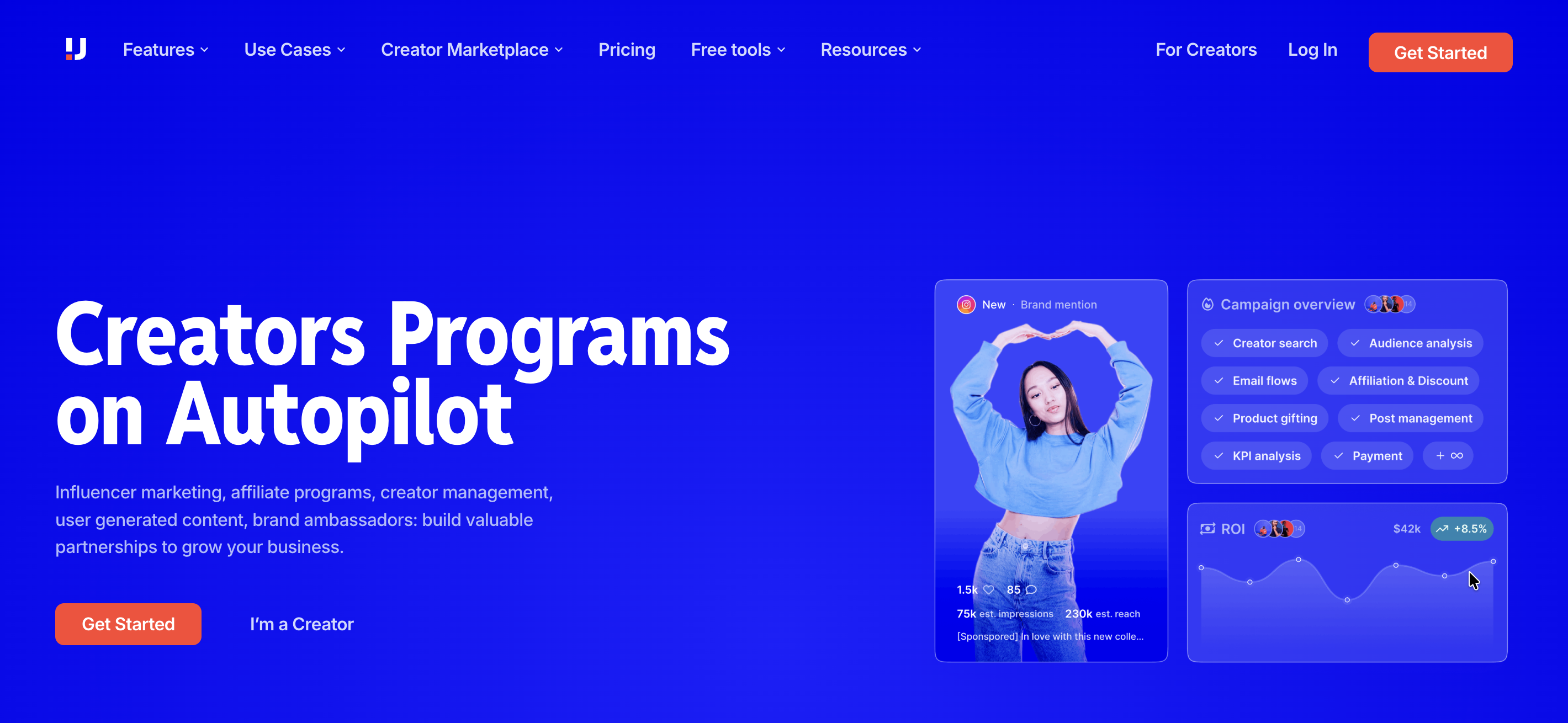
Upfluence is built around the idea that your best influencers are probably already your customers. It hooks into your Shopify, WooCommerce, or Magento store. Then it scans your customer base for people with social followings. On top of that, it layers a campaign management suite.
For engineering teams, Upfluence's value tends to come from its commerce integrations and its programmatic hooks into the campaign data. It is less about a public REST API you can experiment with on a Friday afternoon. API access is generally provisioned and scoped through their team.
API & Platform Features
- Customer-to-creator matching against Shopify, WooCommerce, and Magento stores.
- Creator search across Instagram, TikTok, YouTube, Twitch, and others with filters for audience and performance.
- Outreach, contracts, briefs, product seeding, affiliate codes, and payments managed in-platform.
- Live capture forms that identify influential customers at checkout or sign-up.
- Reporting on attributed sales, ROI, and creator performance across campaigns.
Pros
- +Strongest-in-class for turning existing customers into paid or affiliate creators.
- +Commerce integrations are deep, not bolted on.
- +Useful for both one-off campaigns and ongoing affiliate-style creator programs.
Cons
- −API documentation is not openly published; access is gated behind a sales motion.
- −UI density can feel heavy if you only need a slice of the functionality.
- −Search depth on smaller creators varies by platform. Vet your specific niche during a trial.
Pricing
Upfluence does not publish pricing publicly. Plans are custom and depend on the size of your customer base, which modules you enable, and how many active campaigns and creators you run. Plan on a sales call and a quote rather than a self-serve checkout.
What Users Actually Say
Common praise on G2 centers on the customer-to-creator workflow and the affiliate tooling. The recurring criticism is the learning curve and the cost relative to teams that only need discovery. If you do not use the commerce features, you are paying for them anyway.
Best For
E-commerce and DTC brands that want to convert existing customers into creators and run affiliate-driven campaigns without stitching together five tools.
GRIN: Best for managing known creator relationships like a serious CRM
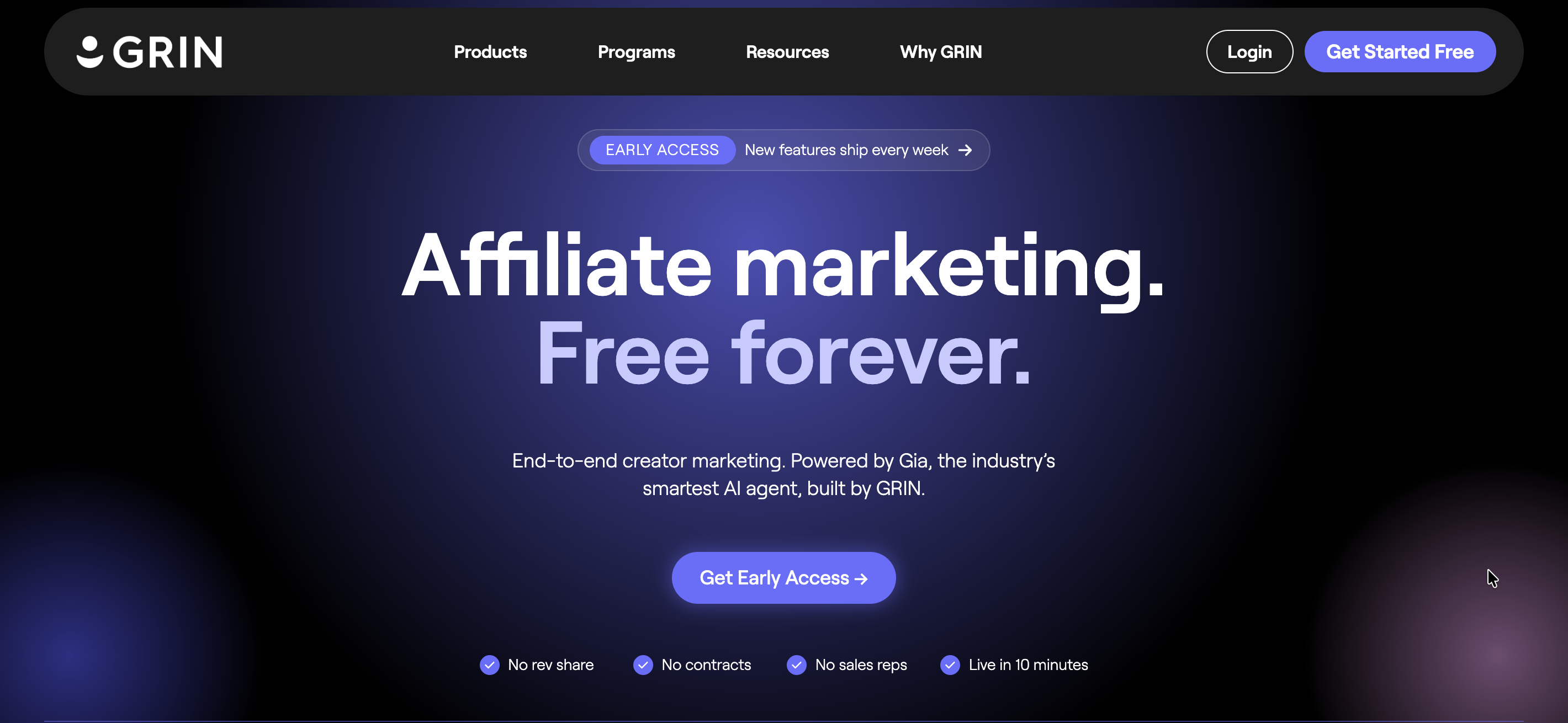
GRIN positions itself as a creator management platform for direct-to-consumer brands. It puts a heavy emphasis on owning the relationship rather than renting it from a marketplace. The product feels less like a search engine and more like a CRM tailored for creator partnerships. Email, gifting, contracts, payments, and reporting are all wired together.
The API surface exists primarily to keep GRIN in sync with the rest of your stack. Think Shopify, WooCommerce, Salesforce, Klaviyo, and similar tools. It is not meant to act as a public developer platform you build novel products on top of.
API & Platform Features
- Creator CRM with first-party relationships, email history, contracts, and performance per creator.
- Integrations with Shopify, WooCommerce, Magento, BigCommerce, and major email/CRM tools.
- Product gifting workflows including shipping, tracking, and attribution.
- Affiliate links, discount codes, and payment processing for creator partnerships.
- Content library, usage-rights tracking, and reporting on EMV, sales, and engagement.
Pros
- +Built around the full creator-relationship lifecycle rather than one-off campaigns.
- +Commerce and email integrations are mature and reliable for DTC operations.
- +Strong reporting once your data is fully wired in.
Cons
- −Public API documentation is not openly browsable; integrations and access go through their team.
- −Discovery is intentionally lighter than dedicated discovery platforms. GRIN expects you to bring or build a creator list.
- −Annual contracts and enterprise pricing put it out of reach for small teams.
Pricing
GRIN does not publish pricing. Contracts are typically annual and quoted based on the size of your program. That means the number of creators, modules enabled, and integrations required. Treat it as an enterprise procurement, not a credit-card sign-up.
What Users Actually Say
Reviewers consistently call GRIN the strongest "creator CRM" option and praise the support team. The most common complaints are pricing, especially for smaller brands. Reviewers also note that the discovery experience is lighter than competitors that lead with a search database.
Best For
DTC brands that already know which creators they want to work with. They need a serious system of record for the relationship, content, and payments.
CreatorIQ: Best for enterprise programs that need governance and roll-up reporting
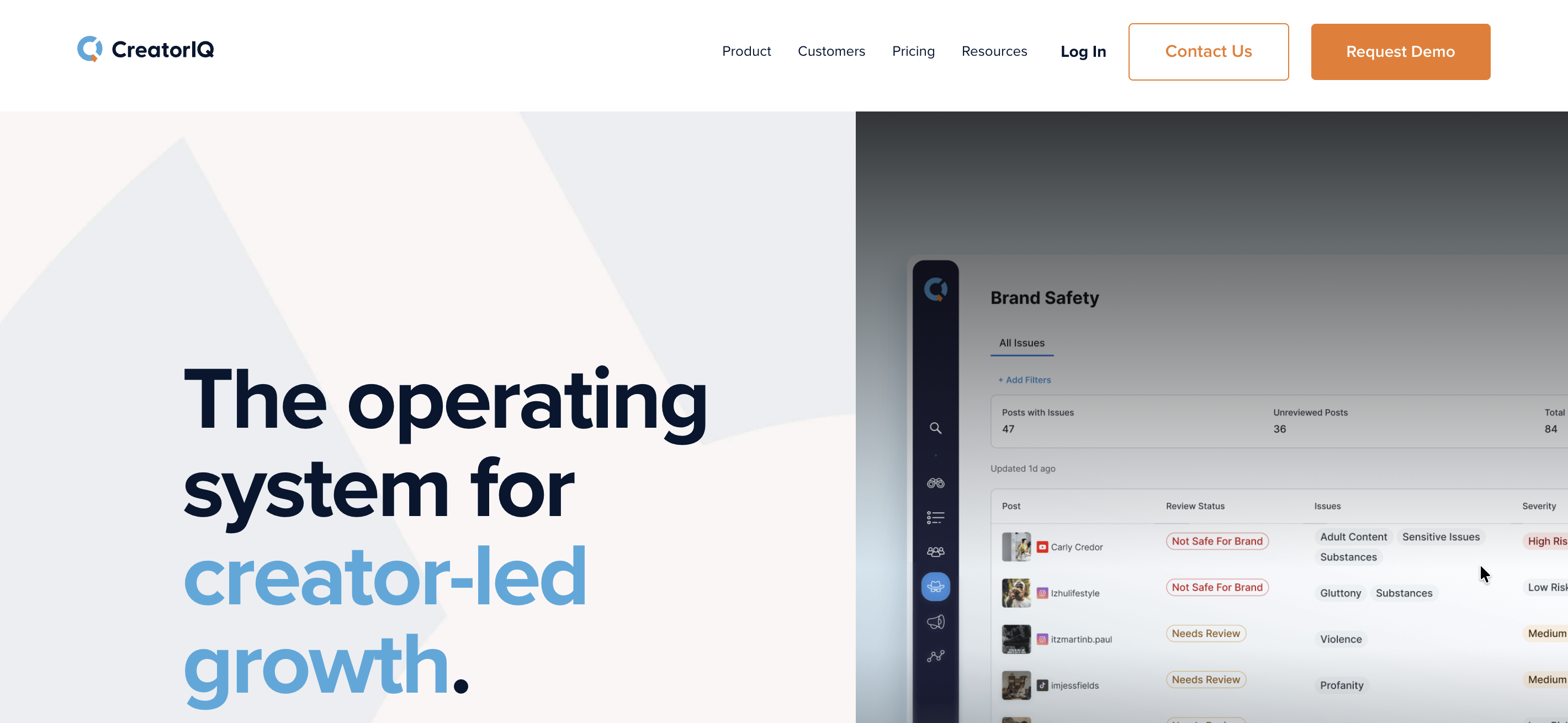
CreatorIQ is the platform you see in the footer logos of very large brand decks. Think Disney, Unilever, Sephora, and a long list of agencies. It is built for enterprise creator programs that span dozens of markets, hundreds of stakeholders, and tens of thousands of creators.
The API and integration story is correspondingly mature. It is firmly an enterprise motion: scoping, security review, MSAs, and a solutions team. Say you are a five-person startup that wants to "just call an API." CreatorIQ is probably not your first stop. But say you are a global brand or holding-company agency that needs reporting to roll up cleanly across regions. Then it very much is.
API & Platform Features
- Discovery across a large indexed creator network with audience and performance filters.
- Campaign management, briefs, contracts, content approvals, and rights management at enterprise scale.
- Integrations with major CRMs, BI tools, and marketing clouds; programmatic access scoped through their team.
- Roll-up reporting across brands, regions, and agencies, which is useful for holding companies.
- Compliance, fraud-detection, and audit features designed for regulated industries.
Pros
- +Built for scale, so the data model and reporting hold up across very large programs.
- +Strong integration and security posture for enterprise IT review.
- +Network and agency relationships make it a safe institutional choice.
Cons
- −API access and documentation are gated behind sales and solutions engagement.
- −Pricing and onboarding overhead are significant; not appropriate for small teams.
- −Power and surface area mean a longer ramp before the platform delivers value.
Pricing
CreatorIQ does not publish pricing. Engagements are enterprise contracts scoped to your program size, regions, integrations, and support needs. Expect a multi-month evaluation and procurement cycle.
What Users Actually Say
Enterprise reviewers praise the depth, the integration support, and the reliability at scale. The criticism is consistent across enterprise tools: cost, implementation time, and complexity for teams that do not need the full surface area.
Best For
Large brands, holding-company agencies, and global creator programs where governance, integrations, and roll-up reporting matter more than self-serve API ergonomics.
Influencers.club: Best for cross-platform creator enrichment and identity at scale
API docs: docs.influencers.club
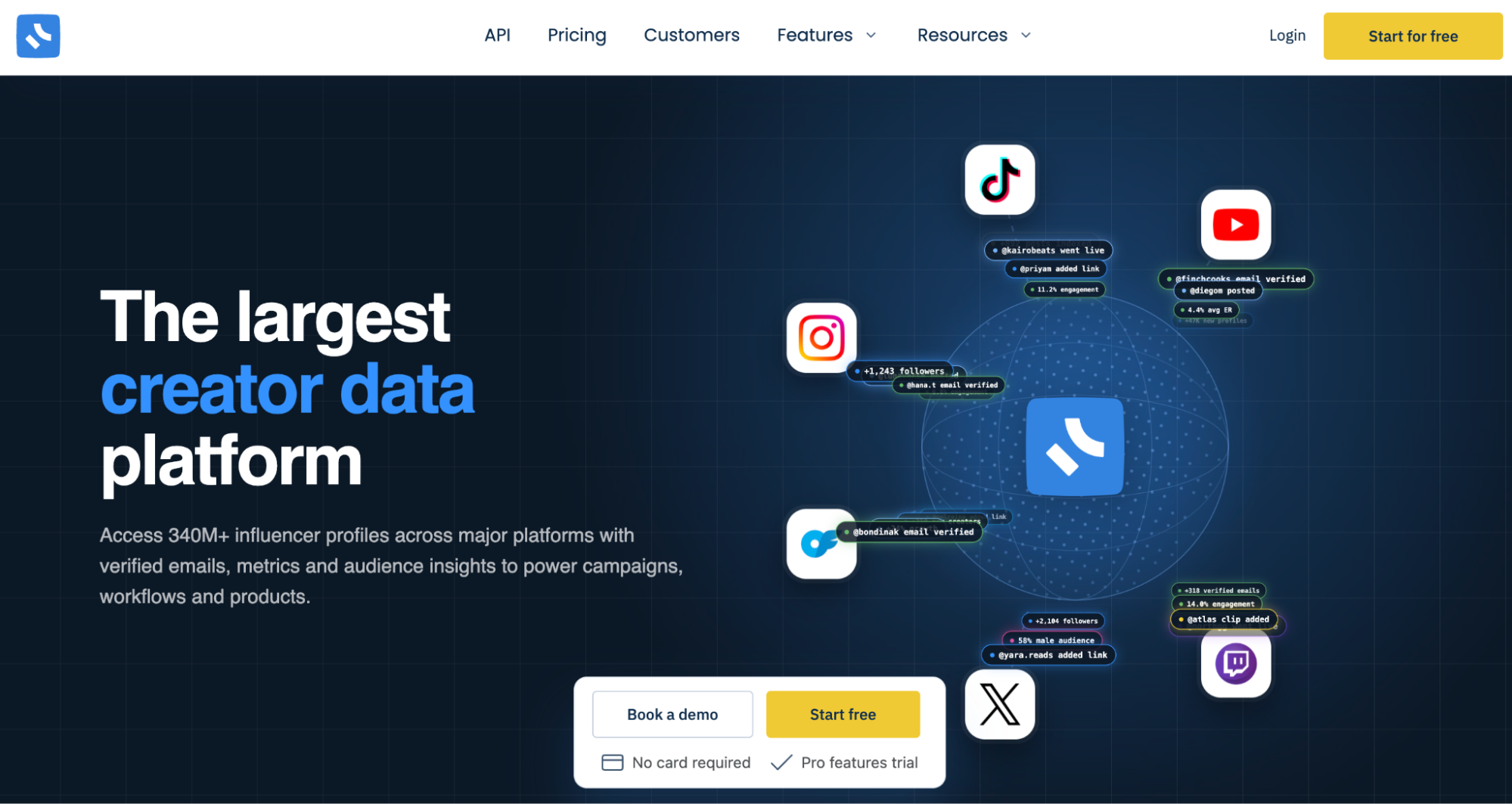
Influencers.club belongs in the same bucket as Modash. It is a data layer, not a campaign suite. But it optimizes for a different axis: breadth. Discovery and enrichment run across 340M+ creator profiles and 47 platforms, from Instagram, TikTok, and YouTube out to Twitch, X, and a long tail most databases never index. Every profile is keyed to a cross-platform identity, so one creator is one record with their other accounts attached, rather than four disconnected rows you have to reconcile yourself. The docs are public and you can get an API key without a sales call.
Say you have 10,000 emails or handles sitting in your signup table and you need to know which of them are creators, how big they are, and where else they post. That is one batch enrichment job, not a scraping project and not a quarter of engineering time. Or you are building a discovery feature and need creators filtered by audience country and engagement, returned with contact info you can act on. What you do not get is contracts, gifting, or payouts. The platform assumes you already have somewhere to put the data.
API & Platform Features
- REST API covering creator discovery, lookalike search, single and batch enrichment (up to 10,000 handles or emails per job), post-level engagement data, and credit/usage endpoints.
- Enrich by handle or email returns the creator's full cross-platform social graph: connected accounts, follower counts, growth trends, posting frequency, and verified contact info, covering every linked account rather than the single profile you looked up.
- Coverage across 47 platforms, so niches that live on Twitch or X are queryable through the same endpoints as the big three.
- Discovery filters for audience location, age and gender, engagement signals, follower growth, keywords in public bios, brand mentions, monetization flags (TikTok Shop, YouTube monetization), and link-in-bio content.
- MCP server plus native integrations with HubSpot, Salesforce, Snowflake, Zapier, Clay, and n8n.
- Campaign tracking runs through the same API. Monitor creators, posts, and keywords in real time, with webhooks pushing changes to your endpoint instead of you polling for them.
Pros
- +Fully self-serve onboarding: read the public docs, create an account, generate your key, and start calling. Every new account gets 10 free credits usable across discovery, enrichment, and every other endpoint, with no card and no sales call.
- +Platform coverage is the widest on this list by a distance, which matters when the creators your product cares about live beyond Instagram, TikTok, and YouTube.
- +Per-call credit costs are low (0.01 credits per profile on discovery, 0.03 for raw enrichment) and credits roll over, so a high-volume product does not get punished for being chatty.
Cons
- −No creator-relationship workflow. Discovery, enrichment, and tracking are covered, but briefs, contracts, gifting, and payouts are not, so you pair it with one of the platforms above or with your own tooling.
- −Audience insights and fake-follower signals are strongest on larger Instagram accounts and thinner on smaller accounts and newer platforms.
- −Discovery on a handful of the 47 platforms is still filling in. Vet your specific niche during the free trial rather than assuming parity across all of them.
Pricing
Pricing is published on the site, which is rarer in this category than it should be. API access sits on the Pro tier, from $208/month, which also includes full audience data and the CRM and automation integrations. Starter, from $140/month, is dashboard only, so if you are here for the API, Pro is your starting point. Agency is custom. Credits are the unit of account: one credit is one valid export, and API calls are priced by call type, from 0.01 credits per profile on discovery up to 1 credit for a full enrichment. Credits roll over month to month and seats are unlimited. Every new account self-onboards with 10 free credits and Pro features enabled, so you can test the endpoints against your own use case before committing. Check influencers.club/pricing for current numbers before quoting internally.
What Users Actually Say
Reviewers consistently lead with two things: the platform coverage and the hit rate on contact info versus alternatives they tried first. Support responsiveness comes up a lot, particularly around API onboarding. The recurring criticism is credit math, the same complaint every credit-based tool in this category gets. Teams underestimate what a high-frequency workflow will burn until they model it against the credit calculator.
Best For
Product, data, and RevOps teams who need creator data as infrastructure: discovery, enrichment, and cross-platform identity sitting behind their own UI. It fits best when your creators are not confined to Instagram, TikTok, and YouTube. It also suits marketers who are never going to stand up a backend, since the MCP server, Clay, n8n, and Zapier routes let you assemble a working creator workflow without an engineer.
Where does OutlierKit fit next to these platforms?
OutlierKit is not an influencer marketing platform and is not a replacement for any of the five above. None of them should be ripped out for it. What OutlierKit is, is the YouTube intelligence layer you bolt on next to them when you want sharper signal on which channels are actually breaking out, which videos are outperforming a channel's own baseline, and which keywords are trending before they show up in a discovery database.
Concretely, the OutlierKit API exposes outlier scores, channel similarity, keyword research, transcripts, and comments as JSON-in / JSON-out endpoints at 2 to 10 credits per call. The typical pattern teams use:
- Use Modash, Aspire, Upfluence, GRIN, CreatorIQ, or Influencers.club for discovery, enrichment, CRM, contracts, and payments. That is what they are actually built for.
- Use the OutlierKit API to score the YouTube channels surfaced by those platforms. Is this creator's recent video an outlier vs. their own median, or just a normal upload? Are their topics trending or fading?
- Use competitor analysis and content strategy workflows to vet creators before paying them and to track what actually worked after a campaign ends.
If your team is specifically focused on finding YouTube micro-influencers or pricing nano-influencer sponsorships, the OutlierKit data is the part most discovery platforms do not give you natively. That is channel-level outlier signal rather than just follower counts and engagement rates.
The honest summary: pick one of Modash, Aspire, Upfluence, GRIN, CreatorIQ, or Influencers.club based on the table above. If your program is YouTube-heavy, add OutlierKit as the intelligence layer. If it is not, you probably do not need us, and we would rather you know that now than three months in.
Want OutlierKit walked through against your stack?
Book a 30-minute demo with the founder. We'll run the API live and cover how it fits next to Modash, Aspire, Upfluence, GRIN, and CreatorIQ.
Related API resources
OutlierKit API overview
Endpoints, auth, pricing: the full capability map for the intelligence layer.
Build on the OutlierKit API
How SaaS teams wire OutlierKit underneath their own influencer, agency, and creator-intelligence products.
OutlierKit MCP server
The live remote connector. One URL, ten tools, no API key to manage.
OutlierKit + n8n automation
Scheduled creator-vetting, outlier alerts, and reporting pipelines built on n8n.
Claude + OutlierKit prompt templates
AI-assisted competitive analysis with ready-to-use Claude prompts against OutlierKit data.
Sources and method
Features, API access and pricing notes come from each vendor's public site and documentation at publication. The user review notes summarize themes from public G2, Capterra and TrustRadius listings and are not quotes. The ranking weighs documented API access and fit, not a paid integration test.
Sources

Evaluating creator-intelligence APIs for your platform?
Book a 30-minute demo with the founder. We'll walk through the OutlierKit API live against your use case and cover volume and platform-integration pricing.
Ready to grow your YouTube channel?
OutlierKit finds the videos beating their channel average in your niche. Then it writes your title, description and chapters and reviews your script before you record.
Try OutlierKit Free