YouTube Pitch Audit Template: The 3-Slide Deck That Shows a Prospect Their Gap
Prospects don't remember a 30-slide audit. They remember one number and one idea they hadn't thought of.
So this pitch audit template has three slides. Slide 1: where the prospect stands against channels their size, as one number. Slide 2: three proven angles they aren't doing, each backed by an outlier video. Slide 3: the 90-day plan and the first thing you'd test. It uses outside data only, so you need no Studio access, and it takes about an hour to fill. PowerPoint, PDF and an Excel worksheet, free.
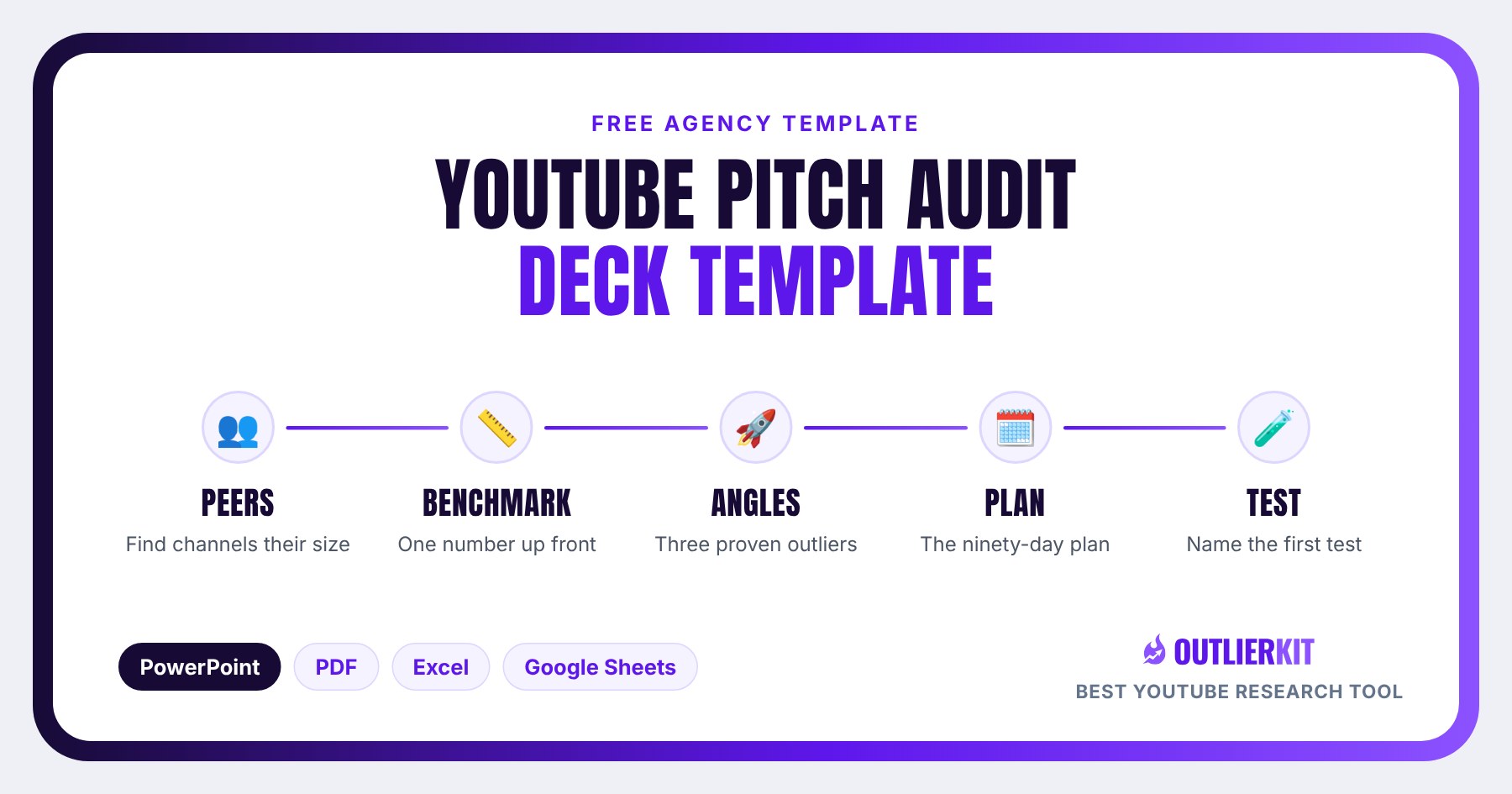
What is a YouTube pitch audit template?
A YouTube pitch audit template is a short deck an agency fills with public data about a prospect's channel and presents before the prospect signs. It shows where the channel stands in its niche, what's already working for similar channels, and what you'd do first.
It's deliberately not a full audit. A full audit needs Studio access and grades everything. A pitch audit makes one argument in three slides: there's a gap, it's closable, and here's the first move. The method behind each slide is in how to audit a YouTube channel for a pitch.
Download the pitch audit deck: PowerPoint, PDF, Excel or Google Sheets
Direct downloads, no email needed. The deck is plain on purpose. OutlierKit has no white-label export, so you paste the findings into your own brand: logo, colours, fonts. That's what the template is for.
Three slides with speaker notes, plus an instructions slide
For the follow-up email or a leave-behind
Size peers, outlier angles, 90-day plan
Copy link delivered by email · best for teams
| Format | Best for |
|---|---|
| PowerPoint (.pptx) | The deck. Three slides plus an instructions slide to delete. Speaker notes carry the script. Opens in Keynote and Google Slides too. |
| The same three slides with notes, for the follow-up email or a printed leave-behind. | |
| Excel (.xlsx) | The research worksheet: size peers with the median formula, outlier angles, and the 90-day plan. |
| Google Sheets | The research worksheet for teams. We email you a copy link. |
What's inside the three slides?
Three slides, the speaker notes behind them, and the worksheet that feeds them. Each part has one way to fill it in well.
Where they stand vs the niche: one number
A single big number: the prospect's average views per video as a share of the median for channels their size in their niche. Three supporting lines underneath, nothing else.
Fill it in well: Pick peers within about 2x of the prospect's subscriber count, never the biggest channel in the niche. A gap against a giant reads as an insult. A gap against peers reads as an opportunity.
Three proven angles they aren't doing
Three angles, each backed by an outlier video from the last 90 days that beat its own channel's average by 3x or more.
Fill it in well: Check the prospect's last 30 uploads before you commit to an angle. Pitching something they already made is the fastest way to lose the room. One angle from a channel their own size is worth two from big channels.
The 90-day plan and the first test
Three 30-day blocks and one named test: a working title, the evidence behind it, and a success line the prospect can check without you.
Fill it in well: End on a test, not a promise. "Beats your channel average by 1.5x within 14 days" is a line they can check. "We'll grow your channel" is a line they've heard from every agency.
Speaker notes with the script
Each slide's notes carry a script and a sourcing reminder, so a junior strategist can present it.
Fill it in well: Read the script once, then put it in your own words. The pitch fails when it sounds like a template, which is ironic for a template.
Research worksheet (Excel)
Three tabs that feed the three slides. The peer tab works out the median and the slide 1 percentage for you.
Fill it in well: Keep the worksheet even after you send the deck. If they sign, it becomes the starting peer set for onboarding and the first monthly report.
Who this template is for, and who it isn't
Use it if
Agencies pitching expert channels
Coaches, consultants, advisers and other experts buy evidence. Three slides of their own niche's data beat a credentials deck.
Freelancers doing cold outreach
Record a five-minute walkthrough of the three slides and send it with the PDF. It gives the prospect a reason to reply.
Strategists pitching a budget internally
Same three slides, different audience. Show your own company's channel against its niche before asking for production money.
Skip it if
You want the method, not the slides
Use How to audit a YouTube channel for a pitch instead: the full method behind each slide, step by step.
The prospect has already signed
Use YouTube client onboarding template instead: the questionnaire and kickoff doc for week one.
You have Studio access and need a full audit
Use YouTube channel audit template instead: a scorecard that uses private metrics like CTR and retention.
How do you fill in the pitch audit in about an hour?
Five steps with a time budget for each. Everything comes from outside data: you only need the prospect's channel URL. The times are my own budget for the workflow with OutlierKit, not a measured average.
Find 8 to 12 size peers (15 minutes)
Run Similar Channels on the prospect's channel with size matching on. Keep peers in the same niche and region, within about 2x of the prospect's subscribers. Paste them into the worksheet's peer tab; it gives you the median and the slide 1 number. Competitor Studio does the same and adds a full niche map if you want a deeper pitch.
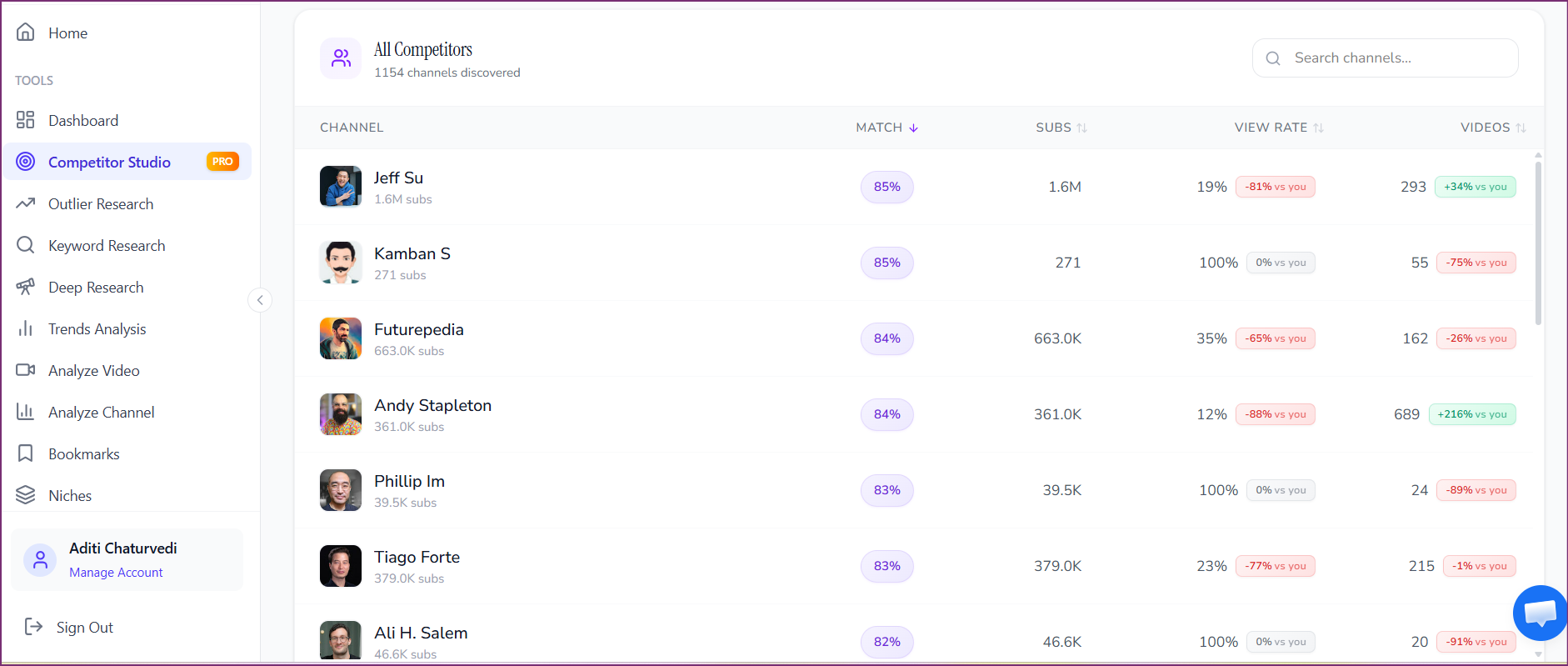
Competitor Studio in action. Click to explore the tool.
Tool for this step: Competitor Studio →
Find three proven angles (20 minutes)
Search the prospect's two or three core topics in Outlier Finder, sorted by relevance, with a minimum outlier score of 3. Log ten candidates from the last 90 days, then name each angle in five words.
Outlier Finder in action. Click to explore the tool.
Tool for this step: Outlier Finder →
Check what the prospect already does (10 minutes)
Pull the prospect's last 30 uploads and cross off any angle they've already used. Note their best recent video too. You'll want it on the call if they say "we tried that".
Channel Analysis in action. Click to explore the tool.
Tool for this step: Channel Analysis →
Back the first test with demand (10 minutes)
Run the first test's topic through Keyword Research. Put the monthly search volume and the source outlier next to the working title on slide 3, then set the success line.
Keyword Research in action. Click to explore the tool.
Tool for this step: Keyword Research →
Brand it and rehearse (5 minutes)
Paste in your agency's logo, colours and fonts, delete the instructions slide, and read the speaker notes once out loud. Export a PDF for the follow-up email.
By hand, step one means searching YouTube for the prospect's topics and opening channel after channel to find ones their size. Step two means sorting each channel's videos by views and dividing by its average. It works, but it eats an afternoon per prospect, and most agencies pitch more than one prospect a week.
What does a filled-in pitch audit look like?
I filled the deck for a real prospect on November 20, 2026: a retirement-planning channel run by a Certified Financial Planner, with about 11,800 subscribers. I'm not naming it. It's a working business, and the point is the method. The research cost 16 credits.
Slide 1: 56%
The prospect averages 7,732 views per video. Similar Channels with size matching found eight US retirement-planning channels with 5,920 to 22,500 subscribers. Their median is 13,695 average views per video. So the prospect gets 56% of what channels their size get. That's the big number, and the three lines under it name the peers.
Slide 2: three proven angles
| Angle | Proof video | Channel | Result |
|---|---|---|---|
| Years of advising, compressed into one video | 15 Years of Advising $2M+ Retirees in 18 Minutes | James Conole, CFP® (217,000 subs) | 48,265 views, 18.1x his recent average |
| Retirees give the advice | The Best Retirement Advice From Retirees | Streamline Financial (221,000 subs) | 165,000 views, 14.9x its recent average |
| One blunt instruction for an age group | I'm a Retirement Planner: My Honest Advice to Anyone Over 50, Diversify Now | Sean At The PeakFP (13,100 subs) | 8,000 views, 18.2x his channel average |
Angle three is the one I'd lead with in the room, because the channel is about the prospect's size. But step three caught something. The prospect's last 30 uploads include a blunt instruction aimed at a wealth bracket: a title telling people with $2M saved to retire now. So angle three isn't new to them in form. It's new in who it targets: an age group instead of a net worth. Say that on the slide. Prospects respect an audit that knows their channel.
Angles one and two passed the check cleanly. Neither format appears in the prospect's last 30 uploads.
Slide 3: the plan and the first test
- Days 1 to 30: two "years of advising" videos and one retirees-give-the-advice video.
- Days 31 to 60: double down on whichever beat the channel average. Add the age-group angle.
- Days 61 to 90: keep the winner, retire the loser, and report against the same eight peers.
- First test: "Retirees who did a Roth conversion: what they'd do differently." Evidence: the Streamline Financial outlier, plus 4,801 monthly searches for "roth conversion". Success line: about 11,600 views within 14 days, which is 1.5x the channel average.
Notice what slide 3 doesn't say. No view targets for the quarter, no promises about leads or clients. It names one test, the line it has to clear, and the date the prospect will know.
Which OutlierKit tools fill the deck, and what does it cost?
For a quick pitch, Similar Channels, Outlier Finder, a recent-uploads pull and Keyword Research cover all three slides. That's the 16-credit example above, and it fits inside the free trial's 30 credits. For a bigger prospect, run Competitor Studio on their channel. It adds the niche map, audience psychographics, Sponsor Intelligence and how peers monetize, which makes slide 2 much harder to argue with.
Competitor Studio is on Pro ($99 a month, 500 credits, 10 runs) and Max ($399 a month, 2,000 credits, 40 runs). An agency pitching a couple of prospects a month while serving one to three clients fits Pro. Pitching weekly on top of four or more client niches is Max territory. Extra credits are $19 per 100.
OutlierKit is a YouTube research and planning tool built for experts, consultants and coaches who use YouTube to share what they know, and for the agencies that run those channels. Once a video is planned, its packaging and script tools write ranked titles, the description and chapters, and review the script before the client records. The MCP connector lets Claude run the same research for each client.
What do you say when the prospect pushes back?
Four objections come up in almost every pitch. The worksheet already holds the answer to each.
"We're too small for that to work."
"Angle three came from a channel with 13,100 subscribers, about your size. It got 18 times its normal views."
"We tried that already."
"Show me the one you made." Then compare its title and opening with the outlier. Usually they made the topic, not the angle.
"Can you guarantee views?"
"No, and nobody honest can. What I can promise is the first test, the line it has to clear, and the date we'll know."
"Why can't we just do this ourselves?"
"You can. This took about an hour. Doing it every month for every video, and acting on it, is the job you'd be hiring us for."
If they sign, the worksheet becomes your starting point. The peer set moves into the client onboarding template and then into the monthly client report, so the number on slide 1 is the number you report against from month one.
Get the Google Sheets worksheet by email
The Sheets edition mirrors the Excel research worksheet, median formula included. Enter your email and we'll send the copy link.
Frequently asked questions
What goes in a YouTube pitch audit?
Three things: where the prospect stands against channels their size in their niche, shown as one number; three proven angles they haven't used, each backed by an outlier video; and a 90-day plan that ends with one named test. Anything more belongs in the paid engagement, not the pitch.
Can I do a pitch audit without access to the prospect's YouTube Studio?
Yes. This template uses outside data only: public subscriber counts, views, upload history and outlier multiples. CTR and retention need Studio access, which you get after they sign. Save those for the full channel audit.
How long does the pitch audit take to fill in?
About an hour with OutlierKit, as budgeted in the five steps: 15 minutes for size peers, 20 for angles, 10 to check the prospect's uploads, 10 for demand, 5 to brand it. By hand, finding size peers and outliers takes most of an afternoon.
How many credits does a pitch audit use?
The worked example on this page used 16 credits: two outlier searches (2 each), one Similar Channels lookup (5), one recent-uploads pull (5) and one keyword lookup (2). That fits inside the free trial's 30 credits. A Competitor Studio run (50 credits, Pro and Max plans) adds the niche map, sponsors and audience profile for bigger pitches.
Should I send the deck before the call or present it live?
Present it live, or record a short walkthrough for cold outreach. Send the PDF after. A deck sent cold gets skimmed, and slide 1 without your framing can read as criticism.
Can I put my agency's branding on it?
Yes. The deck is plain on purpose, with an "[Agency logo]" placeholder and one credit line you can delete. OutlierKit has no white-label export, so agencies paste the findings into their own branded deck. This template is that deck.
Related reading
- How to audit a YouTube channel for a pitch: the method behind each slide
- YouTube client onboarding template: what to send the day they sign
- How agencies use YouTube research: the pitch, report and plan loop
- How to find outlier videos: the evidence behind slide 2
- How to audit a YouTube channel: the full audit once you have Studio access
- Best YouTube marketing tools for agencies: the wider agency stack
- OutlierKit for agencies: plans and workflow for multi-client teams
Fill your next pitch audit in about an hour
See how agencies build all three slides from outside data with Competitor Studio, Outlier Finder and Keyword Research. Book a 30-minute walkthrough with the founder, or start free with 30 credits.
Book a Demo