YouTube strategy for finance educators who keep filming the wrong money lesson
Most finance channels stall for one reason. They teach in the order the educator learned, not in the order people search. The videos that beat channel averages in this niche answer a beginner's exact question, with a number or a step count in the title.
This playbook shows you how to find those questions with OutlierKit, copy the title pattern that already works, and fill a 30-day calendar. The download has every worksheet and prompt.
Published September 8, 2026. By Aditi.
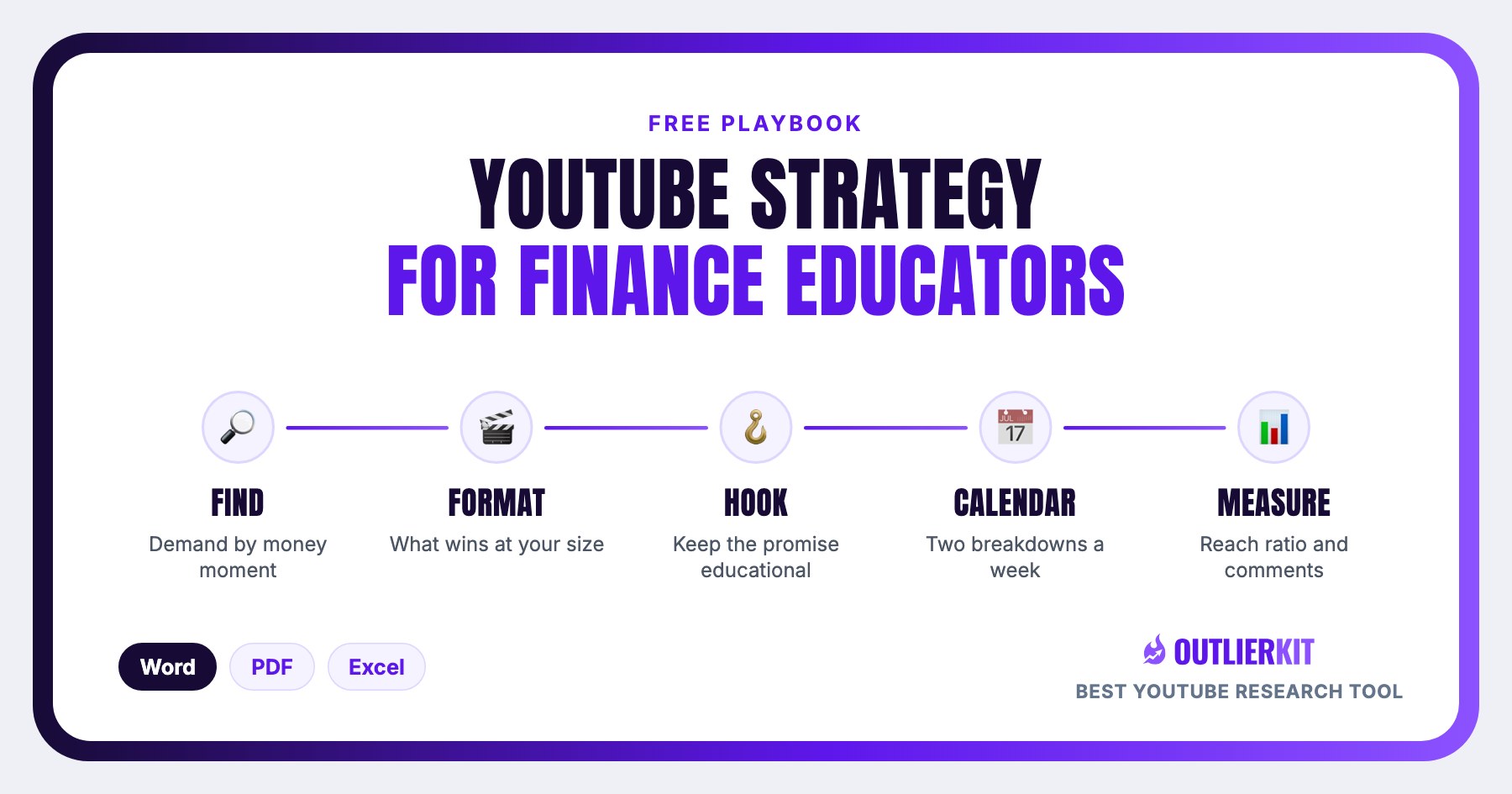
- 1Find the demand by money moment
- 2Pick the format that beats averages at your size
- 3Copy the hook, keep the promise educational
- 4Fill 30 days: two breakdowns a week, one event slot open
- 5Measure by reach ratio and comments, not subscribers
What is a YouTube strategy for finance educators?
A YouTube strategy for finance educators is a repeatable way to choose money topics by demand, package each one so it beats your channel's average views, and measure what worked before you film the next one. It starts from what viewers type into YouTube, not from a syllabus.
It matters more in finance than in most niches. Titles here fail in two directions: too generic (how to invest) or too promotional (why gold now). The videos that break out are specific, educational and dated. That shape is also the compliance-safe one, because a promise to explain is not a promise to return.
Finance channels, broken down
Full breakdowns of four finance educators at different sizes, with the format mix and reach ratio you can measure your own channel against:
OutlierKit Channel Analysis

Nischa
Personal finance
- Subscribers
- 2.2M
- Avg views
- 550.5K
OutlierKit Channel Analysis

Mark Tilbury
Money & side hustles
- Subscribers
- 8.6M
- Avg views
- 6.4M
OutlierKit Channel Analysis

The Plain Bagel
Personal finance & markets
- Subscribers
- 1.2M
- Avg views
- 353.3K
OutlierKit Channel Analysis

How Money Works
Macro & consumer finance (faceless)
- Subscribers
- 1.7M
- Avg views
- 903.1K
Stats are from our most recent snapshot of each channel. Scroll sideways for more. For live numbers, outlier videos, and up-to-date revenue estimates, run a fresh analysis on OutlierKit →
Free download
Download the finance educators playbook
Direct downloads, no email required. The Word and PDF editions hold the full playbook with fill-in fields and a five-prompt pack. The Excel calendar has 30 days pre-slotted with two evergreen breakdowns a week and one event slot held open.
Why finance educators stall on YouTube
Three failures repeat across finance channels of every size. Each one is a packaging problem, not a knowledge problem.
Teaching in syllabus order
Lesson one is what to know first. Lesson seven is what the educator finds interesting. YouTube does not care about the order, so lesson seven gets 3% of lesson one's views.
What it looks like: A channel posts compound interest, then asset allocation, then factor investing. The beginner who found the first video never sees the third.
Generic or promotional titles
How to invest competes with a million videos. Why gold now reads as a pitch. Neither tells a viewer what they will be able to do after watching.
What it looks like: Two videos on the same channel: Investing basics gets 400 views, Starting from zero: how to begin your savings journey on a low income gets 8 times the channel's normal.
Hedging titles into invisibility
Compliance fear pushes educators toward vague titles. The fix is not vaguer wording. It is a specific educational promise, which is both clearer and safer than a return promise.
What it looks like: Six steps for complete beginners is specific and makes no forecast. Double your money in 2026 is specific and a problem. Aim for the first shape.
The five-step playbook for finance educators
The same five steps every OutlierKit strategy uses, adapted to money content: find the demand, pick the format, copy the hook, fill the calendar, measure by reach ratio.
Find the demand by money moment
Search Outliers for the moments people hit before they search: first paycheck, over 50, low income, inheritance, first job, side income. Keep the videos that beat their channel's average by 5 times or more. Those are questions with proven demand and thin answers. Note the exact words in each title.
Tool for this step: Outliers →
Outliers in action. Click to explore the tool.
Pick the format that beats averages at your size
Three formats win in finance: the step-count breakdown (6 steps for beginners), the number-in-title explainer (the 50/30/20 rule), and the reaction to a market event. Filter the outliers to channels near your subscriber count. The format that repeats three times at your size is your format.
Tool for this step: Outlier formats →
Outlier formats in action. Click to explore the tool.
Copy the hook, keep the promise educational
Take the three best titles and swap only the nouns. Beginner, step count, and constraint (low income, in your 20s, over 50) are the parts that carry. Run the phrase through Keyword Research to confirm people type it. Every title should promise understanding, never a return.
Tool for this step: Keyword Research →
Keyword Research in action. Click to explore the tool.
Fill 30 days: two breakdowns a week, one event slot open
Schedule two evergreen breakdowns a week from the demand list. Hold one slot every two weeks for a reaction to whatever the market does, because a same-week reaction is the fastest way a small finance channel gets recommended. Deep Research can draft the first ten titles from your outlier list.
Tool for this step: Deep Research →
Deep Research in action. Click to explore the tool.
Measure by reach ratio and comments, not subscribers
After seven days, compare each video's views to your channel's average. Anything above 2 times is a format to repeat. Then read the comments: in finance, the next video's topic is almost always a question in the comments of the last one. Video Analysis pulls both in one view.
Tool for this step: Video Analysis →
Video Analysis in action. Click to explore the tool.
What the pattern looks like in finance educators' videos
Three videos from three finance channels, all verified on YouTube and pulled from OutlierKit during the Find Your Next Viral Idea session in September 2026. Different channel sizes, the same title shape.
The pattern: [Money task] for complete beginners, with a step count or a constraint in the title. Budgeting for beginners, how to save as a beginner, six steps for complete beginners.
Budgeting for Beginners: Take Control of Your Money Step by Step
Beeravo: Your Finance World, 1,450 subscribers. 21,000 views, which is 14.2x the channel's typical video.
What matters here: The title matches what people type: budgeting for beginners. A 1,450-subscriber channel has almost nobody to recommend it to, so these views came from search.
Pulled from OutlierKit on 4 September 2026; figures drift as views accrue. Published on YouTube 2026-02-10.
How to Save and Budget as a Beginner (2026 Money Reset)
Party Of 1 Podcast, 25,000 subscribers. 54,000 views, which is 23.6x the channel's typical video.
What matters here: The same beginner phrase on a larger channel, 23.6 times normal. The phrase did the work at both sizes.
Pulled from OutlierKit on 4 September 2026; figures drift as views accrue. Published on YouTube 2025-12-19.
How to Start Managing Your Money | 6 Steps for Complete Beginners
Michela Allocca, 88,200 subscribers. 66,300 views, which is 6.2x the channel's typical video.
What matters here: Six numbered steps and the words complete beginners on an 88,200-subscriber channel. 6.2 times normal.
Pulled from OutlierKit on 7 September 2026; figures drift as views accrue. Published on YouTube 2026-08-16.
A 1,450-subscriber channel, a 25,000-subscriber channel and an 88,200-subscriber channel got 14.2, 23.6 and 6.2 times their normal views from the same promise. That is a pattern, not luck. Your version swaps in the money task you teach best.
10 YouTube video ideas for finance educators, backed by what is going viral in beginner personal finance
We pulled the 12 videos beating their own channel's average in beginner personal finance on 8 September 2026, worked out why each one won, and turned the patterns into ten titles you can film in order. Every video links to YouTube, and every idea names the outlier it is modelled on.
- Outlier videos analysed
- 12
- Biggest multiple in the set
- 23.6xon a 25.3K-subscriber channel
- Idea number one
- Budgeting for complete beginners: the 6-step first month
The pattern that wins: Beginner beats topic. Every winner names the viewer's level (beginner, from zero, first paycheck) rather than the subject alone.
No signup. The same report exists for thirteen other audiences: see all 14 viral ideas reports.
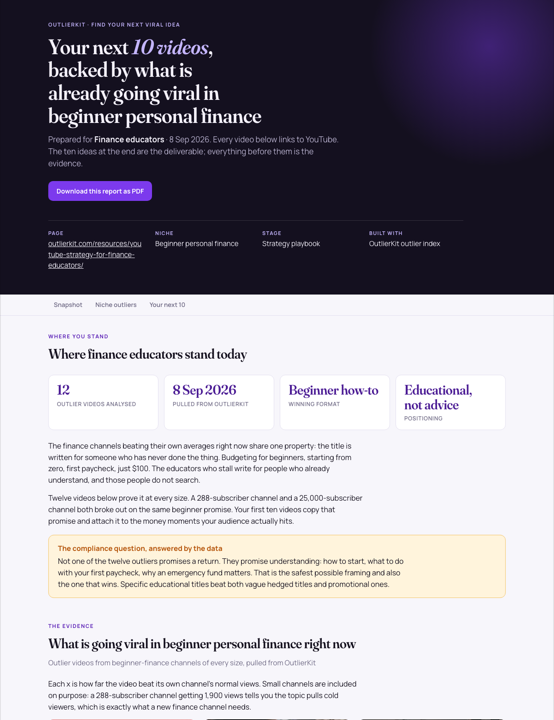 Preview, opens the full report
How to run this in OutlierKit
The whole playbook runs in four screens. A free trial has enough credits for the first pass on one topic.
- 1
Open Outliers and search a money moment
Type the moment, not the topic: budgeting for beginners, saving on a low income, first paycheck. Sort by outlier score and keep everything above 5 times.
- 2
Filter to channels near your size
A 2 million subscriber channel's outlier tells you little about what a 3,000 subscriber channel can copy. Filter to your range and look for the shape that repeats three times.
- 3
Check the phrase in Keyword Research
Paste the title's core phrase. You want real search demand and weak existing answers. That combination is where a small channel ranks for years.
- 4
Draft ten titles with Deep Research, then schedule
Give Deep Research your outlier list and your audience. Pick the eight best titles, drop them into the calendar download, and film the first one this week.
Before you record: packaging and script tools
Once you pick the idea, OutlierKit writes the packaging and checks your script. You still film and edit the video yourself. The Title tool ranks its titles against real breakout videos near your topic. All four are on every plan and the 30-credit trial. On Pro and Max, the MCP connector also lets Claude run OutlierKit research for you.
Title
Writes 16 titles and ranks them against real breakout videos near your topic, with a score and a one-line reason for each.
Open in the app →How it worksDescription & hashtags
Writes the 150 characters people see and the rest of the description separately, then picks your hashtags.
Open in the app →How it worksChapters
Writes chapter titles that help viewers scan the video and jump to the part they came for.
Open in the app →Script review
Scores the script you wrote and shows what to fix before you record, so you reshoot and re-edit less.
Open in the app →How it works
Do this yourself in Claude
Paste this prompt into Claude with the OutlierKit connector switched on. Replace everything in square brackets with your own niche, channel, or topic. Claude calls OutlierKit for you and writes back the answer.
I teach [personal finance topic, e.g. budgeting] to [audience, e.g. first-job earners in their 20s]. Use OutlierKit to find finance videos from the last 60 days with an outlier score above 8 about [topic]. For the top 5, pull the comments and summarize the three questions viewers keep asking. Then write 8 titles for my channel that answer those questions, each with a specific number or step count, and flag any title that makes a promise I should soften for compliance.
- Tools Claude calls
- outliers_search, videos_comments, videos_get
- What it costs
- about 14 credits. Most calls cost 2 credits and a few cost up to 10, with no daily limits.
Plan requirement: the OutlierKit MCP connector is available on the Pro plan ($99 a month, 500 credits) and the Max plan ($399 a month, 2,000 credits) only. It is not included in Hobby ($49) or the free trial (30 credits). To connect it, open Claude, go to Settings, then Connectors, and add https://outlierkit.com/mcp. The full setup and all ten tools are on the OutlierKit MCP server page, and plans are compared on the pricing page.
Frequently asked questions
What should a finance educator make videos about first?
How do I write finance titles that are specific but compliance-safe?
How many videos a week does this playbook assume?
Which finance channels should I study?
Does the download need an OutlierKit account?
Related guides
The playbook for advisors who manage money and want clients, with retirement case studies.
Who is winning in finance right now, with reach ratios and formats.
The demand-first workflow, with a money coach as the worked example.
The general strategy one-pager and 90-day calendar this playbook extends.
Where finance sits against every other niche on RPM and competition.

Find your first ten finance video ideas today
Start a free trial, run Outliers on the money moment you teach best, and fill the calendar download before the week is out. No credit card.
Start free trial