YouTube Content Strategy Template
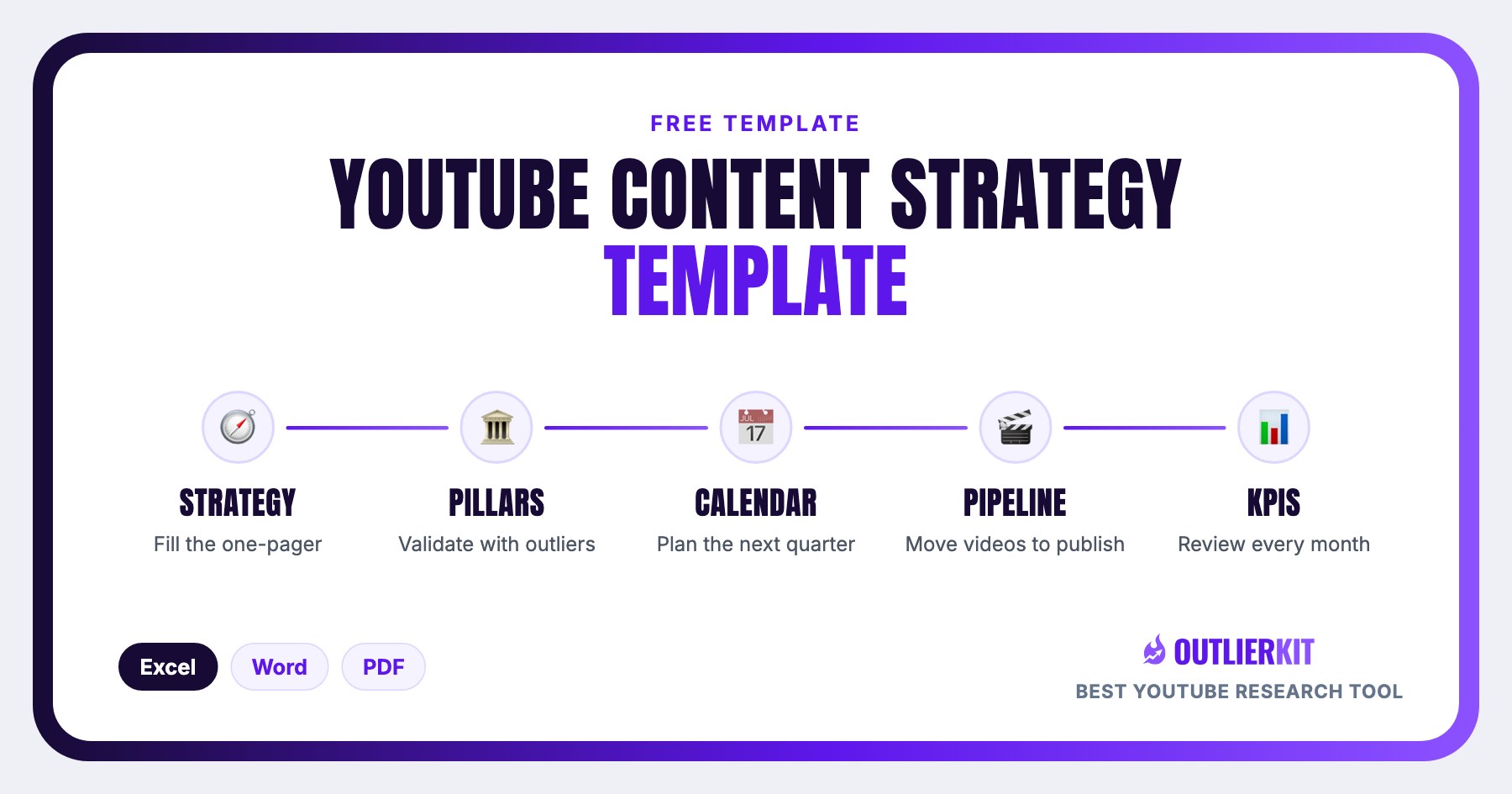
Everything a channel strategy needs in one download: a one-page channel strategy, 3-5 content pillars with proof of demand, a 90-day content calendar, a video production pipeline, and a monthly KPI tracker. Download as Excel, Word, or PDF.
- 1Strategy One-Pager
- 2Content Pillars
- 390-Day Calendar
- 4Video Pipeline
- 5KPI Tracker
What is a YouTube content strategy?
A YouTube content strategy is the documented plan for what a channel publishes, in what order, and on what cadence, the layer that turns a growth strategy into an actual publishing schedule. It has five working parts: a one-page channel positioning statement, 3-5 content pillars with proof of demand, a 90-day calendar, a production pipeline, and a monthly KPI review.
It is worth separating from the two things it gets confused with. A growth strategy decides what you are betting on and why: positioning, audience, format bets. A content calendar is just the dates. A content strategy sits between them: it is where the bets become a publishing plan concrete enough to execute and measure. Without it, a growth strategy stays theoretical and a calendar is filled with whatever came to mind that week.
The template below is that plan as a fillable document. If you need the strategic layer first (how to choose the positioning and pillars the template asks you to name), start with the YouTube strategy framework, then come back and fill this in.
Free download
Download the template: Excel, Word, or PDF
Direct downloads, no email required. All three formats contain the same framework, pick the one that matches how you plan.
What's inside
The strategy one-pager, field by field
The first tab is a single page with 7 fields. Every other tab (pillars, calendar, pipeline, KPIs) executes what you define here. The full one-pager is documented below; the downloads just save you the setup.
Channel mission (one sentence)
[We help AUDIENCE achieve OUTCOME through FORMAT, e.g. ‘We help first-time creators pick profitable niches through data-driven teardowns’]
Forcing audience, outcome, and format into one sentence is the whole test: if you can’t name who it’s for and what changes for them, every downstream decision (pillars, titles, cadence) turns into guesswork.
Fill it in well: If the sentence doesn’t name a specific audience AND a specific outcome, it’s a slogan, not a mission. “Great content that inspires people” fails the test; “we help first-time creators pick profitable niches” passes it.
Target viewer
[Who exactly? Age range, situation, what they type into YouTube search at 11pm]
“Everyone interested in finance” is not a viewer. The 11pm-search detail matters because it captures the moment of real intent: the exact phrasing your titles and thumbnails need to answer.
Fill it in well: Describe one person, not a demographic. “Men 18-34 into fitness” is a media-kit line; “a 26-year-old who just got a desk job, gained weight, and searches ‘workout for beginners at home no equipment’” is a viewer you can write titles for.
Viewer's #1 problem
[The single pain your channel solves better than anyone]
Channels grow by owning one problem, not by covering a topic. Pick the single pain you solve better than anyone: every content pillar you define later must trace back to it.
Fill it in well: Write ONE problem. If you list three, you’ve chosen none: the test is whether your target viewer would read it and say “that’s exactly my situation,” not whether it covers everything you might make.
Your unfair advantage
[Access, skill, data, or story competitors can't copy]
This is your defense against being outspent or out-produced. Access, a rare skill, proprietary data, or a lived story are the things a bigger channel can’t clone by hiring an editor.
Fill it in well: It only counts if a competitor can’t buy it. “I work hard” and “high production quality” are budgets, not advantages; “I ran a restaurant for ten years” or “I have the dataset” can’t be hired away from you.
North-star metric (12 months)
[e.g. 100K subs / 4K watch hours / $5K MRR from the channel]
One number, twelve months out. A single north-star metric settles arguments about what to publish: if a video idea doesn’t move it, the idea waits.
Fill it in well: Pick ONE metric: channels tracking five north stars track none. Subscribers, watch hours, or channel revenue are all valid choices; writing all three means no video idea ever gets vetoed.
Upload cadence
[e.g. 1 long-form per week + 3 Shorts, pick a cadence you can hold for 6 months]
Consistency beats volume. Pick the cadence you can hold for six months without burning out: the 90-day calendar tab is built around whatever number you commit to here.
Fill it in well: Pick the cadence you can hold on your worst month, not your best. Three videos a week during a motivated fortnight followed by a month of silence trains the algorithm, and your audience, to forget you.
Primary monetization
[AdSense / sponsors / product / affiliate / services]
How the channel makes money shapes what you make. A sponsor-funded channel optimizes for niche authority; an AdSense channel optimizes for volume: decide before you plan a single video.
Fill it in well: Choose one primary model, not “all of the above.” A channel optimized for everything is optimized for nothing: you can add secondary revenue later, but the primary model decides what kind of videos you make first.
Tab 2
Content pillars: the form
A content pillar is a repeatable theme with proven demand, not just a topic you like. The pillar table asks for five things per pillar, and the third column is the one that keeps you honest: if you can't point to outlier videos in your niche proving people watch this theme, it's a hobby, not a pillar. Aim for 3-5 pillars that together cover 100% of your uploads.
Example row: illustrative personal-finance channel
A generic example to show how a filled row reads, not a real creator's data. Your pillars come from outlier research in your own niche.
Tabs 3-5
The 90-day calendar and KPI tracker
90-Day Content Calendar
One row per video, 12 weeks ahead. Every upload gets a pillar, a working title, and a primary keyword before it gets a filming date. Fill the Result column weekly: views at 7 days per video is what turns this from a wish list into a strategy, because it tells you which pillars actually earn their share of uploads.
Monthly KPI Tracker
Fill one row from YouTube Studio on the 1st of each month; it takes five minutes. Twelve rows later you have a trend line for subscribers, views, watch hours, CTR, and revenue that tells you whether the strategy is working long before the north-star metric comes due. The workbook also includes a Video Pipeline tab so every idea moves left to right (research, script, filmed, edited, published) instead of stalling half-done. With a team, run that pipeline as a board: the YouTube content calendar for Notion gives every video one owner and a gate between stages.
Is this the right template?
Who this template is for, and who it isn't
Use it if
New channels that need direction before uploading
You haven't published yet, or you've published without a plan. The one-pager forces the niche, audience, and outcome decision before you sink months into videos that don't add up to a channel.
Channels stuck posting consistently without growth
You upload on schedule but the numbers are flat. Pillars plus the monthly KPI review reveal which content actually earns attention and which is just habit, so you can shift uploads toward what works.
Channel managers & teams
Running a channel with editors, writers, or a client involved? The one-pager is the single shared document describing what the channel is, so every title, script, and thumbnail decision traces back to the same strategy.
Skip it if
You haven't picked a niche yet
Use the YouTube Niches Guide instead, pick a niche with data before writing a strategy for it.
You want the strategy driven by competitor data
Use the YouTube Competitor Analysis Template instead, work out what's proven in your niche first, then feed it into this strategy.
You want the full methodology, not the document
Use the YouTube Growth Strategy guide instead, the strategy playbook this template operationalizes.
How to use it
From blank template to a 90-day plan in 5 steps
Fill the strategy one-pager
Answer the 7 fields: mission, viewer, problem, advantage, north-star metric, cadence, monetization. Every other tab executes what you define here.
Validate pillars with outlier data
For each of your 3-5 pillars, find outlier videos in your niche: videos doing 5-10x their channel's average. No outlier proof means no proven demand.
Plan 12 weeks of uploads
Fill the 90-day calendar: one row per video with pillar, working title, and primary keyword. Detail the next 2-4 weeks fully; keep the rest as topics.
Execute the pipeline
Move each video left to right through the production pipeline (research, script, film, edit, publish) so nothing stalls half-finished.
Review KPIs monthly
Fill the KPI tracker from YouTube Studio on the 1st of each month. Double down on pillars that outperform; kill the ones that consistently miss.
Step 2 is where most strategies fall apart: validating pillars by hand means scrolling hundreds of videos. Outlier research surfaces the 5-10x videos in any niche in minutes, so every pillar in your table has proof behind it.
Frequently Asked Questions
How often should I revisit the strategy one-pager?
Review the KPI tracker monthly, but revisit the one-pager itself quarterly. Mission, target viewer, and unfair advantage should stay stable for a year or more; the north-star metric and upload cadence deserve a quarterly sanity check against real results. Rewrite the one-pager only when the data forces it (a pillar consistently outperforming the others, or three straight months of misses), not every time a single video flops.
What should a YouTube strategy include?
A complete YouTube strategy includes seven things: a one-sentence channel mission naming your audience and outcome, a specific target viewer, the number-one problem you solve, your unfair advantage, a 12-month north-star metric, a sustainable upload cadence, and a primary monetization model. From there, 3-5 content pillars and a 90-day calendar turn the strategy into actual uploads.
How many content pillars should a YouTube channel have?
Three to five. Fewer than three and the channel depends on one format that can go stale; more than five and the audience never learns what you stand for. Each pillar must solve a named viewer problem and have outlier proof (videos in your niche performing 5-10x their channel’s average) before it earns a share of your uploads.
How far ahead should I plan my YouTube content?
Plan 90 days of topics but only detail 2-4 weeks fully. The 90-day horizon keeps every upload tied to a pillar and a goal, while the short detailed window leaves room to react: when a video overperforms or a new outlier format appears in your niche, you adjust the plan instead of being locked into it.
Is this YouTube strategy template free?
Yes. The Excel workbook, Word document, and printable PDF all download directly from this page with no signup and no email. All three contain the same framework (the strategy one-pager, content pillars, 90-day calendar, and KPI tracker) so pick the format that matches how you work.
How does OutlierKit help validate content pillars?
The riskiest part of any content strategy is committing months of uploads to unproven topics. OutlierKit finds outlier videos (ones performing 5-10x their channel’s average) across any niche, which is exactly the evidence the “Proof it works” column in the pillar table asks for. If outliers exist for a pillar, demand is proven before you film anything.
Related Resources
YouTube Growth Strategy
The strategy methodology this template operationalizes: positioning, pillars, and the outlier-first approach.
YouTube Competitor Analysis Template
Fill your pillars with competitor-proven formats: the research template that feeds this strategy.
YouTube Strategy: The Framework
The strategic layer above this template: how to choose the positioning and pillars before you fill one in.
All Free YouTube Templates
Script, audit, competitor, and description templates, all free, all downloadable.
Real channel breakdowns
See these strategies in the wild: full data-backed analyses of channels in this niche, including outlier videos, upload cadence, and growth patterns.
OutlierKit Channel Analysis

Marques Brownlee
Consumer Technology & Hardware Reviews
- Subscribers
- 21.1M
- Avg views
- 3.0M
- Total views
- 5.5B
OutlierKit Channel Analysis

Ali Abdaal
Productivity & education
- Subscribers
- 6.6M
- Avg views
- 381.3K
- Total views
- 550.5M
OutlierKit Channel Analysis

Growth In Reverse
Creator-growth teardowns
- Subscribers
- 3.1K
- Avg views
- 1.2K
- Total views
- 99.1K
Stats are from our most recent snapshot of each channel. For live numbers, outlier videos, and up-to-date revenue estimates, run a fresh analysis on OutlierKit →

Validate your strategy before you film
OutlierKit finds the 5-10x outlier videos in your niche: real proof of demand for every content pillar in this template, in minutes instead of weeks of guessing.
Try OutlierKit Free