How Coaches Use YouTube Research to Turn a Channel Into a Client Pipeline
Coaches start YouTube research from the client's end. A creator asks "what should I post?". A coach asks "what is my future client already searching for?". That one flip changes the whole workflow.
We analyzed how coaches and educators use OutlierKit. Coaches lead with keyword research, and no other segment does. They are also the segment most likely to pay for research: when one video brings in one client, the research pays for itself many times over. The winners reach a large share of their audience. Mark Tilbury reaches 74% of his subscribers per video, close to the 0.73x median for beginner personal finance in our reach ratio benchmarks for 7 niches.
What does the coach usage data show?
Coaches and educators use three OutlierKit features most:
58%
use Keyword Research (their #1 feature)
55%
use Outlier discovery
53%
run Channel Analysis
OutlierKit usage data, July 2026. Share of coach and educator accounts using each feature.
Keyword Research on top is the tell. A creator can afford to experiment: if a video flops, they lose a week. A coach loses more, because the channel is supposed to bring in clients. So coaches flip the order. Instead of starting with an idea and hoping people search for it, they start with proof of demand and build the video to meet it.
How do coaches pick video topics?
Find the questions your clients already type
Start in Keyword Research. Type the problem you solve, not your job title. Nobody searches "certified mindset coach". They search "how to stop procrastinating" or "how to price my services". Build a list of 10 to 20 real search phrases, map each one to a stage (problem aware, solution aware, ready to act), and flag the phrases with strong search volume and weak video answers. That last group is your goldmine: high demand plus weak supply means a well-made video can rank for years.
Keyword Research in action. Click to explore the tool.
Tool for this step: Keyword Research →
Find the proven angle with Outliers
An outlier is a video that massively overperformed its channel's normal reach. When a 2,000-subscriber channel gets 300,000 views on one video, the topic and angle did the work, not the audience size. Run your keyword topics through Outliers and look for angles that repeat across channels. One breakout is luck. Three similar breakouts on different channels is a proven format. Note the title and thumbnail patterns on the winners, and the video length the audience rewards.
Outlier Finder in action. Click to explore the tool.
Tool for this step: Outlier Finder →
Study the winners with Channel Analysis
Run Channel Analysis on three to five channels one step ahead of you, not the giants. You want three answers. What share of their videos actually performs, so your expectations stay honest. What their best videos have in common: topic, format, length, timing. And what they ignore, because the gaps in their coverage are openings for yours.
Channel Analysis in action. Click to explore the tool.
Tool for this step: Channel Analysis →
What does the workflow look like for a money coach?
Personal finance is one of the biggest coaching niches on YouTube, and one of the most common niches among OutlierKit users. The demand-first workflow, applied to a money coach who helps people budget and save:
- Keyword Research surfaces what future clients type: "how to start budgeting", "50/30/20 rule explained", "how to save money on a low income". Questions, not topics. Keep the phrases with high demand and thin, outdated answers.
- Outliers shows the proven angle: salary-breakdown and "how I budget my paycheck" formats repeatedly beat generic money tips across finance channels, including small ones. Three repeats across channels is a format, not luck.
- Channel Analysis calibrates against the winners. Nischa (2.2M subs, roughly 550K average views) and Mark Tilbury (8.6M subs) both built their growth on exactly these formats. Study their hit rate, format mix, and cadence.
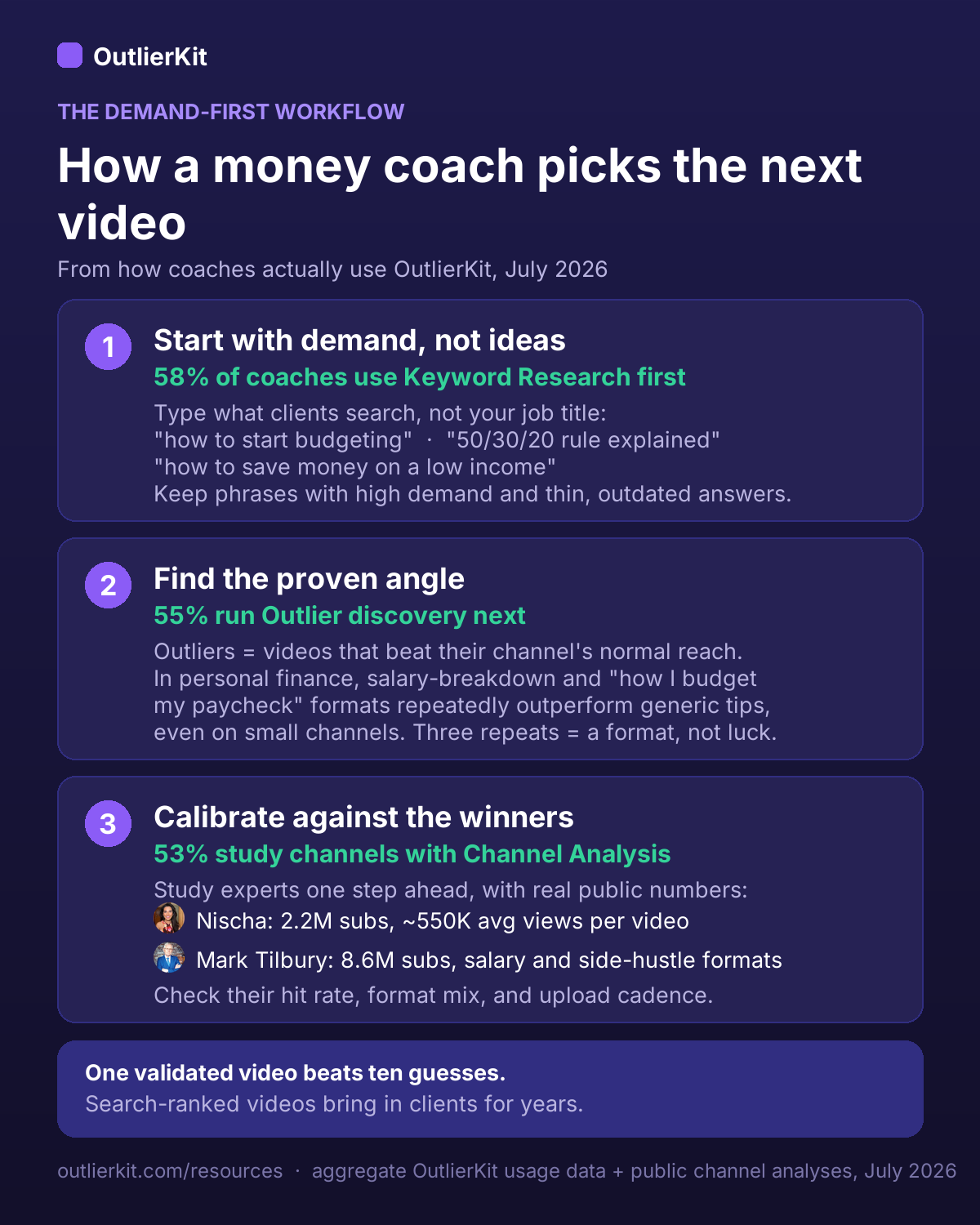
The demand-first workflow at a glance. Save or share it.
That is a green light. You now film one video with confidence instead of ten videos on hope. Coach channels that grow run a filter that only lets validated topics through.
What do winning money channels deliver?
Run Channel Analysis on the two biggest personal-finance educators and the benchmark becomes concrete. All figures are from their live OutlierKit channel analyses:
Accountant turned personal-finance educator. 247 videos, 136M total views.
2.2M
subscribers
550K
avg views / video
25%
of subs reached per video
Money and side-hustle formats. 351 videos, 2.2B total views.
8.6M
subscribers
6.4M
avg views / video
74%
of subs reached per video
Read the percentages, not the subscriber counts. Nischa reaches the equivalent of 25 percent of her subscriber base with every upload, and Mark Tilbury reaches 74 percent. For contrast, many large channels average 2 to 6 percent: John Hammond sits at 2.3 percent and Iman Gadzhi at 6.3 percent on the same measure. The gap is format discipline. Both money channels are built on the exact formats the outlier data surfaces: salary breakdowns, budgeting walkthroughs, and money mistakes. Both win on hit rate rather than volume, and the demand-first workflow copies that.
Frequently Asked Questions
How many videos does a coach need before this works?
Fewer than you think. Search-driven channels win on precision, not volume. Ten videos that each answer a real searched question beat fifty videos filmed on instinct. The workflow matters more than the count: every video should map to a phrase your future clients already type, an angle that has already overperformed for someone, and a gap the winning channels have left open.
Do I need a big subscriber count for outlier research to matter?
No. Outlier research helps most when you are small. An outlier is a video that beat its channel's normal reach, so it shows which topics let small channels outperform their size. That is exactly the situation a new coaching channel is in. Filter for outliers from channels near your size and you get a list of angles proven to work without an existing audience.
Is this different from just doing YouTube SEO?
Keyword research is where the workflow starts, not where it ends. SEO tools tell you which topics get searched. The outlier step adds the part SEO cannot see: which video format actually wins on that topic. Coaches on OutlierKit combine both, which is why their most-used feature is Keyword Research and their second is Outliers.
What should a coach measure instead of views?
Three things. Search share: how much of your traffic comes from search rather than browse, because search traffic compounds. Watch time on your decision videos, meaning the ones closest to your offer. And leads per video: put a clear next step in every video and track which ones actually book calls. One video that brings two clients a month beats ten videos with big view counts and no calls.
Which expert-niche channels can you study?
These are live, data-backed analyses of expert-led and education channels, with outlier videos, cadence, and revenue estimates:
Real channel breakdowns
See these strategies in the wild: full data-backed analyses of channels in this niche, including outlier videos, upload cadence, and growth patterns.
OutlierKit Channel Analysis

Nischa
Personal finance
- Subscribers
- 2.2M
- Avg views
- 550.5K
- Total views
- 136.0M
OutlierKit Channel Analysis

Codie Sanchez
Boring Businesses & Financial Freedom
- Subscribers
- 2.2M
- Avg views
- 427.8K
- Total views
- 406.8M
OutlierKit Channel Analysis

Mark Tilbury
Money & side hustles
- Subscribers
- 8.6M
- Avg views
- 6.4M
- Total views
- 2.2B
OutlierKit Channel Analysis

The School of Life
Philosophy & psychology
- Subscribers
- 9.7M
- Avg views
- 820.6K
- Total views
- 993.8M
Stats are from our most recent snapshot of each channel. For live numbers, outlier videos, and up-to-date revenue estimates, run a fresh analysis on OutlierKit →
Sources and method
The feature shares come from aggregate OutlierKit usage data for July 2026: the share of coach and educator accounts that used each feature. No individual account is named.
Channel figures come from OutlierKit's live channel analyses. The money coach is an illustrative example, not a client engagement.
Sources
- Nischa channel analysis: subscribers, average views and reach per video
- Mark Tilbury channel analysis: subscribers, average views and reach per video
- John Hammond channel analysis: the 2.3% comparison
- Iman Gadzhi channel analysis: the 6.3% comparison
- OutlierKit reach ratio benchmarks: views per subscriber medians across 7 niches

Related reading
Find what your future clients already search for
Run the demand-first workflow on your niche: keyword demand, proven outlier angles, and the gaps winning channels left open. Free trial includes 30 credits.
Try OutlierKit Free