YouTube strategy for music production houses whose catalog competes with itself on one channel
Studios and production companies upload every release to one channel with the song title as the video title. The catalog competes with itself, nothing reaches beyond existing fans, and the people who license music never find it. The videos that beat channel averages in music are titled the way listeners search: mood, genre and use case.
This playbook shows you how to research those searches with OutlierKit, split the catalog across three channel types, and schedule releases and evergreen mixes. The download has every worksheet and prompt.
Published September 8, 2026. By Aditi.
- 1Find the demand in the listener's language
- 2Split the catalog across three channel types
- 3Title by use case on the catalog channel, by technique on the studio channel
- 4Schedule by channel type
- 5Measure per channel type, and count clicks to licensing
What is a YouTube strategy for music production houses?
A YouTube strategy for music production houses is a plan for a company that owns a catalog and works with several artists, rather than for a single musician. It separates the catalog channel (long mixes and playlists titled by mood and use), the artist channels (releases), and the studio channel (production breakdowns), and gives each its own audience, cadence and measure.
The split matters because the three audiences search differently. A listener types lofi music for studying. A fan types the artist's name. A producer types how this drum sound was made. One channel cannot rank for all three, and a release-only channel ranks for none of them beyond the fan base.
Catalog music channels, broken down
Full breakdowns of channels built on catalog and mood music rather than a single artist, with the format mix and reach ratio a production house can measure against:
OutlierKit Channel Analysis

Lofi Girl
Lofi & ambient music
- Subscribers
- 15.8M
- Avg views
- 6.2M
OutlierKit Channel Analysis

Soothing Relaxation
Relaxation music
- Subscribers
- 12.0M
- Avg views
- 8.4M
OutlierKit Channel Analysis

Relaxing Music Collection
Ambient White Noise & Study Aid
- Subscribers
- 43.8K
- Avg views
- 441.0K
OutlierKit Channel Analysis

Divyastra Records
Devotional & Meditation Music
- Subscribers
- 17.5K
- Avg views
- 92.5K
Stats are from our most recent snapshot of each channel. Scroll sideways for more. For live numbers, outlier videos, and up-to-date revenue estimates, run a fresh analysis on OutlierKit →
Free download
Download the music production houses playbook
Direct downloads, no email required. The Word and PDF editions hold the full playbook with fill-in fields and a five-prompt pack. The Excel calendar schedules weekly evergreen mixes on the catalog channel alongside release-driven uploads on the artist channels.
Why production houses stall on YouTube
Three failures repeat across studios and production companies of every size. None of them is about the music.
One channel for everything
Releases, mixes and studio content on a single channel confuse the recommendation system about who the audience is. Every upload lowers the average for the next one.
What it looks like: A studio with 40 releases, 6 mixes and 10 behind-the-glass videos on one channel averages 800 views. The same mixes on a catalog channel of their own average 20,000.
Song titles as video titles
A song title is searched by people who already know it. A mood and a use case are searched by everyone else. Catalog videos rank on the second kind of title.
What it looks like: Calming study playlist: chill music for studying, concentration and focus got 9 times its channel's normal views. The same tracks under the album name got the average.
No studio channel, so licensees never arrive
Sync buyers, creators and other producers search for how sounds are made and what a catalog contains. A studio channel of production breakdowns is the only upload type that reaches them.
What it looks like: A how-this-track-was-made breakdown reaches producers and licensees who would never watch the official video, and links them to the licensing page.
The five-step playbook for music production houses
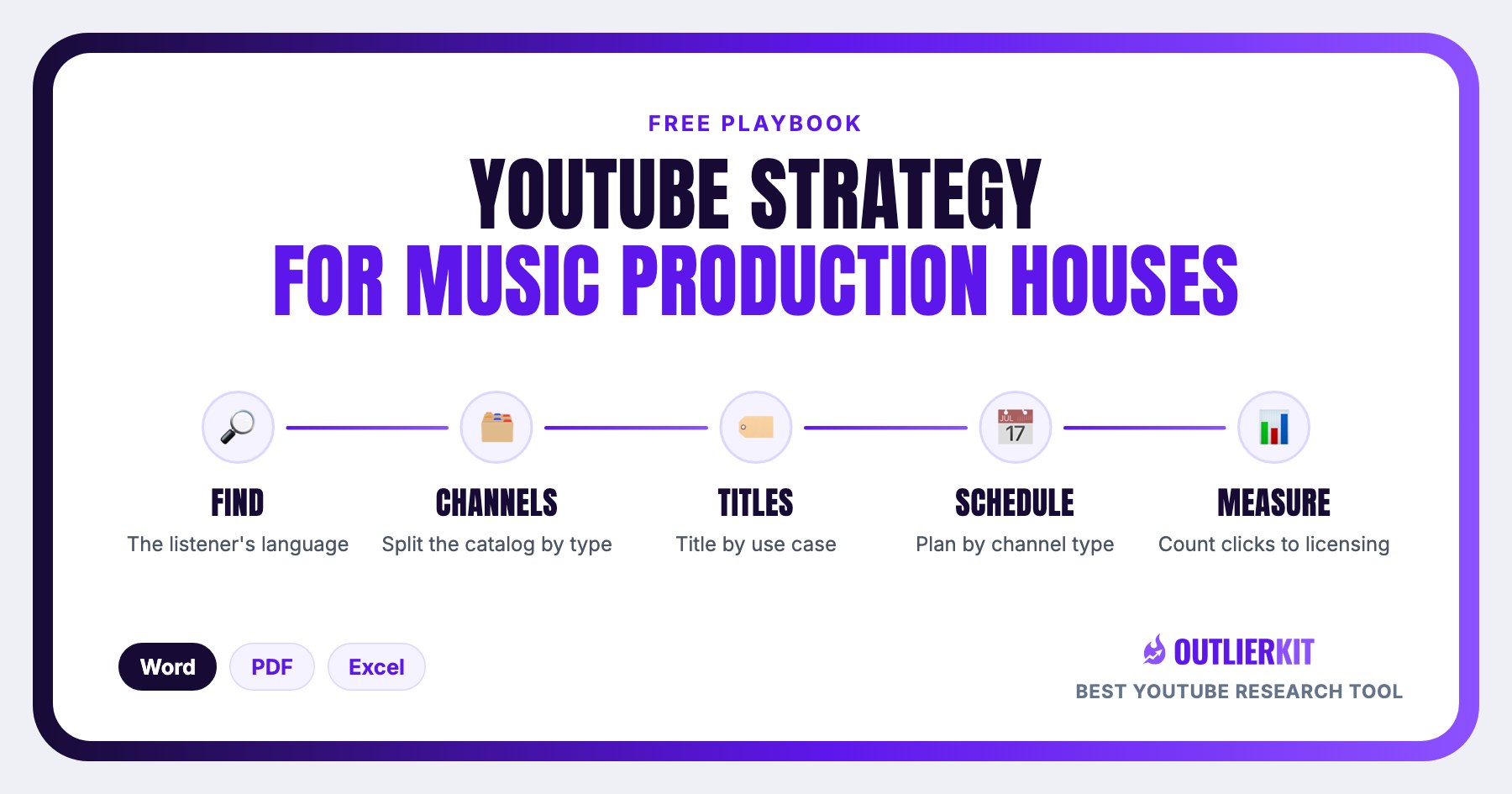
The same five steps every OutlierKit strategy uses, adapted to a catalog business: find the listener's search language, split the channels, title by use case, schedule by channel type, measure per channel.
Find the demand in the listener's language
Run Keyword Research on mood plus use case, not on your artists: music for studying, sleep music, lofi for work, genre type beat. Then search Outliers for the same phrases and keep videos that beat their channel average by 5 times or more. The titles that win are your catalog channel's naming system.
Tool for this step: Keyword Research →
Keyword Research in action. Click to explore the tool.
Split the catalog across three channel types
Catalog channel: long mixes and playlists by mood and use, one to three hours, weekly. Artist channels: releases, lyric videos, live sessions, on the release schedule. Studio channel: production breakdowns, gear and technique, for producers and licensees. Filter the outliers by format to see which of the three has the most headroom in your genres.
Tool for this step: Outlier formats →
Outlier formats in action. Click to explore the tool.
Title by use case on the catalog channel, by technique on the studio channel
Catalog titles carry mood, use and duration: calming study playlist, relax music for deep sleep, one hour, no ads. Studio titles carry the technique: how we mixed the vocal on this track. Artist titles keep the song and add the format: lyric video, live session. Take the three best outlier titles in each type and swap in your genre.
Tool for this step: Outliers →
Outliers in action. Click to explore the tool.
Schedule by channel type
Weekly evergreen mixes on the catalog channel, because they compound on search for years. Release-driven uploads on artist channels, with a lyric video or live session two weeks after each official video. Two studio breakdowns a month. Deep Research drafts the first month of catalog titles from your outlier list and your genres.
Tool for this step: Deep Research →
Deep Research in action. Click to explore the tool.
Measure per channel type, and count clicks to licensing
Compare each video to its own channel's average, never across channel types. Catalog videos are judged on reach ratio and search share over months; artist videos on the first week; studio videos on clicks to the licensing or contact page. Channel Analysis shows all three channels on one screen.
Tool for this step: Channel Analysis →
Channel Analysis in action. Click to explore the tool.
What the pattern looks like in music production houses' videos
Three catalog-style channels at three sizes, pulled from OutlierKit on 8 September 2026 and checked live on YouTube the same day. The smallest has 487 subscribers; the largest has 1.3 million.
The pattern: [Mood] music for [activity], with the genre or the duration attached. The title is the listener's search phrase, not the artist's or the album's name.
Calming Study Playlist - Chill Music For Studying, Concentration, and Focus
Slow life sound, 25,000 subscribers. 54,084 views, which is 9.0x the channel's typical video.
What matters here: Mood plus use case, three times over: calming, study, focus. A 25,000-subscriber catalog channel got 9 times its normal views from a title written in the listener's search language, not the artist's.
Pulled from OutlierKit on 8 September 2026; figures drift as views accrue. Published on YouTube 2025-09-16.
Relax Music Deep Sleep - Study, Relax, Work, De-stress, Just Listen (NO-ADS) 1HOUR
The Sound Of Relaxation, 1,320,000 subscribers. 16,000 views, which is 8.3x the channel's typical video.
What matters here: The same use-case title shape still beats the average on a 1.32 million subscriber catalog channel. Duration and no ads are part of the promise, because the listener is choosing a session, not a song.
Pulled from OutlierKit on 8 September 2026; figures drift as views accrue. Published on YouTube 2026-07-05.
RELAXING NIGHT FOCUS R&B Mix Playlist | Late Night Vibes, Relaxing, Study & Late Working Music
Mellow Night R&B, 487 subscribers. 6,800 views, which is 14.0x the channel's typical video.
What matters here: A 487-subscriber channel with a genre, a mood and a use case in the title got 14 times its normal views. Catalog videos rank on the search phrase, so channel size matters less than the title.
Pulled from OutlierKit on 8 September 2026; figures drift as views accrue. Published on YouTube 2026-07-18.
A 25,000-subscriber channel, a 1.32 million subscriber channel and a 487-subscriber channel got 9, 8.3 and 14 times their normal views from the same title shape. Catalog videos rank on the phrase, so the naming system matters more than the channel size.
10 YouTube video ideas for music production houses, backed by what is going viral in study and relaxation music
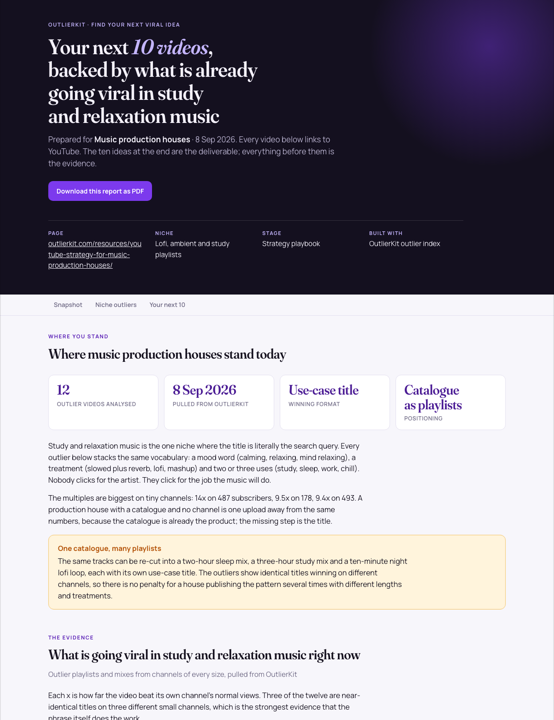
We pulled the 12 videos beating their own channel's average in study and relaxation music on 8 September 2026, worked out why each one won, and turned the patterns into ten titles you can film in order. Every video links to YouTube, and every idea names the outlier it is modelled on.
- Outlier videos analysed
- 12
- Biggest multiple in the set
- 19.6xon a 3.1K-subscriber channel
- Idea number one
- 2026 ultimate mind relaxing lofi beats: study, sleep and chill (part 1)
The pattern that wins: Stack the uses. Study, sleep, chill, work, de-stress: three uses in the title cover three searches.
No signup. The same report exists for thirteen other audiences: see all 14 viral ideas reports.
 Preview, opens the full report
How to run this in OutlierKit
The whole playbook runs in four screens. A free trial covers the first pass on one genre.
- 1
Open Keyword Research on a mood plus a use case
Type the phrase a listener would use for your genre: lofi for studying, ambient for sleep, upbeat instrumental for work. Note the demand and how strong the existing videos are.
- 2
Search Outliers for the same phrase and group by format
Keep everything above 5 times its channel average. Sort the winners into catalog mixes, artist videos and studio breakdowns. The group with the most winners at your size is where the first channel goes.
- 3
Copy the naming system
Take the three best catalog titles and write your own in the same shape: mood, use, duration, no ads. Confirm each phrase in Keyword Research.
- 4
Draft a month of catalog titles with Deep Research, then schedule
Give Deep Research your genres, your outlier list and your release dates. Drop the titles into the calendar download: weekly mixes, release-driven artist uploads, two studio breakdowns.
Before you record: packaging and script tools
Once you pick the idea, OutlierKit writes the packaging and checks your script. You still film and edit the video yourself. The Title tool ranks its titles against real breakout videos near your topic. All four are on every plan and the 30-credit trial. On Pro and Max, the MCP connector also lets Claude run OutlierKit research for you.
Title
Writes 16 titles and ranks them against real breakout videos near your topic, with a score and a one-line reason for each.
Open in the app →How it worksDescription & hashtags
Writes the 150 characters people see and the rest of the description separately, then picks your hashtags.
Open in the app →How it worksChapters
Writes chapter titles that help viewers scan the video and jump to the part they came for.
Open in the app →Script review
Scores the script you wrote and shows what to fix before you record, so you reshoot and re-edit less.
Open in the app →How it works
Do this yourself in Claude
Paste this prompt into Claude with the OutlierKit connector switched on. Replace everything in square brackets with your own niche, channel, or topic. Claude calls OutlierKit for you and writes back the answer.
We are a music production house with [number] artists in [genres]. Use OutlierKit to research the keyword [genre] music for [use case] and find the 10 videos in the last 90 days that most beat their channel average for that search. Group them into catalog videos (mixes and playlists), artist videos (releases, lyric videos, live sessions) and studio videos (production breakdowns). Then recommend which of our three channel types should publish what next month, with 6 titles each written in the pattern that is winning.
- Tools Claude calls
- keywords_research, outliers_search, channels_get
- What it costs
- about 24 credits. Most calls cost 2 credits and a few cost up to 10, with no daily limits.
Plan requirement: the OutlierKit MCP connector is available on the Pro plan ($99 a month, 500 credits) and the Max plan ($399 a month, 2,000 credits) only. It is not included in Hobby ($49) or the free trial (30 credits). To connect it, open Claude, go to Settings, then Connectors, and add https://outlierkit.com/mcp. The full setup and all ten tools are on the OutlierKit MCP server page, and plans are compared on the pricing page.
Frequently asked questions
Do we really need three channels?
Can we use our own tracks in the catalog mixes?
How does this differ from the music labels page?
What about Content ID and monetisation on catalog mixes?
Does the download need an OutlierKit account?
Related guides
Roster benchmarking and format scanning by genre for label teams.
The single-artist release playbook this page extends to a catalog.
What data-driven producers do differently to multiply views.
Current policy on ambient and generated catalogs.

See your genre's search language in one demo
Book a 30-minute demo. We will run Keyword Research and Outliers on your genres live, show you which channel type has the most headroom, and hand you the first month of catalog titles.
Book a demo