YouTube Music Channel Growth Strategy: Playlists, Loops & Search
Music channels grow on YouTube through session time, not virality. Pick one of three paths: mood-branded ambience (the Lofi Girl model), searchable artist support content, or music video essays. Then own a specific mood or question in search, and monetize the listening habit beyond AdSense.
The biggest music channels have “viewers” who never watch the screen, and low playback RPMs push them to earn outside AdSense. The live Lofi Girl channel analysis shows the ambience path at full scale. Our sleep and ambient niche audit found that 58 percent of breakouts in sleep and rain sounds came from channels under 1,000 subscribers. This page is the music edition of the YouTube growth strategy playbook, including the 2026 AI-music rules.
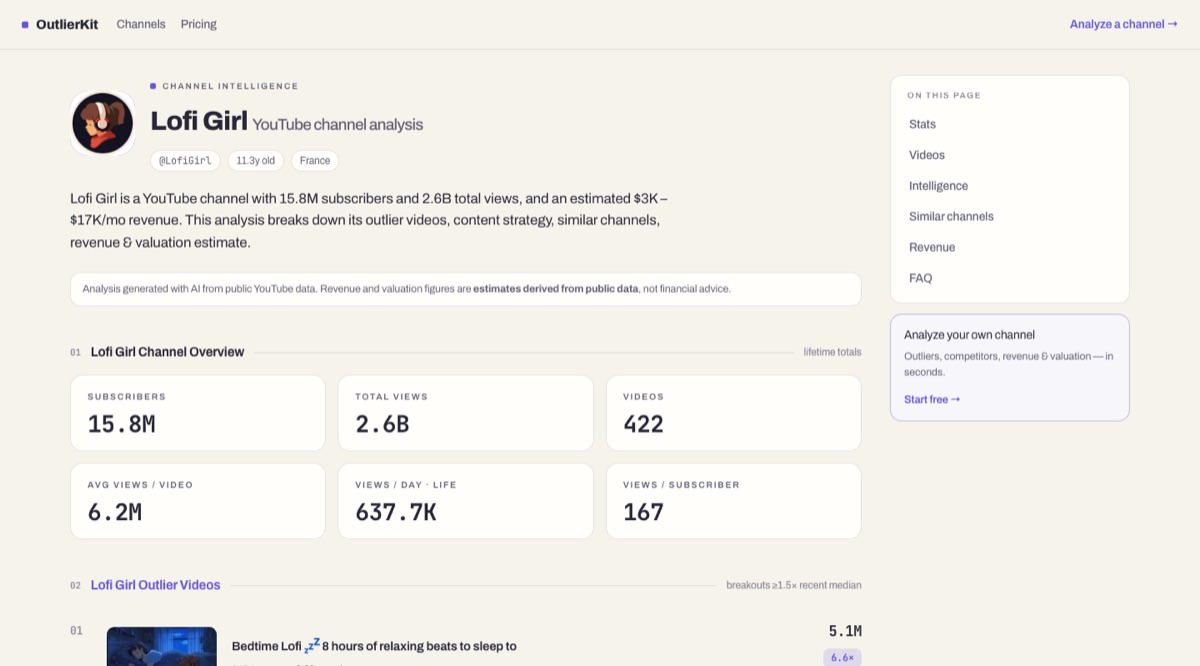
The live Lofi Girl channel analysis on OutlierKit: the ambience path at full scale
Which music channels win on session time?
These analyses show outlier videos, upload cadence, and revenue estimates for channels that already win on session time:
OutlierKit Channel Analysis

Lofi Girl
Lofi & ambient music
- Subscribers
- 15.8M
- Avg views
- 6.2M
- Total views
- 2.6B
OutlierKit Channel Analysis

Soothing Relaxation
Relaxation music
- Subscribers
- 12.0M
- Avg views
- 8.4M
- Total views
- 5.0B
OutlierKit Channel Analysis

Sleepless Historian
Sleep history (faceless)
- Subscribers
- 702.0K
- Avg views
- 130.0K
- Total views
- 41.2M
Stats are from our most recent snapshot of each channel. For live numbers, outlier videos, and up-to-date revenue estimates, run a fresh analysis on OutlierKit →
Which path should a music channel take?
The ambience path: mood-based session time
Lofi Girl and Soothing Relaxation grow differently from normal channels. Viewers arrive through mood searches ('lofi study music', 'relaxing piano'), stay for hours, and return daily. Session time and habit drive growth: long mixes, live radio streams, and consistent mood branding. One well-positioned 3-hour mix can out-earn dozens of standard videos, because watch time compounds and clicks do not.
The artist path: searchable support content
For musicians releasing original work, support content grows the channel far more than raw song uploads. Pair every release with searchable formats: how-you-made-it breakdowns, covers of searched songs in your style, and performance videos targeting instrument or genre queries. The music is the product. The searchable content is the distribution.
The essay path: music as a topic
Polyphonic, Middle 8, and Sideways grow by treating music as subject matter: video essays on artists, theory, and scenes. This path runs the standard growth loop (outliers, keywords, retention) with a music lens. It monetizes far better than music playback, because speech content earns stronger RPM and fits sponsors.
How do you grow a music channel in 5 steps?
Ambience, artist, and essay channels have different viewers, formats, and monetization. A channel that alternates between lofi mixes and music essays confuses the algorithm's audience model and stalls all three. Pick one path per channel; expand only after it's established.
'Jazz' is a genre. 'Jazz for rainy evenings' is a mood someone searches at a specific moment. Music discovery on YouTube is context-driven. Study which mood-keyword combinations have demand with beatable competition. Then brand your channel around the context you can own.
For playback formats, a consistent mood matters more than a hook. Order tracks so they flow, avoid jarring transitions, and use visual loops that reward leaving the stream on. Playlists and live radio streams turn casual listeners into daily sessions. Watch time per viewer is the metric to track, ahead of CTR.
AI-generated music channels multiplied, and enforcement grew with them. YouTube's 2026 monetization rules require disclosure and penalize mass-produced, undifferentiated AI uploads. Meanwhile, AI-assisted channels with real curation, original branding, and consistent quality continue to monetize. If you're building an AI music channel, curation and identity protect you. Upload volume does not.
Music playback RPM is among YouTube's lowest, so the successful channels stack revenue: streaming-platform routing, licensing and sync, merch and vinyl (Lofi Girl's model), and channel memberships for the daily-habit audience. Treat YouTube as the audience engine and monetize the habit it builds.
How do sleep and ASMR channels grow?
Sleep content takes the ambience path to its end point: the audience wants to stop watching. So 8-10 hour formats win, transitions must be smooth, and “boring” is the product. Sleepless Historian's live analysis shows the hybrid opportunity. It merges sleep-paced narration with a content niche (history). This builds an evergreen catalog that compounds for years. For the production workflow, see the AI sleep & relaxation channel guide.
Frequently Asked Questions
What is the best YouTube music channel growth strategy for 2026?
Pick one of three proven paths and commit. The ambience path uses mood-branded mixes and live streams optimized for session time (the Lofi Girl model). The artist path uses searchable support content like covers, breakdowns, and performance videos distributing your original music. The essay path uses music-as-topic video essays, which monetize best. Across all three: own a specific mood or question rather than a genre. Also diversify revenue beyond AdSense early, because playback RPM is low.
How do music channels like Lofi Girl grow on YouTube?
On session time and habit rather than clicks. Ambience channels win mood-based searches ('lofi study music'). They hold viewers for hours with consistent vibe and seamless mixes. They convert them into daily returning listeners via live radio streams and recognizable branding. The algorithm rewards the enormous watch time per viewer. The daily habit monetizes through memberships, merch, and licensing. Ads are not the main driver.
What is the growth strategy for AI music channels like AI Music Diva?
AI music channels grow by pairing generation volume with human curation and a distinct identity. That identity means a recognizable virtual artist, consistent genre-mood positioning, and quality filtering. It matters because YouTube's 2026 monetization rules penalize mass-produced, undifferentiated AI uploads. The rules still allow disclosed, curated AI music. The channels surviving enforcement treat AI as the instrument and branding as the strategy: one virtual persona, one mood territory, consistent visual identity. Full policy details are in our AI music monetization guide.
What is the best sleep and ASMR channel growth strategy for 2026?
Sleep and ASMR is the ambience path at its most extreme. Viewers deliberately fall asleep to your content. So 8-10 hour formats, zero jarring transitions, and dark ambient visuals maximize the session. Target the intent keywords ('rain sounds for sleeping', 'sleep story'). Also study Sleepless Historian's hybrid. It is sleep-paced history narration that merged the sleep niche with storytelling and built a massive evergreen catalog. RPM is modest, but watch-time volume and evergreen shelf-life compensate. See the AI sleep-content workflow for the production side.
Is a 2025 music channel strategy still valid in 2026?
The three paths are unchanged. Here is what changed in 2026. AI-music enforcement got real teeth, with disclosure requirements and demonetization of mass-produced uploads. Auto-dubbing opened essay-path channels to global audiences. Mood-based search demand keeps growing. YouTube cements itself as the default background-audio platform. Ambience and sleep formats are, if anything, stronger bets than in 2025.
Real channel breakdowns
See these strategies in the wild: full data-backed analyses of channels in this niche, including outlier videos, upload cadence, and growth patterns.
OutlierKit Channel Analysis

Polyphonic
Music essays (faceless)
- Subscribers
- 1.1M
- Avg views
- 359.3K
- Total views
- 151.6M
OutlierKit Channel Analysis

Middle 8
Music video essays
- Subscribers
- 719.0K
- Avg views
- 719.8K
- Total views
- 77.7M
Stats are from our most recent snapshot of each channel. For live numbers, outlier videos, and up-to-date revenue estimates, run a fresh analysis on OutlierKit →
Sources and method
The channel examples come from the live OutlierKit channel analyses linked on this page. The sleep breakout figure comes from OutlierKit's sleep and ambient niche audit. The three paths and five steps are editorial guidance drawn from those channels, not a survey of music creators.
Sources
- OutlierKit Lofi Girl channel analysis: the ambience path at full scale
- Sleep and ambient niche audit: breakout rates and who owns the breakouts in sleep and rain sounds
- AI music monetization rules 2026: disclosure and mass-produced content rules

Related reading
Find the mood keywords your channel can own
Keyword Research shows which mood-search combinations have demand and beatable competition. This is the positioning step most music channels skip.
Try OutlierKit Free