How to research a YouTube drama niche before you commit
Most drama channels hit their first plateau within six months. The cause is almost always the niche they picked. A 30-minute Competitor Studio session answers the five questions you need data for before you touch a script.
Creators who build lasting drama channels in 2026 do one thing differently. They check the sub-niche (a smaller, more specific topic) with real data before they spend a year uploading. That means looking at how often hits show up, how much of the niche the big channels own, which sponsors show up, and who already runs paid offers.
Story-led niches can still break out. In our trending niches report, 12.5 percent of sampled true crime and unsolved mystery videos beat their own channel by 10x, second of six niches. Below are the five questions, the 30-minute workflow, and the warning-sign checklist that separate sub-niches you can win from traps.
TL;DR
- Pick a drama sub-niche with data, not a gut feeling.
- A 30-minute Competitor Studio pass answers five questions: viewer demand, channel competition, sponsor fit, paid offers and audience.
- Each Competitor Studio run costs 50 credits.
- If you see two or more warning signs, pick a different lane before you upload anything.
What does each research question tell you?
| Question | What it tells you | Data that answers it |
|---|---|---|
| Demand signal | Are searches and views growing or flat? | Outlier count in last 90 days |
| Supply saturation | How many channels already own the top 50 spots? | Top channels' share of top 50 |
| Sponsor fit | Which types of business reach this audience? | Competitor sponsor list |
| Funnel precedent | Are top channels running paid offers beyond AdSense? | Funnel map output |
| Audience profile | Who watches and why? | Comment intelligence module |
Real Drama & Commentary Channel Breakdowns (Live Data)
Before the checklist, look at the raw numbers. These are full data-backed analyses of drama and commentary channels, including outlier videos, upload cadence, and revenue estimates:
OutlierKit Channel Analysis

Podcast Cringe
Podcast-clip commentary
- Subscribers
- 293.0K
- Avg views
- 337.7K
- Total views
- 96.6M
OutlierKit Channel Analysis

American Redact
Commentary (faceless)
- Subscribers
- 160.0K
- Avg views
- 474.7K
- Total views
- 60.8M
Stats are from our most recent snapshot of each channel. For live numbers, outlier videos, and up-to-date revenue estimates, run a fresh analysis on OutlierKit →
Why do most drama channels die in year one?
The failure usually looks the same. A creator picks a drama sub-niche because they already follow the stories. Maybe it's a creator war, a celebrity feud, or a scene they're part of.
They upload hard for three to six months. They hit a ceiling between 5,000 and 20,000 subscribers. Then the break-out hit they were hoping for never shows up. The reason is rarely video quality or how often they post. It's that the sub-niche was already crowded when they started. Or the audience doesn't click on sponsors. Or stories run out faster than they expected.
Three things drive this. First, drama niches fill up faster than evergreen ones. When a story breaks, ten channels cover it in a week. Then the top two soak up the long-tail search traffic for months.
Second, there are fewer kinds of advertisers in drama than in finance or tech. So sponsor variety dries up before views do. Third, the pool of stories in any feud or fandom runs out. That means the hits slow down, and the creator can't see it from the inside.
Most niche-picking advice online (see how to find your YouTube niche, best niches for beginners, and low-competition niche ideas) assumes you're picking between broad categories. Drama is different. What matters is the sub-niche, not the category. And the data you need isn't shown by search-volume tools. You need outlier data across a whole niche, plus funnel data for each top channel. That's the gap the steps below fill.
Which 5 questions need data before you commit?
You can answer each question below in minutes with the right tool. What matters is answering all five before you pick. Skipping one is the top reason creators pick niches that look good on paper but flop in the feed.
Is demand growing or flat?
Data to check: Count the outlier videos in the sub-niche over the last 3 months. An outlier is a video doing way better than the channel's normal views (3x or more). Compare that count to the 3 months before. A healthy niche makes more break-out hits each quarter, not fewer.
How crowded is the niche?
Data to check: Look at the top 50 videos. What share do the top 5 channels hold? If five channels own more than 60% of the top 50, it's hard to break in. Under 40% means there's room for a new voice.
Which advertisers reach this audience?
Data to check: Pull the sponsor list across the top 10 channels. If 3 or more different types of businesses (like legal tech, VPN, creator tools, or subscriptions) show up again and again, the niche can pay through sponsors.
Do top channels make money beyond AdSense?
Data to check: Check the funnel map for the top 10 channels. Count how many run a Patreon, a paid community, a course, merch, or a newsletter. Zero paid offers at the top is a warning sign.
Who is in the comments and why?
Data to check: Scan comment themes across the top outliers. Are viewers asking for more? Defending the creator? Complaining? Loyal defenders mean an audience worth winning over.
None of these questions can be answered by a single-channel SEO plugin. You need to scan the whole niche. Every channel in the group. Every outlier in the last 90 days. Every sponsor across the top 10. That's the gap Competitor Studio fills. One bonus check after the five: list the three story angles the top channels run. If you can't name a fourth angle a real viewer would want, you'll struggle to stand out before you even upload.
To see how the crowding threshold works, run it on a real group. Seed a channel like American Redact (live analysis above), let the niche map return the peer group, and count how many of the top 50 videos belong to the top 5 channels. The arithmetic: 33 of 50 slots is 66 percent, past the 60 percent line, so entry is hard. 15 of 50 is 30 percent, under the 40 percent line, so there's room for a new voice. The count takes two minutes. The share is what varies niche to niche.
How does the 30-minute Competitor Studio walkthrough work?
The workflow below is exact. Stick to the time limits. Don't go deeper on any one step until you finish all five. The point is to see the shape of the niche, not become an expert in one corner.
30-minute research timeline
Seed one channel (5 min)
Pick one channel that fits the sub-niche you're thinking about. Not the biggest. The most typical. Drop it into Competitor Studio and let the tool build the group. If the group has fewer than eight peer channels, your sub-niche is too narrow. Try a different seed.
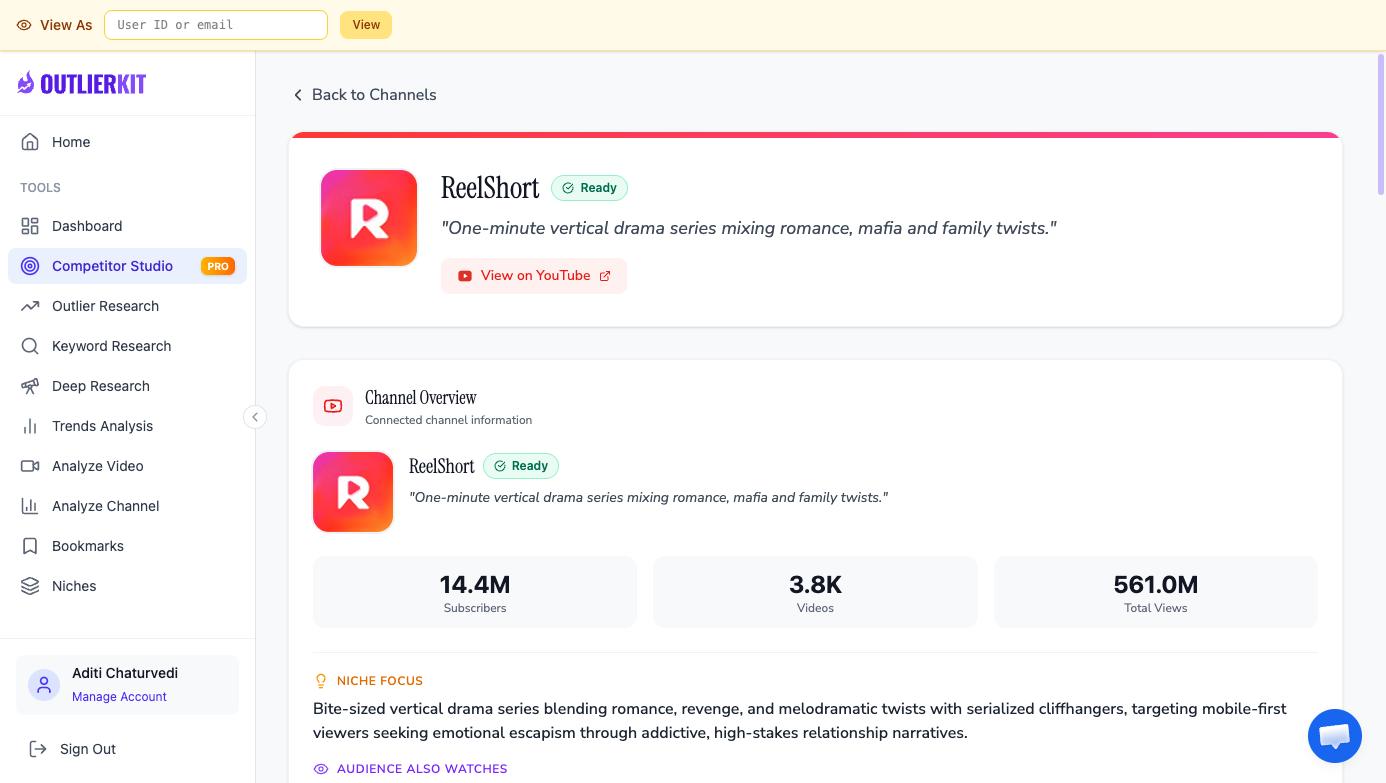
Read the niche map (5 min)
The niche map groups peer channels into clusters. Look for two things. How many separate clusters are in the sub-niche? And are the channels packed tight or spread out? One dense cluster with three big channels means the niche is crowded. Three smaller clusters with mid-size channels is the best shape for new creators. Our Niche Research tool shows the same cluster data if you want a second view.
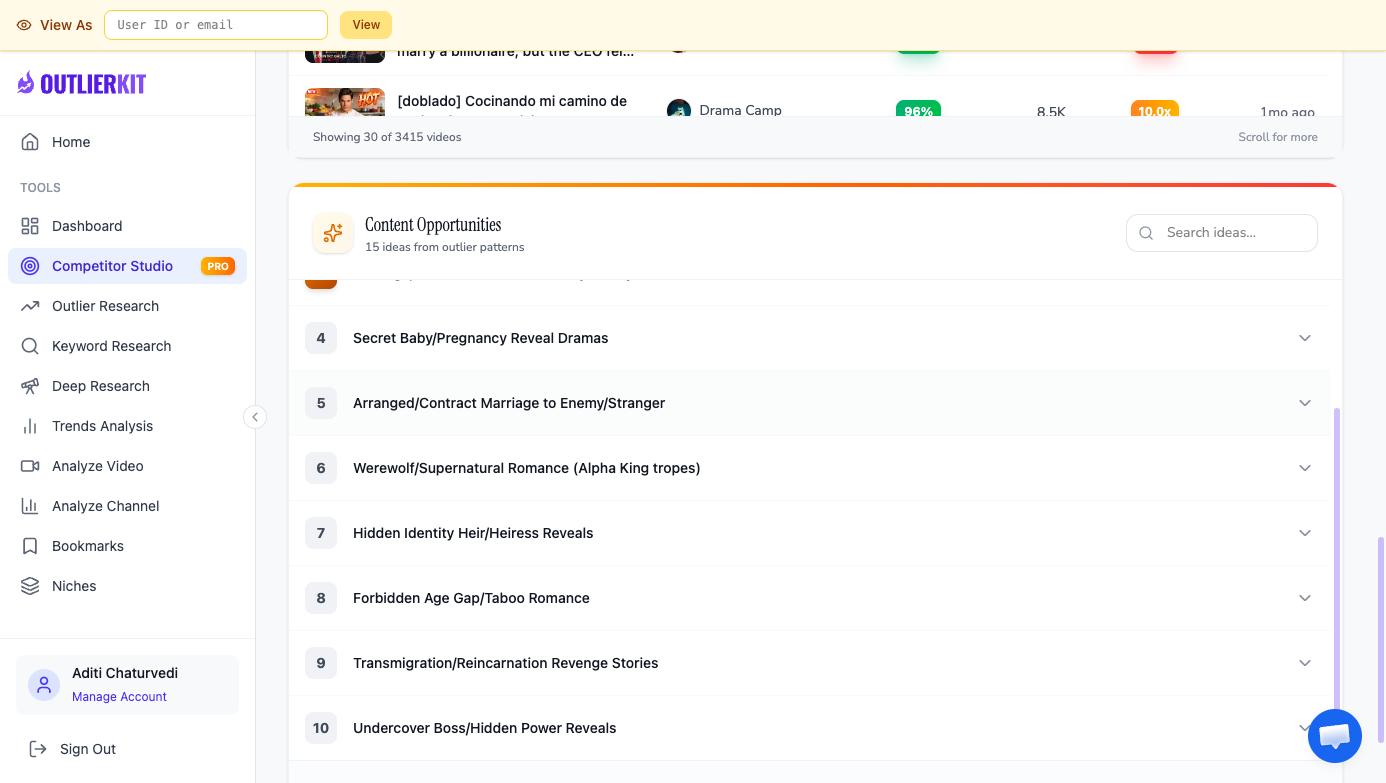
Scan outlier videos (10 min)
Pull every video in the group with 3x or more the channel's normal views over the last 90 days. Sort them by how big the jump was. This is the most important step. Look for three things. Is the list growing or shrinking versus the last 90 days? Are the hits stuck on one story, or spread across many? Are mid-size channels making hits, or only the giants? Our Outlier Finder shows the same ranking if you want to slice it apart.
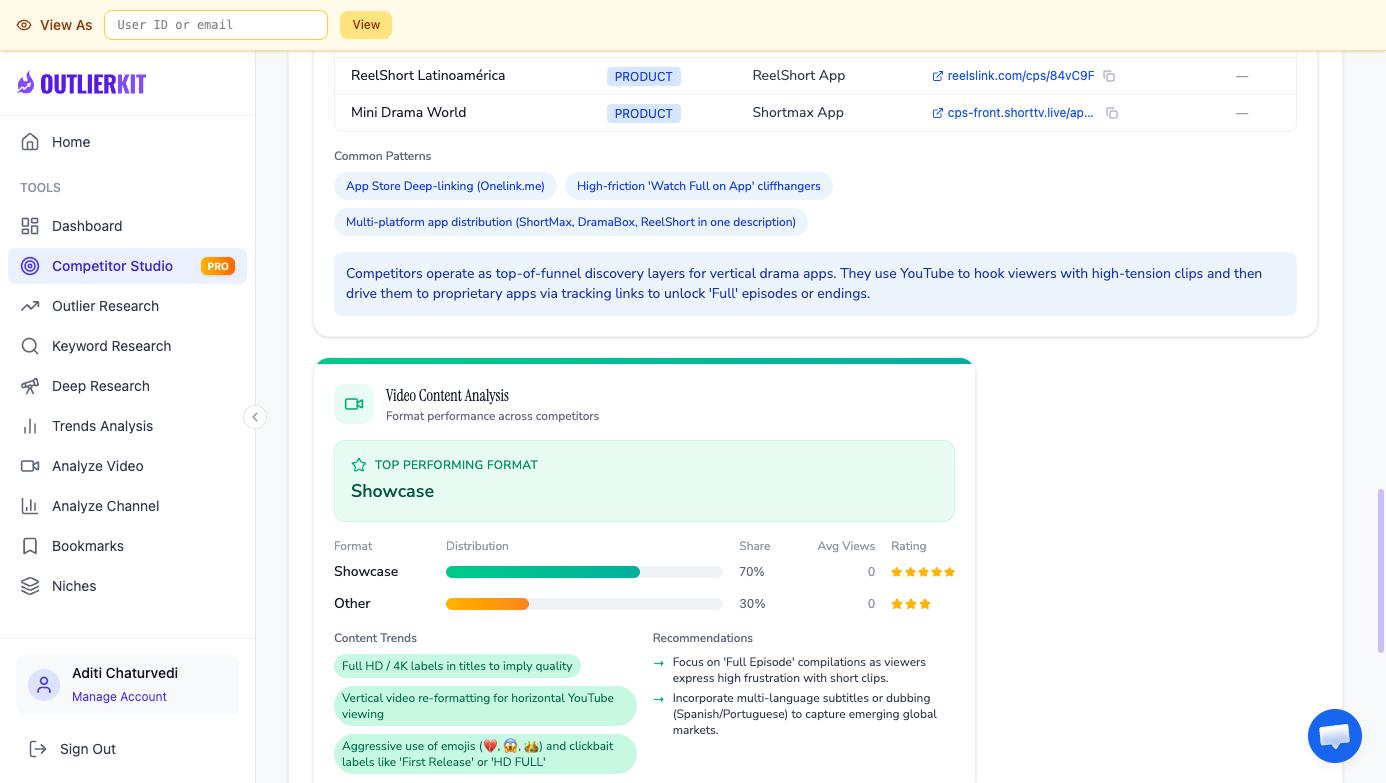
Check sponsor and funnel data (5 min)
Open the sponsor list and funnel map for the top 10 channels. Count how many different types of business appear. Count how many of the top 10 run a paid offer beyond AdSense. Two or more business types plus at least one paid offer means the niche can pay. Zero paid offers means you'll live on AdSense alone. Check our drama RPM and CPM benchmarks to see if that ceiling fits your goals. RPM is dollars earned per 1,000 views.
Read comment intelligence (5 min)
Scan the comment themes across the top outliers. Look for repeat questions (free video ideas). Count defenders vs. attackers (loyalty check). Spot any unmet requests that show up again and again. A good comment theme has at least one repeat question the top channels haven't answered. That's your opening.
Which warning signs and go signs should you look for?
After your 30-minute pass, check your findings against this list. Two or more warning signs? Pick a different lane or a different seed channel. Three or more go signs with zero warnings is the clearest green light you'll see in a fast-moving category like drama.
Red flags: don't enter
Top 3 channels own more than 70% of top-50 positions
Search and suggested slots are locked up. New uploads rarely break through.
Outlier frequency dropping quarter over quarter
The audience is shrinking, moving to another format, or running out of fresh stories.
Fewer than 2 advertiser verticals in sponsor inventory
A niche with only one kind of sponsor is one policy change away from a revenue crash.
Zero funnel offers across the top 10 channels
Either the audience is too small to buy, or they don't convert. You'll be stuck with AdSense only.
Comment themes dominated by hostility or legal threats
Lots of moderation work, higher chance of losing ads on a video, and more strike risk.
Green flags: data says go
A mid-size channel (50K to 300K subs) produced the top outlier
Shows the giants don't own the niche. Good execution still wins here.
Outlier frequency up 20% or more over the prior quarter
Demand is rising and uploads haven't caught up yet. That's the best window.
3+ advertiser verticals recurring across the top 10
A mix of sponsors means the niche can survive if one category pulls out.
At least one top channel runs a paid community or course
Proves the audience buys more than ads. You have a second income stream to plan for.
Comment themes include specific recurring questions
Unanswered questions are free video ideas and an easy way to stand out.
One extra note for drama. If the sub-niche overlaps a lot with short-form (see vertical micro-drama), run the Shorts outlier pass on its own. Long-form and short-form economies in drama split further apart than in most categories.
Frequently Asked Questions
Research process
How long should niche research take before I commit to a drama channel?
Thirty minutes of focused research beats thirty hours of random browsing. The Competitor Studio workflow has a clear time limit. You seed one channel, read the niche map, scan outliers, check sponsor and funnel data, and review comment themes. If you still can't answer the five core questions with real data after that, the niche isn't ready, or you need a different seed channel.
How many channels do I need to analyse before I have a real signal?
Seed one good channel. Then let the niche map show you the full group. You want about 10 to 20 peer channels in view, plus the top 50 videos in the niche. That's enough to score how crowded it is and how often hits show up. Looking at just 2 or 3 channels alone is almost always misleading. You can't see the top channels' share of the niche until you see the whole group.
What is the single most important metric in drama-niche research?
How often the niche produces break-out hit videos over the last 3 months. It's an early sign for both viewer demand and format health. A niche with rising outlier counts almost always has rising search traffic and rising RPM (dollars earned per 1,000 views) too. A niche with falling outlier counts is shrinking, even if the top channels still look fine on the surface.
Does this research process work for sub-niches I have already started?
Yes. Running it on a channel you already own is often more useful than running it on a new niche. You're checking whether the guesses you made at launch still hold up. If outlier counts are falling, or sponsor types have dried up, the research tells you whether to pivot, double down, or add a second income stream before AdSense drops.
Interpreting results
How do I interpret conflicting signals, for example strong demand but saturated supply?
Treat the five questions like a score sheet, not pass-or-fail rules. Strong demand with a crowded niche means you need a sharper edge. That could be a clear angle, a format the big channels aren't using, or an audience they ignore. Heavy uploads with weak sponsor fit is the more dangerous combo. It caps your income even if you win views.
What if the top channels in the niche are all anonymous or have no obvious funnel?
It usually means the niche runs on AdSense alone and the creators want volume over brand. That's fine if RPMs are high enough. But it caps your upside too, because you inherit the same ceiling. Read our drama RPM guide at /resources/youtube-drama-channel-rpm-cpm/ to decide if that ceiling works for you.
How often should I re-run the research after launch?
Every 60 to 90 days. A drama niche can shift faster than an evergreen one because stories keep changing. Running the five questions each quarter catches crowding, sponsor drift, and comment-tone changes before they hit your revenue. Most creators who plateau skipped this step. They only spotted the problem when their RPM dropped.
Can I skip this research if I already have a large following on another platform?
An existing audience speeds up your start. But it doesn't change how the niche works. Crowding, sponsor fit, and paid-offer history still matter, no matter how fast you can bring viewers in. The five-question pass is cheap insurance, even if you're bringing a million followers. It tells you which sub-niche inside drama will pay off best with your audience.
How do you run your first research session?
Block 30 minutes on your calendar this week. Pick the sub-niche that's pulling at you most. Find one channel that fits. Seed it into Competitor Studio. Walk through the five steps in order. Seed, niche map, outliers, sponsor and funnel, comment intel. At the end, score the five questions against the warning-sign and go-sign checklist above.
If the data sends you back to the drawing board, you just saved yourself a year of uploads. If it sends you forward, you now know the top channels' share, the sponsor types, the paid-offer history, and the audience's questions before you script your first video. That's the full gap between creators who plateau and creators who keep growing. For the money side behind these numbers, see the drama RPM and CPM benchmarks and the 2026 drama trends hub. For broader niche context, see the most profitable YouTube niches breakdown.
Competitor Studio is part of OutlierKit, a research tool built for experts, consultants and coaches on YouTube. It maps a drama niche the same way. When you're ready to run the full workflow, open pricing and pick the tier with niche-wide scans. It's the one line item that pays itself back in the first research session.
Real true-crime and horror channel breakdowns
Analyses of channels in the adjacent commentary, true-crime and folk-horror niches, including their outlier videos and upload cadence:
OutlierKit Channel Analysis

shane
Pop-Culture Docuseries & Conspiracies
- Subscribers
- 18.5M
- Avg views
- 7.8M
- Total views
- 4.4B
OutlierKit Channel Analysis

Polícia Militar do Estado de São Paulo
Law Enforcement & True Crime Action
- Subscribers
- 1.0M
- Avg views
- 171.5K
- Total views
- 309.6M
OutlierKit Channel Analysis

Skull Tales
Hindi Animated Horror Stories
- Subscribers
- 637.0K
- Avg views
- 378.1K
- Total views
- 130.1M
OutlierKit Channel Analysis

Missing Void
Wilderness True Crime & Paranormal Mystery
- Subscribers
- 304.0K
- Avg views
- 222.6K
- Total views
- 40.3M
OutlierKit Channel Analysis

Trikon Tales
Nepali Supernatural Storytelling
- Subscribers
- 254.0K
- Avg views
- 102.4K
- Total views
- 58.7M
OutlierKit Channel Analysis

Nepali Horror Katha
Nepali Folk Horror & Urban Legends
- Subscribers
- 126.0K
- Avg views
- 126.5K
- Total views
- 28.1M
OutlierKit Channel Analysis

جريمة حقيقية
Sensationalist Arab True Crime
- Subscribers
- 108.0K
- Avg views
- 157.7K
- Total views
- 25.1M
Stats are from our most recent snapshot of each channel. For live numbers, outlier videos, and up-to-date revenue estimates, run a fresh analysis on OutlierKit →
Sources and method
The five questions and the warning-sign checklist describe the Competitor Studio workflow on this page. The thresholds are planning rules of thumb, not the result of a survey OutlierKit ran. Channel cards link to OutlierKit channel analyses.
Sources
- OutlierKit trending niches report: 10x outlier rates in six niches, sampled 19 August 2026
- Drama channel RPM and CPM benchmarks: the earnings side of each drama sub-niche
- OutlierKit: most profitable YouTube niches

Related reading
Ready to grow your YouTube channel?
OutlierKit is built for experts, consultants and coaches who share what they know on YouTube. It finds the videos beating their channel average in your niche, then writes your title, description and chapters and reviews your script before you record. On Pro and Max, Claude can run the same research through the MCP connector.
Try OutlierKit Free