YouTube drama channel RPM & CPM: what creators actually earn in 2026
Drama RPM (dollars you earn per 1,000 views) varies 9x across sub-niches. It runs from about $2 to $18 per 1,000 views, based on advertiser fit. The single "drama channel" number you see quoted online is almost never the right frame.
AdSense is only the starting line. The drama channels earning at the top of any range run funnels (the path from free viewer to paying customer). They add sponsor slots, affiliate links, newsletters, and products on top of ads. A legal-drama channel on $12 RPM with 2M monthly views is not the same business as a creator-drama channel on $3 RPM with 2M monthly views. And that's before you count sponsors.
Published RPM tables disagree, so check any single figure against our RPM benchmarks by niche, which put every published range side by side. Below, six drama sub-niches get their RPM ranges from published sources, the sponsor mix and funnel behind each one, and the geography tax that decides whether a $12 RPM channel actually clears $12. If you instead want to know which drama formats are growing fastest right now, start with the 2026 drama trends hub; to pull live outlier opportunities and judge niche viability, see the drama niche research guide.
TL;DR
- Drama splits into six sub-niches, and RPM runs from about $2 to $18 across them.
- Personal finance-drama pays $10 to $18 RPM, and legal-drama pays $8 to $14.
- K-drama recaps, celebrity news and creator drama pay $2 to $6.
- The channels at the top of any range earn beyond AdSense, from sponsors, affiliates and products.
- Drop any drama channel into Competitor Studio to see its sponsor mix, funnel and outlier formats in under ten minutes.
What are the six drama sub-niches?
Each tile below is its own advertiser market. The RPM range shows what the ad auction pays in that market.
Legal / court drama
Entry: High (credibility barrier)
Personal finance x drama
Entry: Medium-High
Revenge & betrayal narration
Entry: Low-Medium
K-drama / C-drama recap
Entry: Medium
Celebrity drama & news
Entry: Medium
YouTube creator drama
Entry: Low
Which drama sub-niches pay best?
| Sub-niche | RPM range (US) | Top monetization beyond ads | Entry difficulty |
|---|---|---|---|
| Legal / court drama | $8-14 | Legal-services affiliates, VPN sponsorships | High (credibility barrier) |
| Personal finance x drama | $10-18 | Brokerage affiliates, course funnels | Medium-High |
| Revenge & betrayal narration | $8-13 | Mobile-game sponsors, AI app affiliates | Low-Medium |
| K-drama / C-drama recap | $3-6 | Streaming affiliates, beauty brand deals | Medium |
| Celebrity drama & news | $3-6 | Generalist advertising | Medium |
| YouTube creator drama | $2-5 | Patreon, merch, Nebula-style direct subs | Low |
Ranges pulled from OutlierKit's 19 most profitable niches analysis, finance niche RPM deep-dive, Lenos 2026 CPM guide, and vidIQ RPM benchmarks. Earnings change with location, video length, and how many mid-roll ads you run.
RPM comparison across drama sub-niches
This chart shows the top of each RPM range against the highest-paying sub-niche. Finance-drama sits at 100. Creator drama sits at about 27.
Bar length shows the top of each RPM range, compared to personal finance-drama at $18.
Why does sub-niche decide RPM more than genre?
YouTube's ad auction runs on keywords and topics, not genres. Advertisers bid on keyword and topic matches. These come from the transcript, title, description, tags, and thumbnail text of a video.
The phrase "drama channel" doesn't show up in any advertiser's targeting list. What shows up is "personal finance," "legal services," "streaming," "mobile gaming," and "beauty."
A 20-minute video that tells a bankruptcy story with retirement-planning tips pulls in brokerages, tax software, credit monitoring, and wealth-management ads.
A 20-minute video that covers a YouTuber's public feud pulls in general ads and the odd VPN spot. Same genre. Different auctions. About 3 to 5 times different RPM.
This is the same pattern OutlierKit showed in the finance niche RPM deep-dive. RPM depends on which advertiser types YouTube can match to your transcript. It does not depend on how big your channel is. Mid-size finance channels often out-earn much bigger entertainment channels on a per-view basis.
"Which drama sub-niche am I really in?" is the most important question for a drama creator's business. Two channels that look the same and have the same viewer count can run businesses that differ by five times.
How to read the earnings of a drama channel you admire
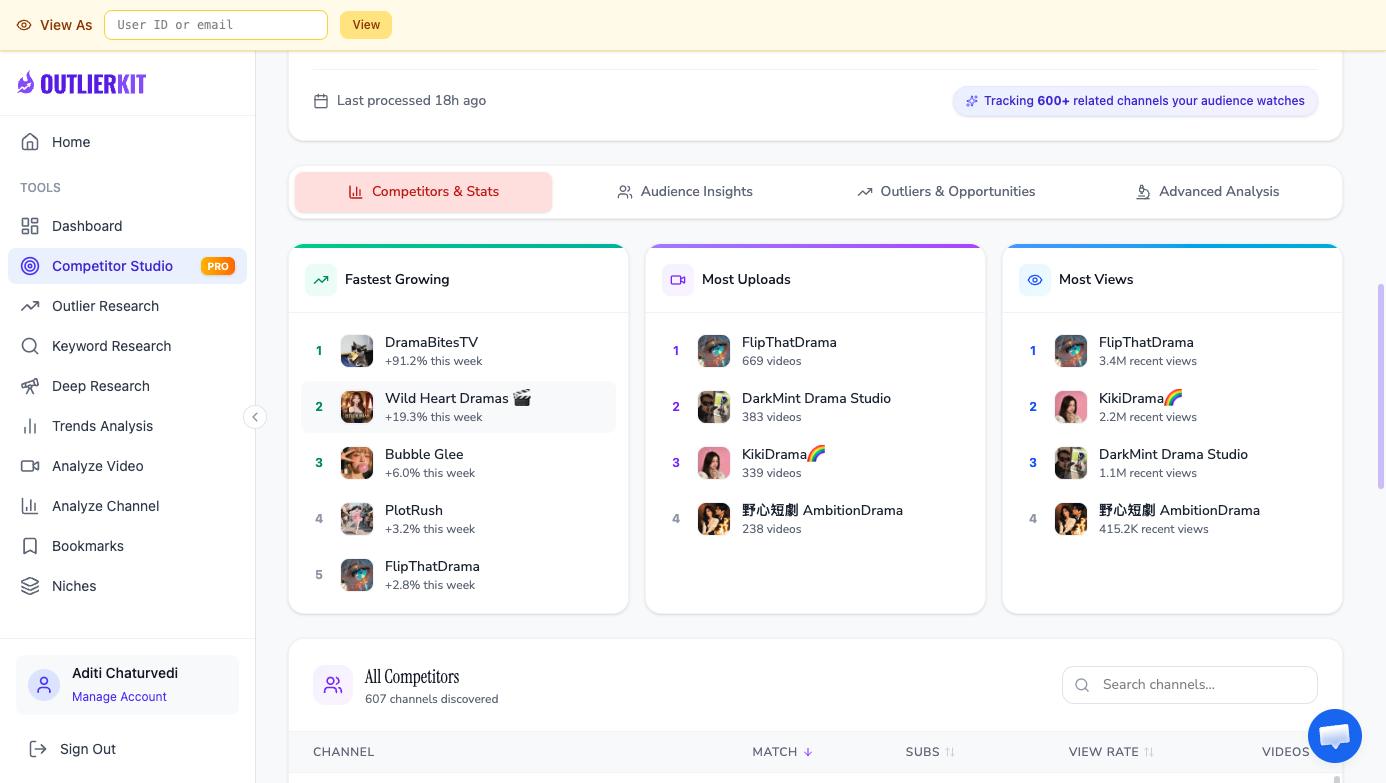
Quoted RPM ranges are a starting point. To pin down what a specific channel actually earns, run this five-step earnings pass inside Competitor Studio. It reads the channel's real sub-niche fingerprint and its full monetization stack: which advertisers keep coming back, and what it sells beyond ads. (For the separate questions of which formats are breaking out and whether a niche is worth entering at all, the drama niche research guide covers the viability and outlier side.)
Drop a channel into Competitor Studio (50 credits)
Paste any drama channel URL into Competitor Studio. The tool pulls its info, video list, and all the ways it makes money.
Read the niche map
See the real sub-niche fingerprint, not the channel's self-description. A channel that calls itself "pop culture commentary" may really be 80 percent celebrity news and 20 percent YouTube creator drama. That changes the RPM you can expect.
Pull outlier videos
Use the outlier finder tool to find videos that beat the channel's own baseline by 3x or more. These are the formats YouTube is rewarding right now in that sub-niche.
Check sponsor intelligence and funnels
Read the Sponsor Intelligence and Funnels and Monetization Mapping modules. They show repeat advertiser types, outside links (newsletters, Patreon, merch stores, courses), and the UTM patterns that show which funnels actually convert.
Read comment intelligence
The comment intelligence module groups repeat viewer questions and complaints. For drama channels, this maps right to which sponsor types will convert and which formats the audience is asking for.
You can finish that research in the time it takes to drink a coffee.
RPM by drama sub-niche, with sources
Each sub-niche below has its own advertiser market. The RPM ranges show what advertisers pay based on topic fit, where the viewers live, and how brand-safe the videos are.
Commentary & reaction drama
Commentary and reaction drama covers the wide commentary channel format. These creators react to news, cultural moments, other creators, or viral clips.
RPM sits in a wide $3 to $8 range. The spread of advertiser types is large. The brand-safety score swings a lot between creators who watch their language and those who don't.
Why advertisers pay what they pay: commentary usually pulls in general ads. The pay goes up when a creator sticks to one topic, like politics, business, or tech, that attracts specific advertisers. The top 10 niches rundown shows commentary as one of the most up-and-down categories for per-view revenue.
Example channels here include big commentary accounts, niche culture commentary, and political commentary channels. Their RPMs cover the full range.
Legal / court drama
Legal and court drama sits in the $8 to $14 RPM range. Channels here cover trial breakdowns, true-crime legal analysis, depositions, and case-law explainers.
Advertisers pay more because the audience shows intent in high-value areas: legal services, identity protection, VPNs, and sometimes financial products.
Why advertisers pay what they pay: YouTube's auction matches transcripts with words like "contract," "liability," "settlement," and "testimony" to legal-services advertisers. That auction gets expensive because one new client for a law firm can be worth thousands of dollars.
Example channels: LegalEagle, JCS Criminal Psychology.
Celebrity drama & news
Celebrity drama and news sits in the $3 to $6 RPM range. The format covers pop culture breakdowns, celebrity feuds, and entertainment-news recaps.
Why advertisers pay what they pay: the auction is mostly general ads. Mobile apps, streaming promos, and consumer goods fill most slots. The brand-safety score is often mixed. Rumors, speculation, and conflict topics make some advertisers bid less. The good news is that Shorts spread well in this category. That pushes up top-of-funnel views.
Example channels: Spill, Popcrave-style news accounts.
Revenge & betrayal narration (high-RPM sleeper)
Revenge and betrayal narration is the quiet winner in the drama space. RPM sits in $8 to $13.
The format is narrated true-story videos, often pulled from forums or sent in by readers. It pulls in strong sponsor demand from mobile games and AI apps on top of AdSense.
The trending niches breakdown shows the steady demand. The automation niches analysis points to a $12.82 RPM number for Reddit-style narration at scale.
Why advertisers pay what they pay: the audience is very engaged. Watch time per video is long. The transcripts match mobile-game and AI-app advertiser bids, which pay well on app installs.
Entry is easy because the format doesn't need you on camera. Text-to-speech or voice-over narration is the norm.
Example formats: narrated cheating stories, revenge-on-in-laws narrations, workplace betrayal narrations.
K-drama / C-drama recap
K-drama and C-drama recap channels earn $3 to $6 RPM. The format squeezes full episodes or full series into 10 to 30 minute recaps.
Where the viewers live pulls RPM down the most. Audiences split across Southeast Asia, Latin America, and smaller US and UK shares.
Why advertisers pay what they pay: the auction pulls in streaming, beauty, and lifestyle bids. These pay less than finance or legal. The good news is strong sponsor demand from streaming platforms and beauty brands that target Gen-Z viewers in Asia-Pacific.
Example formats: full-series K-drama recaps, C-drama romance recaps, modern K-drama vs classic K-drama breakdowns.
YouTube creator drama
YouTube creator drama covers feuds, callouts, and scandal coverage of other creators. It sits at the bottom of the drama RPM scale at $2 to $5. This is also where direct income (Patreon, merch, Nebula-style direct subs) becomes the main revenue line, not a side boost.
Why advertisers pay what they pay: brand safety is low. Coverage often has controversy, legal risk, or language that gets the video flagged as limited ads. General ads fill what's left.
The way these channels make up for it is direct fan support. They often earn more from memberships and merch than from ads.
How do drama channels earn beyond AdSense?
If you stop at AdSense, you're reading one line of the income statement.
The drama channels at the top of any range run the full stack. That means sponsor slots, affiliate links, lead magnets, newsletters, services, books, courses, and memberships.
The Funnels and Monetization Mapping module inside Competitor Studio shows every one of these for any channel.
Common patterns across mid-to-large drama channels:
- Lead magnets. A free download or short guide in the description. It collects emails for a follow-up sequence.
- Newsletters. A weekly or twice-weekly email that covers the biggest stories in the sub-niche. It often has its own sponsor slots.
- Services. Legal-drama and finance-drama channels send high-intent viewers to services like consultations, advisory, or course groups.
- Books and courses. Deep-dive content packed into paid products. These keep selling after the news cycle moves on.
- Memberships. Patreon, YouTube memberships, or Nebula-style direct subs. These are the main revenue line for creator drama and low-RPM sub-niches.
The fastest way to see this: run Competitor Studio on two or three channels in your target sub-niche. Compare what each one sells. You get a real map of what actually makes money with that audience.
Which advertisers sponsor each drama sub-niche?
Sponsor types cluster tightly by sub-niche. When you know the sponsor mix, you know the revenue mix. You also know which sub-niche to pick if you want a certain advertiser type.
| Sub-niche | Dominant sponsor categories |
|---|---|
| Legal / court drama | Legal services, financial tools, VPNs, identity protection |
| Personal finance x drama | Brokerages, tax software, credit monitoring, courses |
| Revenge & betrayal narration | Mobile games, AI apps, meditation/sleep apps |
| K-drama / C-drama recap | Streaming platforms, beauty brands, fashion |
| Celebrity drama & news | Generalist advertising, mobile apps, consumer goods |
| YouTube creator drama | Direct (Patreon, merch), occasional VPN and productivity SaaS |
The pattern is steady. The more real-world money the viewer's next step is worth (hire a lawyer, open a brokerage account, install a mobile game and pay), the higher the RPM and the higher the sponsor's bid. Creator drama sits last because the next step is usually emotional, not commercial.
Running a drama network or production house with several channels instead of one? Read this table as a rate-card map. It tells you which advertiser categories to package across a roster and which channels can share one sales sheet: legal and finance-drama channels sell to the same legal-services and brokerage advertisers, while K-drama and celebrity channels pool into streaming and beauty packages. That roster-level view is exactly what the Sponsor Intelligence module returns when you scan each channel in the network.
How does audience geography change drama RPM?
RPM is not the same everywhere. US, UK, Canadian, and Australian viewers usually pay 2 to 3 times the global average. Lenos' 2026 CPM guide shows US viewers often 5 times higher than India or Southeast Asia on similar categories.
For drama creators, this means where your viewers live matters as much as your sub-niche.
A legal-drama channel with a 70 percent US audience sits comfortably in the $10 to $14 part of its range. The same channel with 30 percent US and heavy India or Philippines traffic averages $3 to $5. The bid for a legal-services ad in those regions is a small fraction of the US bid.
Sub-niche choice and viewer geography work together. Revenge narration and celebrity drama scale globally and handle lower-RPM regions well. Legal and finance-drama work best when you aim at US and UK viewers first. Treat international views as a bonus.
Do Shorts or long-form videos pay drama creators more?
The most common mistake drama creators make in 2026 is thinking Shorts will replace long-form revenue. The math doesn't work. Revid.ai's breakdown puts Shorts at $0.01 to $0.07 per 1,000 views. Long-form drama sits at $3 to $14 depending on the sub-niche.
Shorts
$0.01-0.07
per 1,000 views
- New viewer discovery
- New subscribers
- Short-term trend chasing
Long-form drama
$3-14
per 1,000 views
- Can hold sponsor slots
- More mid-roll ads add up
- Main revenue base of the channel
The math is brutal. 1,000,000 Shorts views at $0.04 RPM equals $40.
The same $40 comes from about 3,000 to 13,000 long-form drama views in the higher RPM sub-niches.
Put another way: 1 million Shorts views earns about the same as 30,000 to 70,000 long-form views, based on the sub-niche.
Shorts still matter. They help with discovery, new subscribers, and chasing trends. The best outlier finder tools for Shorts breakdown pairs well if you run both Shorts and long-form.
Just don't treat them as a long-form revenue replacement.
Frequently asked questions
By sub-niche
What is the highest-RPM drama sub-niche on YouTube in 2026?
Personal finance mixed with drama is the top-paying drama sub-niche. RPM (dollars you earn per 1,000 views) usually runs $10 to $18 in US-heavy markets. Videos that mix a story hook (a bankruptcy tale, a market crash recap, a scam exposé) with finance keywords pull in high-paying ads. These include brokerage platforms, trading tools, tax software, and credit products. Legal and court drama sits just behind at $8 to $14 RPM. Legal services, VPNs, and identity protection advertisers bid hard on those keywords too.
Why do K-drama and C-drama recap channels earn less per view?
K-drama and C-drama recap channels usually earn $3 to $6 RPM. Their ad auctions are filled by streaming, beauty, and lifestyle brands, which bid less than legal or finance brands. Their viewers skew younger. The audience is often split across Southeast Asia, Latin America, and parts of Europe, which pulls the RPM down. The good news is volume. A recap format can stack views fast and add sponsor deals with streaming services and beauty brands.
Monetization beyond ads
Is AdSense the main income source for drama channels?
For most mid-size drama channels, AdSense is the smallest of several income lines. Sponsor deals, affiliate links, memberships, and owned products often bring in more than AdSense once a channel passes about 100K subscribers or 500K monthly views. Legal and finance-drama channels show this best. One sponsor slot from a legal-services brand or a brokerage can pay more than a full month of ad revenue.
How do I find what sponsors a drama channel is already running?
Load the channel into Competitor Studio. Open the Funnels and Monetization Mapping and Sponsor Intelligence modules. The tool pulls description patterns, UTM-tagged links, repeat advertiser types, and outside destinations like newsletters, courses, Patreon, and merch stores. That gives you a clear map of how the channel makes money and how often each sponsor slot changes.
Shorts & distribution
Can drama Shorts replace long-form drama RPM?
Shorts usually earn $0.01 to $0.07 per 1,000 views. Long-form drama earns $3 to $14 per 1,000 views depending on the sub-niche. To match the money from 30,000 long-form views in the legal sub-niche, you would need about 3 to 6 million Shorts views. Shorts still help with reach, new subscribers, and chasing short trends. They do not replace the revenue from a strong long-form catalog.
Which drama sub-niches work best as Shorts?
Celebrity drama, YouTube creator drama, and revenge narration work best as Shorts. These formats are already built around hooks, reactions, and short story beats. Legal and finance-drama lose their RPM edge in Shorts. The high advertiser bids that make long-form legal and finance videos pay well do not carry over to the Shorts ad pool.
Research workflow
How do I break down a drama channel I admire?
Drop the channel into Competitor Studio. Read the niche map to see what sub-niche the channel really competes in, not just what it calls itself. Pull its outliers (videos that get way more views than the channel's usual) with the outlier finder to see which formats are breaking out. Then review the sponsor intelligence and comment intelligence modules. The full pass takes about 5 to 10 minutes per channel. It shows the sub-niche, how the channel makes money, audience signals, and content gaps.
Do RPM numbers apply globally or only in the US?
The RPM ranges in this guide reflect US, UK, Canada, and Australia audience weight. Global averages usually run 2 to 3 times lower. A legal drama channel with a 70 percent US audience can sit at the top of the $8 to $14 range. The same channel with a 30 percent US audience and heavy traffic from India, the Philippines, or Brazil often averages $3 to $5.
Your 30-minute drama earnings audit
Before you commit to a drama sub-niche on the strength of its RPM, spend thirty minutes verifying the money side on real channels. Pick three channels that look like the kind of business you want to build. Drop each one into Competitor Studio and focus on the two earnings modules: the sponsor intelligence map (which advertisers keep coming back, and how often each slot rotates) and the funnels and monetization mapping module (the products, paywalls, and lead magnets stacked on top of AdSense).
By minute 30 you'll know the real RPM floor for that sub-niche, which sponsor types you can realistically land, and how the top channels earn beyond ads. That is the earnings half of the decision. The other half, whether the niche is actually viable to enter right now, and which outlier formats are breaking out, lives in the drama niche research guide, and the format-growth picture lives in the 2026 drama trends hub.
OutlierKit is built for experts, consultants and coaches who share what they know on YouTube, and Competitor Studio reads a drama channel the same way it reads theirs. Pricing for Competitor Studio and the other OutlierKit modules is on the pricing page. If you're starting from a list of five or six drama channels you already like, that's plenty to work with.
Sources and method
The RPM ranges combine the published sources above. They are ranges for planning, not figures from a creator survey OutlierKit ran, and they assume a mostly US audience. Earnings shift with audience location, video length and mid-roll count, so check your own YouTube Studio data before you commit to a sub-niche.
Sources
- Lenos 2026 CPM and RPM guide
- vidIQ RPM benchmarks
- Revid: how much YouTubers make
- OutlierKit: 19 most profitable niches
- OutlierKit: finance niche RPM deep-dive
- OutlierKit YouTube RPM benchmarks: every published RPM range by niche, side by side

Related reading
Ready to grow your YouTube channel?
OutlierKit is built for experts, consultants and coaches who share what they know on YouTube. It finds the videos beating their channel average in your niche, then writes your title, description and chapters and reviews your script before you record. On Pro and Max, Claude can run the same research through the MCP connector.
Try OutlierKit Free