Vertical micro drama on YouTube Shorts: the 2026 creator's playbook
Vertical micro drama is an $8 billion global format, per TheWrap. It grew out of Chinese duanju (Chinese short-form drama). ReelShort and DramaBox made it big around the world. Now it's moving onto YouTube Shorts as the free place to find it in 2026.
The market is big and still growing fast. Per Appfigures, short-drama app downloads grew 992% year over year in Q1 2024, to about 37 million, with ReelShort the category leader. The app crossed about $700 million in revenue in 2025.
Monthly users (MAU means monthly users) went from 40 million in October 2024 to 70 million a year later, per TheWrap.
The second shift is AI. Studios like Holywater and MyMuse have said they want to ship about 100 AI-made series per month.
That cuts the budget per series from $150,000-$300,000 by ten times. It also drops production time from 8-10 days down to 1-2 days per episode for a solo creator.
The third shift is where people watch. The BBC and YouTube UK partnership and Klipa AI's 2026 Shorts trends report both flag tall episode-based fiction as a rising Shorts format.
The Shorts feed rewards two things: people finishing videos, and people coming back. Cliffhanger stories are built to do both. There's a first-mover window open right now for creators who can ship full story arcs.
June 2026 update: the AI tool stack moved again this spring, Kling 2.1, Runway Gen-4 Turbo, Google Veo 3.1, and Luma Ray 2 are now the defaults creators reach for, and per-episode generation cost keeps falling. This guide is the full produce-and-monetize playbook. For which drama formats are growing fastest see the 2026 drama trends hub; for what each sub-niche earns see the drama channel RPM & CPM breakdown; and for the tool-by-tool comparison see AI tools for vertical micro drama 2026.
TL;DR
- • Vertical micro drama is an $8 billion format. ReelShort and DramaBox proved it works worldwide. The cliffhanger setup gets viewers to pay.
- • AI video tools (Kling 2.1, Runway Gen-4 Turbo, Luma Ray 2, Veo 3.1, Sora 2) cut the cost per series by about 10 times. Solo creators can now ship 50 to 100 episode arcs.
- • YouTube Shorts is the free place to find this format in 2026. Shorts RPMs (dollars earned per 1,000 views) are low. But Shorts is the top of a funnel. It feeds paid apps, brand deals, long-form, or selling the story rights.
What does each production stage cost?
| Production stage | What it is | Common tooling | Typical cost | Realistic pace |
|---|---|---|---|---|
| Scripting | 50-100 episodes told in order with cliffhangers | LLM + writer | $0-500/series | 1-2 weeks for outline |
| Visual generation | Keep characters and scenes looking the same | Kling 2.1, Runway Gen-4 Turbo, Veo 3.1, Luma Ray 2 | $100-2,000/series | 1-2 days/episode |
| Audio | Voice, music, and sound effects | ElevenLabs, Suno, Epidemic Sound | $20-200/series | Same day as visuals |
| Editing | Tall 9:16 frame, captions, cuts | CapCut, Premiere | $0-500/series | 1-2 days/episode |
| Distribution | YouTube Shorts plus cross-posting | Native schedulers | $0 | Daily publishing |
What vertical micro drama actually is (and what it isn't)
Vertical micro drama is scripted fiction told in episodes. It's shot or made in a tall 9:16 phone-shaped frame. Episodes run 60 to 90 seconds. A full arc usually spans 50 to 100 episodes. Every episode closes on a cliffhanger.
Popular types include romance, billionaire-CEO plots, werewolf and supernatural, revenge arcs, and secret-identity stories. The format started in China as duanju (Chinese short-form drama) in the early 2020s, as Vitrina writes. ReelShort and DramaBox took it worldwide starting in 2022 and 2023.
It's not the same as a YouTube drama commentary channel. Those channels react to real celebrity or reality-TV fights. See our YouTube drama channel RPM/CPM breakdown for that side.
It's also different from TikTok POV series (usually one creator, one spot, under 60 seconds) and Instagram Reels comedy skits. Vertical micro drama takes more work. It has a full cast, a long story arc, and cliffhangers that keep viewers coming back.
The proof: The Double Life of My Billionaire Husband crossed about 450 million views, per NPR. Many people see it as the first big Western hit.
Miss You After Goodbye hit #1 on ReelShort and DramaBox at the same time, per Real Reel. Titles like Fake Married to My Billionaire CEO and True Heiress vs. Fake Queen Bee show the pattern. Titles are direct and lean on tropes. They're built to grab attention when people browse the app.
Why did the economics make this format explode?
Three numbers show why big media is taking this seriously in 2026:
- The Chinese duanju market went from $500 million in 2021 to $7 billion in 2024. Media Partners Asia thinks it'll hit $16.2 billion by 2030.
- ReelShort's US in-app revenue went from $178 million in Q1 2024 to about $700 million in Q1 2025.
- ReelShort's monthly users went from 40 million to 70 million in one year. About 90% of that audience is in the US.
China duanju market size
Sources: Media Partners Asia, TheWrap, Sensor Tower via Señal News.
ReelShort US in-app revenue
Q1 2024
$178M
ReelShort US in-app revenue
Q1 2025
~$700M
About 3.9x year over year
Real-cast budgets for a ReelShort-size series sit at $150,000 to $300,000. The shoot is tight, just 8 to 10 days. That's already 10 times cheaper than normal scripted TV. AI is cutting it another 10 times.
Brand money is coming in:
- Crocs ran the Charmed to Meet You integration with ReelShort.
- Disney ran the DramaBox 2025 Accelerator.
- Fox partnered with MyDrama on 200+ titles.
- P&G and JCPenney have started placing products inside the fiction itself.
Why AI video generation changed the economics
TheWrap reported that studios like Holywater and MyMuse are aiming for about 100 AI-made series per month. That's how much they can make at that pace. It's not possible with real-cast budgets. AI tools make it work.
For one creator, the math changes too: you can make a series alone, on a laptop, at a cost the format can pay back.
No single tool wins every scene. Creators typically mix two or three of these:
- Kling 2.1 (Kuaishou): Chinese-origin model with strong native vertical output, frequently used for action and emotive beats.
- Runway Gen-4 / Gen-4 Turbo: reference-image conditioning makes it a common choice for maintaining a hero character across shots; Turbo cut the per-clip cost sharply in 2026.
- Luma Ray 2 (Dream Machine): character consistency across multi-shot sequences.
- Google Veo 3.1: high-fidelity scene generation with native audio for establishing shots and environment-heavy beats.
- OpenAI Sora 2: narrative coherence across longer continuous sequences.
- Pika and Minimax Hailuo 02: strong cost-performance for high-volume pipelines.
Production pipeline
Script
Full story arc, beat sheet per episode, cliffhanger at :55
Voice
ElevenLabs or real voice actors. Lock one voice per character
AI video
Kling 2.1, Runway Gen-4 Turbo, Veo 3.1, or Luma Ray 2 with photo references
Edit
Tall 9:16 cuts in CapCut, captions on screen, music bed
Publish
Post a Short every day. Use the same thumbnail and title style
The pipeline above is the universal structure. What varies between creators is the specific tool used at each step and how much the script is storyboarded versus generated on the fly.
The shift from 2024 to 2026 is that every one of these five stages now has at least one tool that a solo operator can run without a post house.
How to find what's already working on YouTube Shorts
Don't write a series before you study the niche. The 2026 playbook:
- Pick a genre (billionaire romance, werewolf, revenge).
- Pull every channel posting short, tall-screen drama in that genre.
- Find the episodes doing 3x to 10x the channel's usual views. Those are outliers.
A good starting channel is the official ReelShort YouTube channel. It posts trailers and episode clips as Shorts. It is the most visible brand in the format on YouTube.
From there, use an outlier scanner to spread out. Look at ReelShort's YouTube rivals, AI drama creators, and nearby fan groups. Our Competitor Studio is built for this exact job. Feed in one channel. Get the full niche outlier view.
Look for:
- Which thumbnail styles are winning this month (close-up face, big text, couple shot).
- Which story hooks in titles are pulling (billionaire, werewolf, revenge).
- Which cliffhanger lines in episode 1 get the most clicks.
Episode 1 is always the most-watched episode in a series. That's the one to study the hardest.
What Competitor Studio reveals: a worked example using ReelShort
We ran the official ReelShort YouTube channel through Competitor Studio as a real example. The output below is what every new creator in this space should see before writing a single script.
- Raw channel size and view counts.
- The niche focus Studio pulled from the videos.
- The 600+ related channels this audience also watches.
- Eight distinct audience groups.
- The audience profile that drives what they watch.
One seed channel. One run. Under ten minutes.
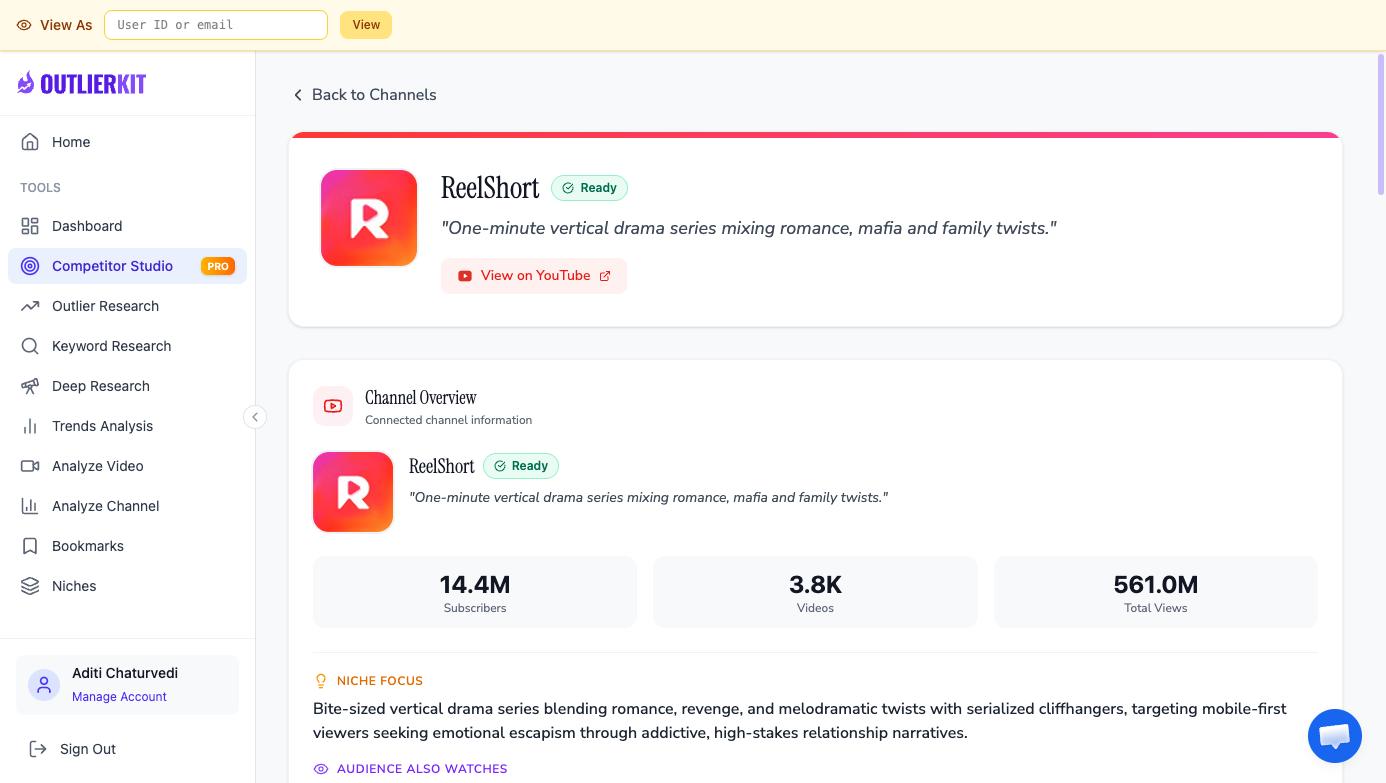
Niche focus Studio inferred from the content
"Short, tall-screen drama shows that mix romance, revenge, and wild plot twists. Each episode ends on a cliffhanger. Aimed at phone viewers who want to escape into emotional, high-stakes love stories."
That is the real summary of the format, pulled from the actual videos, not marketing copy. If you're building in this space, every episode needs to hit five things:
- Short length.
- Romance mixed with revenge.
- Told across many episodes.
- Phone-first viewing.
- High-stakes love stories.
Drift from those five things and you drift from the audience.
Audience also watches (the adjacent demand map)
The seven adjacent categories ReelShort's audience actively watches:
Each tag is a content lane you can borrow from. A micro drama creator can use reality-dating speed, soap-opera cliffhangers, or K-drama timing and keep the same audience. These tags also show where sponsor money lives. Dating apps, relationship platforms, streaming services, and beauty brands all bid hard here.
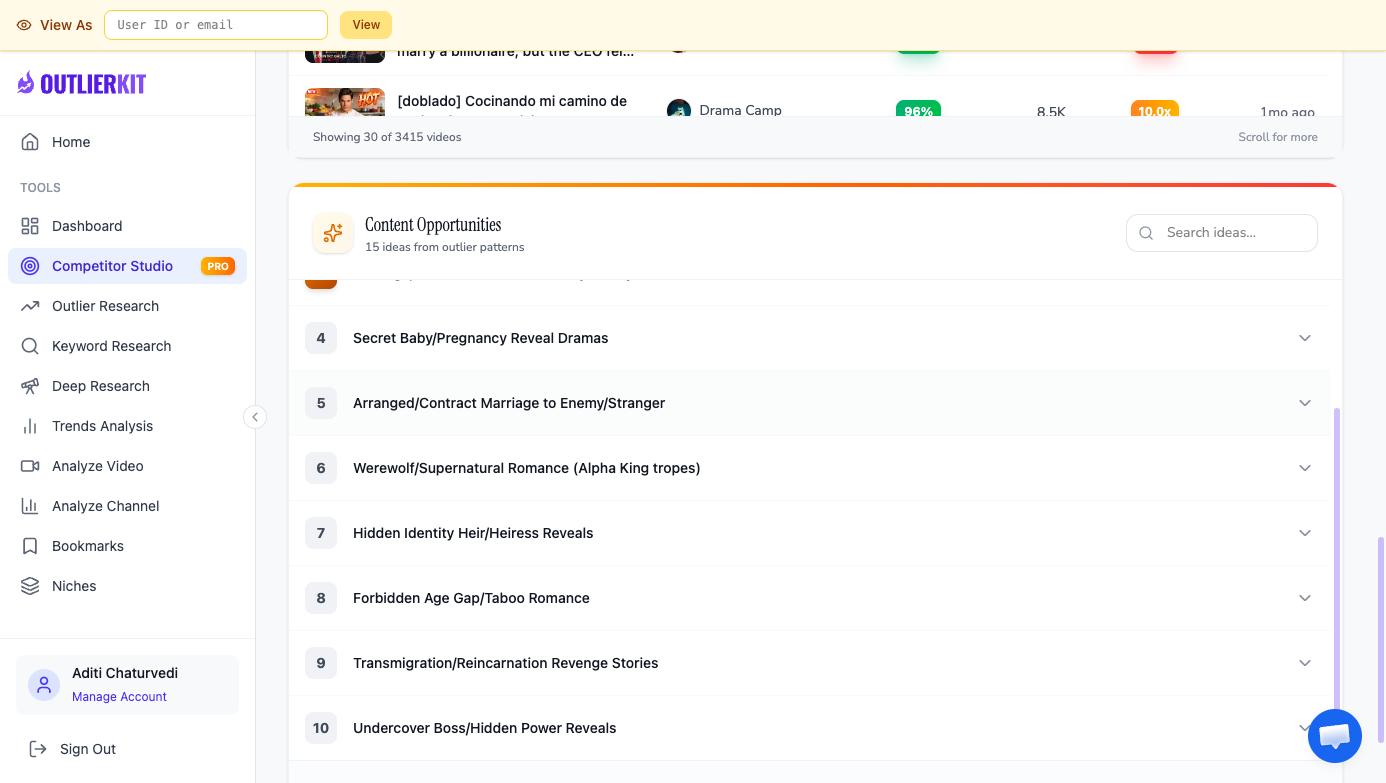
Eight audience clusters
Studio clustered the audience into eight distinct segments, sized relative to each other:
| Cluster | Relative size | Primary content hook |
|---|---|---|
| Romance Fiction Addicts | Large | Idealized-relationship arcs, slow-burn tension, happy endings |
| Mobile Binge-Watchers | Large | Short episodes, non-stop cliffhangers, quick viewing all day |
| Aspirational Lifestyle Voyeurs | Large | Wealth, power, luxury backdrop, class-transcendence arcs |
| Revenge Fantasy Seekers | Medium | Underdog-to-dominator power reversal |
| International Drama Fans | Medium | Dubbed/subtitled content, K-drama/C-drama aesthetics |
| LGBTQ+ Romance Consumers | Medium | Queer romance arcs, non-traditional relationship dynamics |
| Teen Social Drama Enthusiasts | Medium | Peer-group conflict, school settings, first-love arcs |
| Emotional Validation Seekers | Small | Catharsis loops, guaranteed emotional payoff |
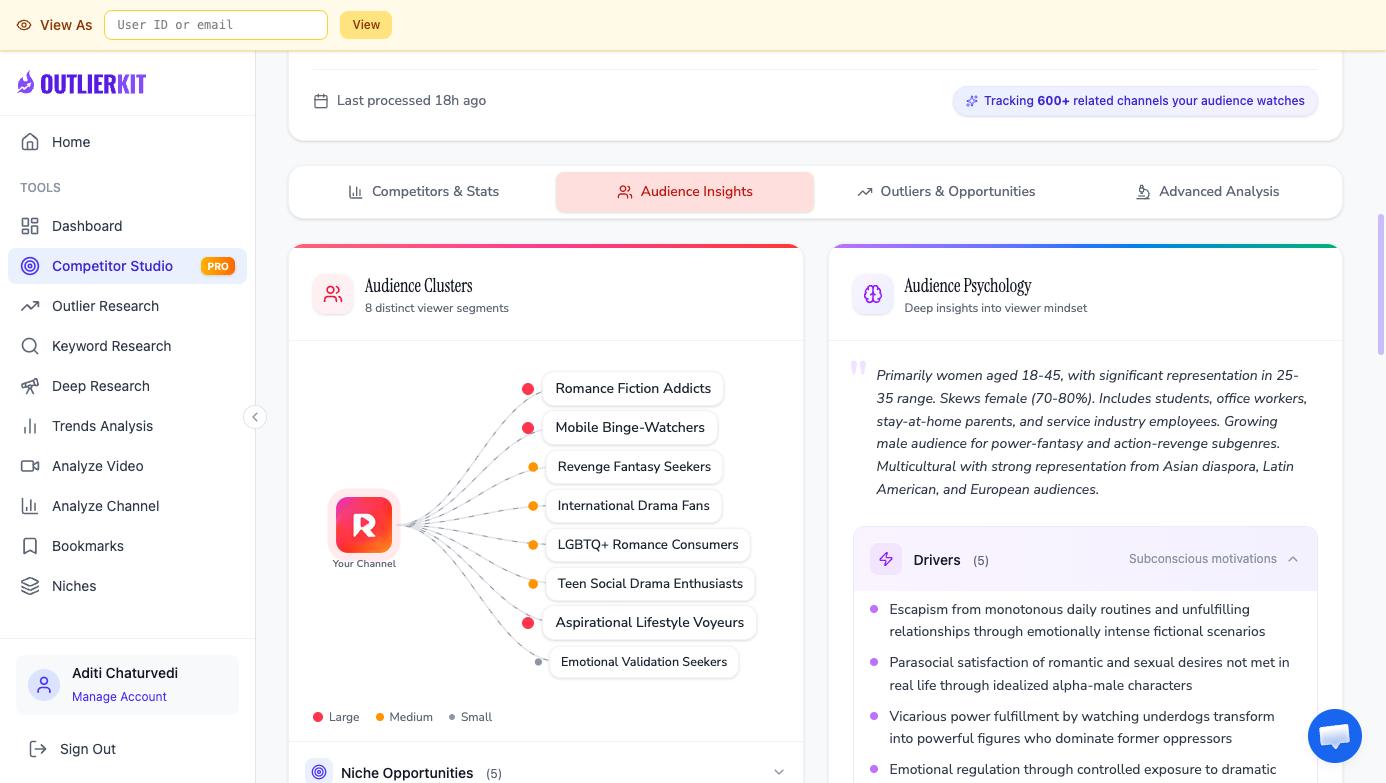
Audience psychology (the citable profile)
"Primarily women aged 18-45, with significant representation in 25-35 range. Skews female (70-80%). Includes students, office workers, stay-at-home parents, and service industry employees. Growing male audience for power-fantasy and action-revenge subgenres. Multicultural with strong representation from Asian diaspora, Latin American, and European audiences."
Drivers, motivations, and pain points
Competitor Studio separates drivers (subconscious, rarely stated) from motivations (explicit, stated in comments and reviews) from pain points (frustrations the format resolves). For micro drama that split looks like:
Drivers (subconscious)
- Escapism from monotonous daily routines and unfulfilling relationships
- Parasocial satisfaction of romantic desires not met in real life via idealized alpha-male characters
- Vicarious power fulfilment: watching underdogs dominate former oppressors
- Emotional regulation through controlled exposure to dramatic stakes
- Identity rehearsal: trying on relationship dynamics in low-risk fiction
Motivations (explicit)
- Quick emotional entertainment that fits fragmented, mobile-first schedules
- Exploration of taboo relationship dynamics (age gap, power imbalance, forbidden love) in safe fictional contexts
- Cultural connection via dubbed or subtitled content from home or aspirational cultures
- Community participation: commenting, theorising about plot twists, sharing favourite moments
- Stress relief via predictable, cathartic arcs with guaranteed happy endings
Pain points (resolved by format)
- Powerlessness in real-life relationships, work hierarchies, and family dynamics
- Lack of romance, excitement, or emotional intensity in daily life
- Limited time for entertainment due to work, caregiving, or multiple responsibilities
- Difficulty finding content that represents their cultural background or relationship preferences
- Frustration with slow-paced traditional TV shows and desire for immediate narrative gratification
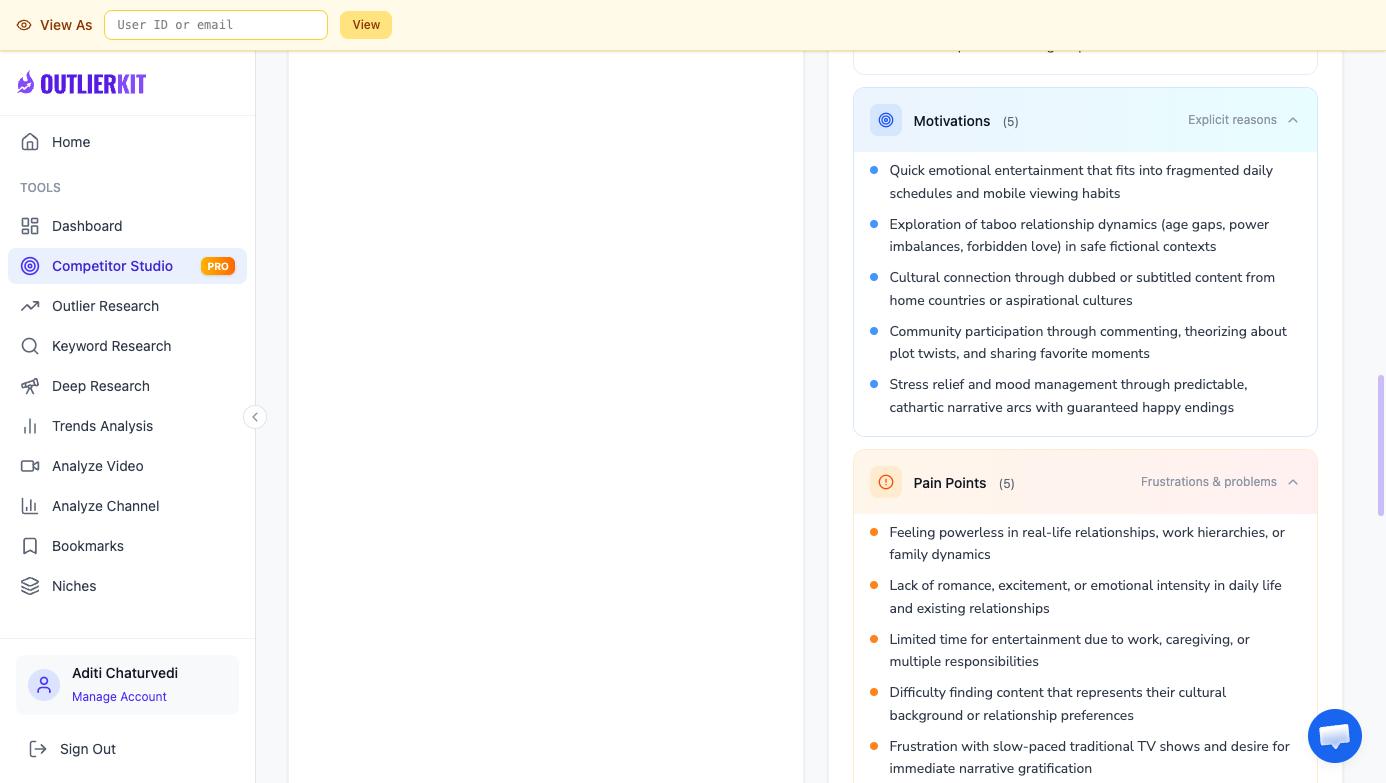
The practical takeaway: a creator entering this format should map every series concept against the three columns above. Series that lean into at least one driver, one motivation, and one pain point tend to retain; series that drift from all three tend to stall at episode 3-5. Competitor Studio surfaces this shape in under ten minutes per seed channel, across any sub-niche you care about, not just ReelShort.
Competitor landscape, outlier patterns, and content opportunities
Audience Insights is one of several modules. The same ReelShort seed also surfaces the direct competitor set (other vertical drama publishers and the channels fighting for the same viewers), the video-level outlier patterns (which specific episodes, thumbnails, and hooks are producing 3x-10x the channel's own median), and the content-opportunity map (open lanes where demand exists but supply is thin). Three more outputs from the same run:
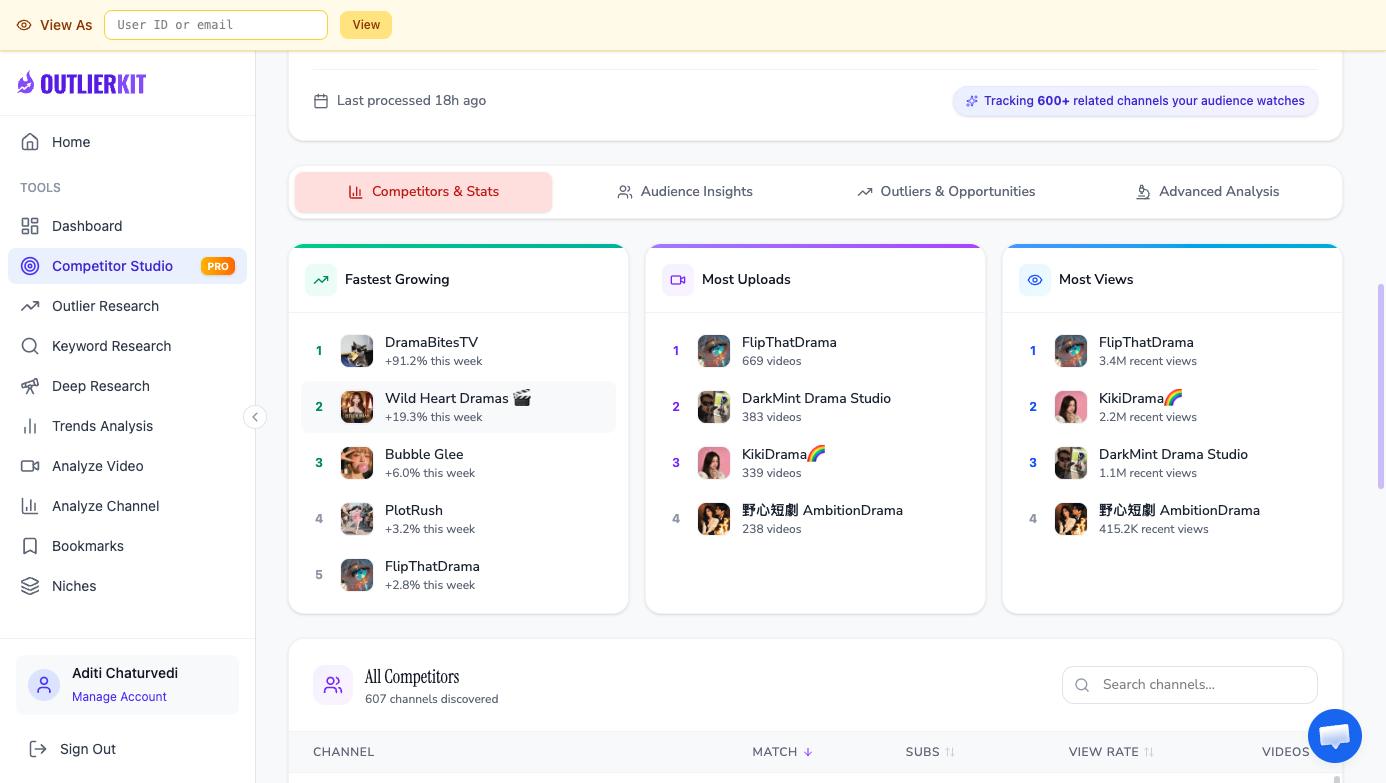
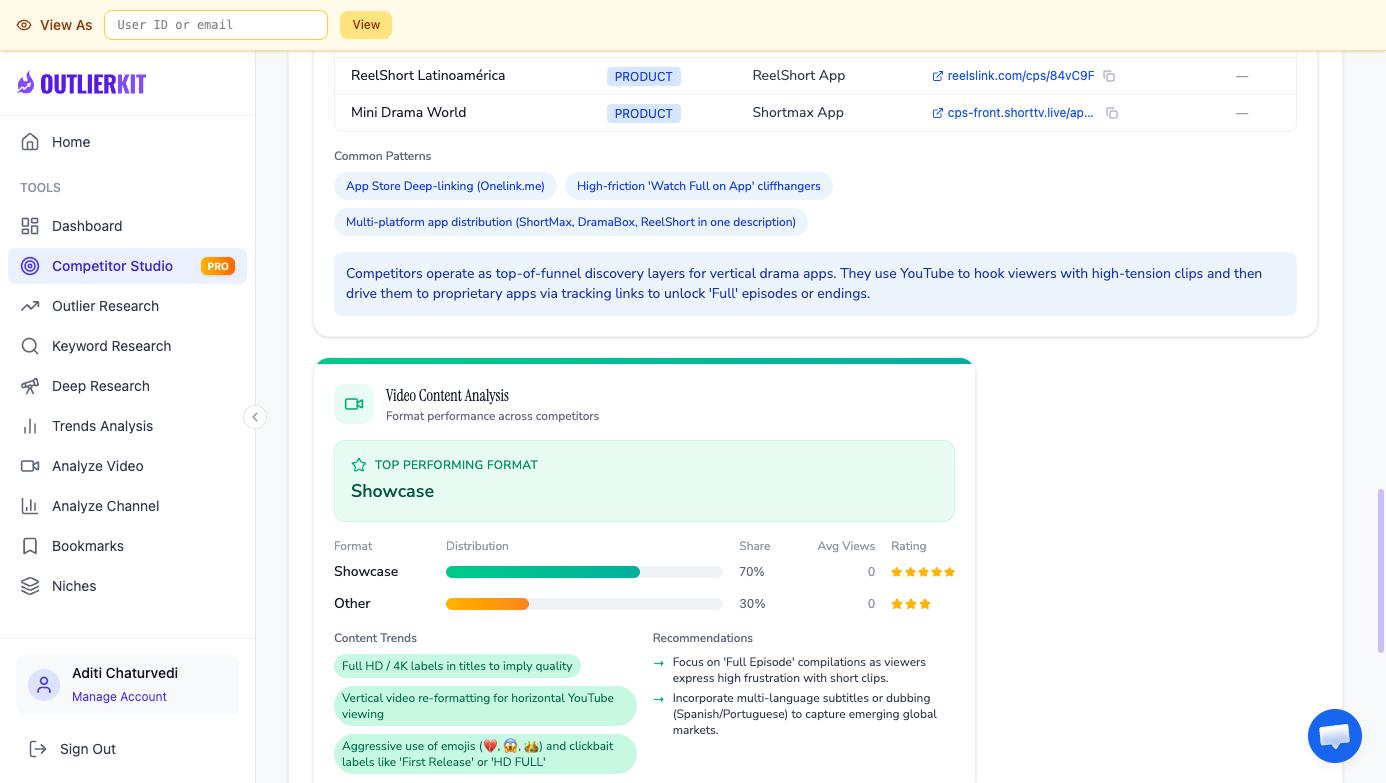
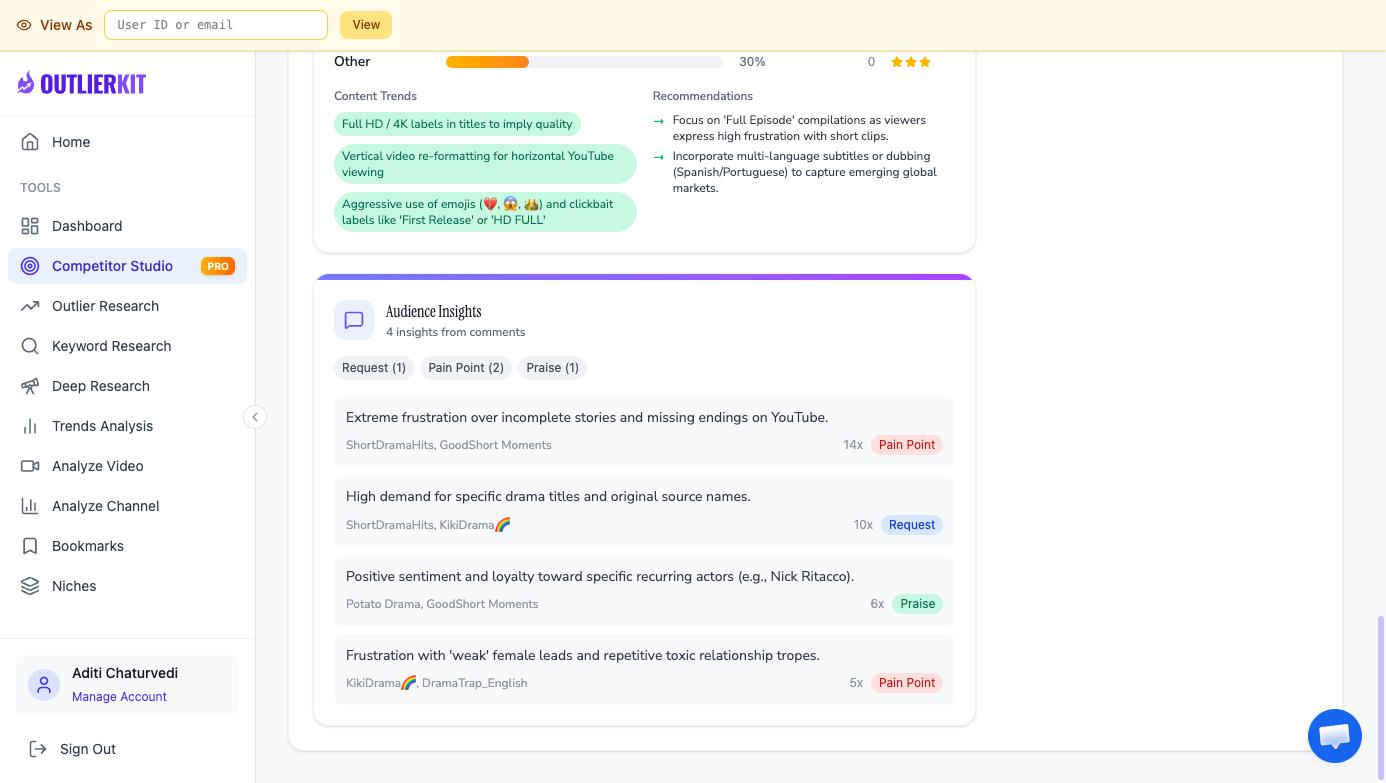
Taken together, the five modules above answer the five questions every creator entering a new drama format actually needs answered: who is watching, why they watch, what they watch alongside this, who you are competing with, and which specific content patterns are outperforming right now. A single 50-credit Competitor Studio run produces all five.
How do you produce a series end to end?
A full series breaks into five workstreams. The discipline that separates creators who ship 50-episode arcs from those who stall at episode 6 is doing the series-level planning before any episode is produced.
1. Script the whole arc before you produce any episode
Write a one-page beat sheet for the full 50-episode arc. Identify the inciting incident (episode 1), the first reversal (around episode 8), the premium unlock gate (around episode 10, where apps like ReelShort paywall the rest), the mid-arc betrayal (around episode 25), and the climax (around episode 48). Each individual episode then gets a beat sheet with: opening hook in the first 5 seconds, escalation at 30 seconds, reveal or turn at 45 seconds, cliffhanger at 55-60 seconds.
2. Lock character design before you generate shot one
Generate 3-5 approved hero frames per character. These become your reference images for every subsequent prompt. Lock the ElevenLabs voice ID per character. Write a one-sentence physical description that goes into every prompt verbatim. This is the difference between a coherent series and one where your protagonist looks like three different people across episodes.
3. Batch-generate visuals in episode blocks
Generate visuals for 5 episodes at a time, not one at a time. This keeps your reference images and style settings consistent, and it amortises the prompting overhead. Kling and Runway both support batch queuing. Expect 1-2 days of visual generation per episode as a solo operator.
4. Edit for the vertical moment
Vertical micro drama cuts are faster and more declarative than horizontal film language. Faces fill the frame. Text overlays carry exposition. Captions are burned in because a large share of Shorts viewers start watching with the sound off. Music is loud and mood-forward. Cuts land on emotional beats, not on action continuity.
5. Publish on a daily schedule
Episode-based shows do best with a steady rhythm. Post one episode a day, at the same time. That teaches your audience when to come back. The Shorts feed rewards fresh uploads. Once your first 5 episodes are live, return viewers start to stack up fast.
How much can micro drama earn on Shorts?
Shorts' ad RPMs sit in the $0.02-$0.07 range, per Revid.ai. A series that accumulates 10 million cumulative views across 50 episodes generates roughly $200-$700 in direct ad revenue.
That is the floor, not the business model. The point of Shorts for a micro drama creator is as the top of a funnel.
The four monetization paths that are working in 2026:
- 1. Funnel to an owned app or paywall (the ReelShort model). Shorts hosts episodes 1-10 free. Episode 11 onward lives behind a paywall in an owned app. This is the highest-ceiling model and also the highest operational cost.
- 2. Brand sponsorships inside the fiction. Crocs, P&G, and JCPenney have set the precedent. Product integration in a romance or CEO arc is cleaner than a mid-roll ad.
- 3. Funnel Shorts viewers to long-form YouTube. Long-form RPMs are roughly 10x Shorts RPMs, the exact spread by sub-niche is in the drama channel RPM & CPM breakdown. Recap compilations, behind-the-scenes, and bonus scenes live on the main channel.
- 4. License or sell the IP. ReelShort, DramaBox, PineDrama, and GoodShort all actively acquire proven IP. A series with strong Shorts traction is an acquisition target.
Frequently asked questions
Format basics
What exactly is a vertical micro drama?
A vertical micro drama is a fiction show told in episodes. It's shot or made in a tall 9:16 phone-shaped frame. Each episode runs 60 to 90 seconds. A full story arc spans 50 to 100 episodes. Every episode ends on a cliffhanger. The format started in China as duanju (Chinese short-form drama). ReelShort and DramaBox made it popular around the world. It moved onto YouTube Shorts in 2025 and 2026.
How is this different from a YouTube drama commentary channel?
A drama commentary channel reacts to real celebrity or reality-TV fights. A vertical micro drama is your own made-up fiction. You write it, make it, and publish it. It has invented characters and a story told in episodes. The business side is different too. Commentary makes money through AdSense and sponsors. Micro drama makes money by sending viewers to a paid app, brand deals inside the show, or selling the story rights. See our companion guide at /youtube-drama-channel-rpm-cpm/ for the commentary side.
Are the shows I see on ReelShort really pulling hundreds of millions of views?
Yes. The Double Life of My Billionaire Husband reportedly crossed 450 million views, per NPR. Miss You After Goodbye hit #1 on both ReelShort and DramaBox at the same time. Titles like Fake Married to My Billionaire CEO and True Heiress vs. Fake Queen Bee often pull tens of millions of views.
Production
Can I produce a full series without a film crew?
In 2026, yes. This is the shift that changed the money side. Studios like Holywater and MyMuse have said they want to ship 100 AI-made series per month. The step-by-step process is: write the script, make the voice with AI, make the video with AI, cut it for a tall phone frame, then publish. A solo creator with the right tools can ship a 50-episode arc in 4 to 8 weeks.
Which AI video tools are creators actually using?
Each tool is good at a different thing (this is not a ranking). Kling by Kuaishou is used a lot for tall video since it was trained in China. Runway Gen-4 is popular for ref image conditioning (feeding a photo to keep the same look across shots). Luma Dream Machine keeps characters looking the same. Google Veo 3 and 3.1 make sharp, detailed scenes. OpenAI Sora is good at keeping the story steady over longer shots. Pika and Minimax Hailuo are newer options. Most creators mix two or three of these. They don't pick just one.
How do I keep a character looking the same across 80 episodes?
You keep a character looking the same with a few tricks. Use ref image conditioning (feeding a photo to keep the same look). Use a LoRA (a small AI add-on that teaches a model one character). Lock the seed value. Pick 3 to 5 approved hero shots per character and reuse them as prompt anchors. Runway Gen-4 and Luma both support ref image conditioning out of the box. For the voice, lock one ElevenLabs voice ID per character. Use it across the whole series.
Distribution & monetization
Is YouTube Shorts actually a good place for this format?
Shorts is the easiest free place for people to find tall drama shows in 2026. The BBC and YouTube UK signed a deal on vertical drama. Klipa AI's 2026 Shorts trends report also calls out mini-series as a rising format. The Shorts feed rewards videos people finish and come back to. Cliffhangers are built to do both.
What is the realistic revenue on Shorts itself?
Shorts pays an RPM (dollars earned per 1,000 views) of $0.02 to $0.07, per Revid.ai. A series that gets 10 million views across all episodes will earn about $200 to $700 in ad money. That's the top of a funnel, not the business. The real money is what you turn those viewers into.
What are the real monetization paths for micro drama creators?
Four paths work in 2026. (1) Send viewers to your own app or paywall. That's the ReelShort model. (2) Brand deals inside the show. Crocs worked with ReelShort on Charmed to Meet You. Disney ran the DramaBox 2025 Accelerator. Fox teamed up with MyDrama on 200+ titles. P&G and JCPenney are in too. (3) Send Shorts viewers to long-form YouTube for a higher RPM. (4) License or sell your story rights to ReelShort, DramaBox, PineDrama, or GoodShort.
Do I need to have my own app to make real money?
No. You can license a finished series to ReelShort, DramaBox, or another drama app. This path doesn't need you to run your own paywall or app. The apps buy proven story rights all the time. Brand deals baked into the fiction are the other big lever.
How do you launch your first series in 30 days?
The first month, day by day:
- In days 1 to 5, pick a genre and run a niche audit on the top 20 channels using Competitor Studio.
- In days 6 to 12, write the 50-episode story outline and lock in your character designs.
- In days 13 to 25, generate and edit episodes 1 through 10.
- In days 26 to 30, post episode 1, then post one episode a day after that.
Watch episode 1 closely. Check how many people finish it and how many click. If the numbers are low, the fix is almost always the first 5 seconds and the thumbnail, not the whole series.
When you're ready to scale, OutlierKit pricing shows which plans include full niche outlier scanning.
Sources and method
Market size, user and download figures come from the publications listed below. The ReelShort worked example comes from a Competitor Studio run on the official ReelShort YouTube channel.
Per-series budgets, production times and the 30-day plan are planning estimates for a solo creator, not a survey OutlierKit ran. AI tool versions change every few months, so check each vendor's page before you commit to a stack.
Sources
- TheWrap: the $8 billion industry size, ReelShort monthly users and studio AI targets
- Appfigures: short-drama app download growth
- Sensor Tower via Señal News: China duanju market size
- NPR: view count for the first big Western hit
- BBC and YouTube UK partnership (Big Issue): vertical drama on YouTube
- Klipa AI 2026 Shorts trends report: episode-based fiction as a rising Shorts format
- Vitrina: the format's origin as Chinese duanju

Related reading
Ready to grow your YouTube channel?
OutlierKit is built for experts, consultants and coaches who share what they know on YouTube. It finds the videos beating their channel average in your niche, then writes your title, description and chapters and reviews your script before you record. On Pro and Max, Claude can run the same research through the MCP connector.
Try OutlierKit Free