The 2026 YouTube drama boom: what the data says about the fastest-growing drama channels, formats, and sub-niches
When people say "YouTube drama" in 2026, they usually mean one of two things. Mixing them up is the most common mistake in trend reports right now.
The first is the classic YouTube drama niche: commentary, recap, legal, and celebrity channels that talk about or narrate real events. The second is vertical micro drama: 60-90 second fiction episodes told in episodes, posted right on YouTube Shorts. We call these two drama worlds Universe 1 and Universe 2. Both are growing in 2026. But they're different businesses. They have different viewers, different ways to make them, and different ways to earn. This hub tells them apart. It shows what's actually growing. It maps every sub-niche to the right pillar. So next time you see a chart saying "drama is blowing up on YouTube," you'll know which drama they mean.
True crime, the measured niche closest to commentary drama, had 12.5 percent of sampled videos beat their own channel by 10x in our six-niche outlier report.
TL;DR
Two drama worlds are growing on YouTube in 2026: commentary, recap, legal, and celebrity drama channels (long videos, real events, mostly faceless or host-led) and vertical micro drama on Shorts (short videos, fiction told in episodes, ReelShort-style). They look alike from far away. Up close, they act nothing alike. To research either lane with real outlier data (an outlier is a video doing way better than the channel's normal), start with the competitor studio tool. It will show you which channels in each world are actually breaking out this week.
How do the two drama worlds compare?
| Type | What it is | 2026 growth signal | Main audience | How they earn |
|---|---|---|---|---|
| Legal / court commentary Universe 1 | Long videos that recap and explain trials, celebrity lawsuits, and court cases | High. Spikes around every big trial; top channels pass 1M+ views per video | US adults 25-54, news-adjacent | Mid-to-high ad rates (legal topics), memberships, Patreon |
| Revenge / betrayal narration Universe 1 | Faceless long videos with AI voices telling revenge and betrayal stories from Reddit-style scripts | High. One of the fastest-growing faceless types in 2025-2026 | Global English, 18-44, mostly on phones | AdSense at scale, affiliate, course funnels |
| K-drama / C-drama recap Universe 1 | Episode recaps and breakdowns of Korean and Chinese shows for Western viewers | Rising. Riding the Netflix and Viki push of Korean and Chinese dramas | Global, mostly women, 18-44 | AdSense, affiliate (streaming apps), sponsorships |
| ReelShort-style on YT Shorts Universe 2 | 60-90 second vertical episodes of romance, billionaire, or revenge drama, posted right on Shorts | Explosive. The fastest-growing fiction type on short-form video | 70% women (per NPR), 25-55, US + SEA | Shorts ad pay, app install funnels, IP licensing |
| Branded micro drama Universe 2 | Vertical drama shows made or paid for by brands as a marketing tool | New. Named at MIPCOM 2025 as a fresh type of show to buy | Brand-dependent, usually 18-44 | Brand budgets, content marketing |
| AI-produced vertical series Universe 2 | Vertical drama shows with AI-made footage, voice, or full production | Early but fast. About 10x cheaper to make than live-action | Same as ReelShort; genre-led | Shorts ad pay, cross-platform distribution |
What does "YouTube drama" mean in 2026?
The fastest way to see what's going on is to split the word "drama" into the two things it now means on YouTube.
Commentary / recap
- Format: Long videos, 10-60 min
- Content: Talk about real events
- Production: Faceless narration or host-led
- Sub-niches: Legal, celebrity, K-drama recap, revenge narration
- How people find it: Search + browse + suggested
- How they earn: AdSense, memberships, Patreon
- Audience: 25-54, US + global English
Vertical micro drama
- Format: Short videos, 60-90 sec per episode
- Content: Scripted fiction told in episodes
- Production: Studio, branded, or AI-made
- Sub-niches: Billionaire romance, revenge, marriage-contract
- How people find it: Shorts feed + app install funnels
- How they earn: Shorts ads, app installs, licensing
- Audience: ~70% women, 25-55, US + SEA
Universe 1: what is the YouTube drama niche?
Universe 1 is the drama niche long-time YouTube viewers know. These are long videos that recap, talk about, or react to real events.
The key trait: it's real, not fiction. The drama happens in the world first. Then the channel covers it. Videos run 10 minutes for celebrity news recaps. They run 60+ minutes for deep narrations and legal breakdowns.
The category is big enough to have clear sub-niches, and each one is growing at a different speed. Legal and court commentary climbs in spikes around big trials. Celebrity and influencer drama moves fast week to week, driven by whatever scandal is breaking. K-drama and C-drama recap channels are the fastest-rising part of classic drama, riding Netflix and Viki's push of Korean and Chinese shows into Western markets. AI-narrated revenge and betrayal stories are the biggest faceless type in Universe 1 by upload count. These are long videos built on Reddit-style scripts.
How these shows get made has changed. Faceless long drama used to need a writer, a narrator, and an editor. With AI voice and stock-footage tools, one person can ship a 30-minute video a day. Upload counts are up about 5x versus 2023. That's made views per video smaller at the bottom, but it's grown the total audience at the top. Faceless narration also overlaps with the OutlierKit list of faceless storytelling and revenge/true-stories niches.
Each of these sub-niches earns very differently, and the spread is wide, roughly 6x between the lowest and highest. This hub is about which formats are growing; for the full earnings picture (RPM and CPM by sub-niche, sponsor mix, and the geography tax) see our dedicated drama channel RPM and CPM analysis.
Universe 2: what is vertical micro drama?
Universe 2 is newer. It's why most 2026 drama trend reports get the story wrong.
Vertical micro drama is scripted fiction shot tall-screen. Each episode runs 60 to 90 seconds. A full show can have dozens or hundreds of episodes.
The format started on special apps. The biggest is ReelShort. Now the same shows are moving onto YouTube Shorts. Shorts is where people find the shows, and where the apps pull in new users.
The numbers on this category are large. Vertical short dramas are now roughly an $8 billion global business, per TheWrap. NPR reports the leading app has around 45 million monthly active users, with roughly 70% of viewership from women.
MIPCOM 2025 formally acknowledged the format as a new commissioning category for major media buyers (background: MIPCOM 2025 coverage).
The genre vocabulary is well-defined. Flagship shows in the billionaire-romance and revenge tropes include The Double Life of My Billionaire Husband, Miss You After Goodbye, Fake Married to My Billionaire CEO, and True Heiress vs. Fake Queen Bee.
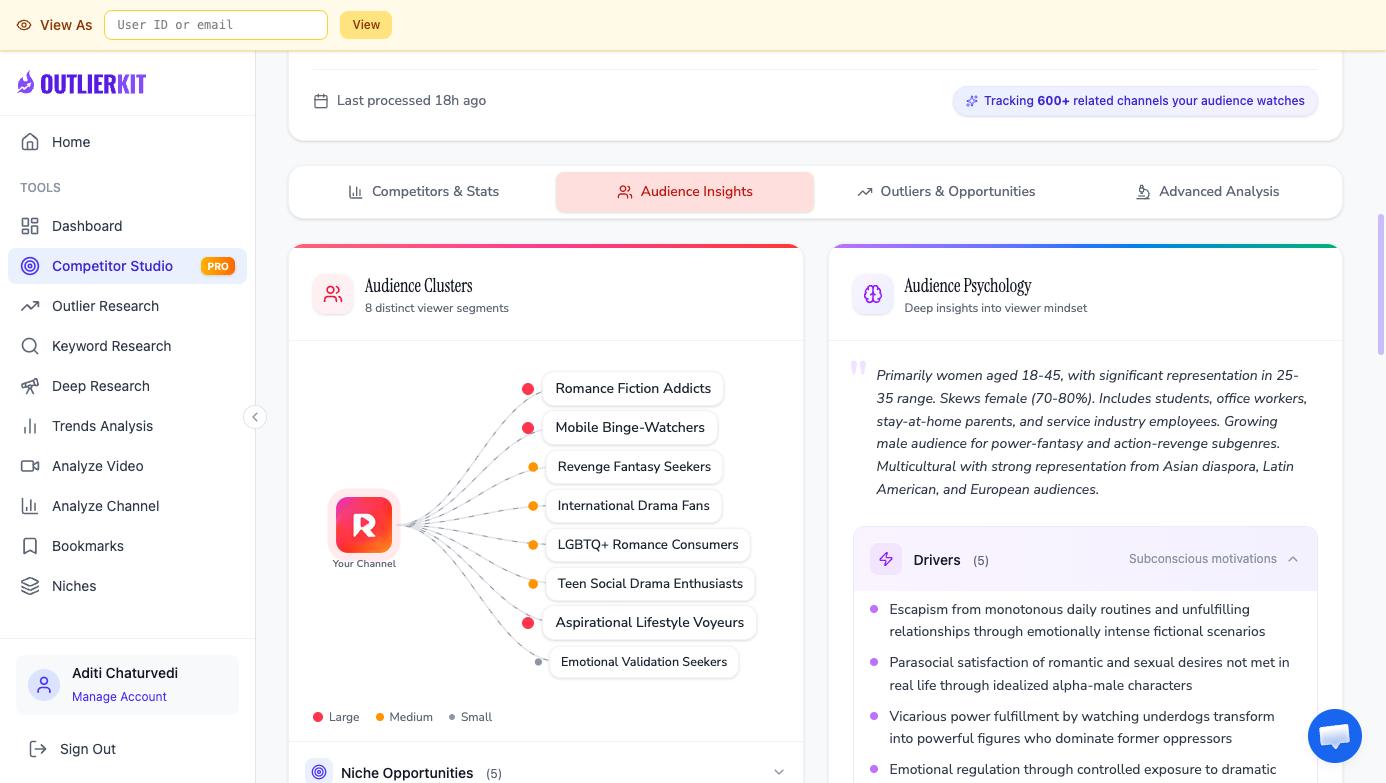
These shows lead the category. Every new creator copies their playbook:
- Strong cliffhangers every 60 seconds.
- Bright, high-contrast thumbnails.
- A clear emotional hook stated in episode one.
On YouTube, tall-screen drama uploads have grown about 8x since 2023. Creators use Shorts one of two ways. They earn directly from Shorts ads. Or they use Shorts to send viewers to a paid app.
For the full breakdown, see our pillar on vertical micro drama on YouTube Shorts. You can also see where this category fits in the broader 2026 YouTube niches guide.
Which drama categories are growing fastest in 2026?
The table ranks categories by growth signal. Growth multipliers are expressed relative to a 2023 baseline in category upload volume and view share, and they are directionally consistent with the broader emerging niches analysis.
Relative growth multiplier by category (vs 2023 baseline)
Growth multipliers are directional estimates based on category upload volume and view share versus a 2023 baseline.
AI-narrated revenge / betrayal narration (long-form)
~5x category growth vs 2023 baseline
Faceless long videos that use AI voices, stock footage, and Reddit or original scripts. They tell stories about revenge, cheating, money, and betrayal at work. Videos run 20-60 minutes and are built to keep people watching. This is the biggest faceless type growing in 2026. It overlaps a lot with Reddit story narration. See the breakdown in the OutlierKit post on faceless automation niches (external: https://outlierkit.com/blog/youtube-automation-niches#1-reddit-story-narrations).
K-drama / C-drama recap channels
~3x category growth vs 2023 baseline
Episode-by-episode recap, analysis, ending-explained, and cast deep-dive videos about Korean and Chinese shows. Netflix, Viki, and iQIYI are pushing these dramas into Western markets. The best channels open with a strong hook in the first 15 seconds. They add detailed scene-by-scene notes. They post around each show's release schedule. This is a built-in win, because every new hit drama opens up fresh search terms.
Vertical micro drama (Shorts)
~8x growth in native Shorts drama uploads vs 2023 baseline
60-90 second episodes told in episodes, posted right on YouTube Shorts. Most use romance, billionaire, revenge, or marriage-contract tropes. This is the fastest-growing drama type on the whole platform. For the full breakdown on how to make it and how they earn, see our pillar on vertical micro drama on YouTube Shorts.
Legal / court commentary
~2.5x category growth vs 2023 baseline
Long videos about trials, celebrity lawsuits, and court cases. Lawyers or legal experts often host these. More and more use AI to help write summaries. Ad rates (what advertisers pay per 1,000 views) run higher here. The viewers are older, US-based, and the topic pulls in finance, insurance, and legal ads. This is a big part of Universe 1. For detailed numbers on how they earn, see our drama channel RPM and CPM breakdown.
What is driving the growth?
Both universes are growing at once because three structural forces line up behind them. Short-form trend tracking at the platform level (see also Klipa's 2026 Shorts trend report ) confirms the same pattern.
The algorithm loves episodes and long watch time
Both kinds of drama tell stories across many episodes. Long recap and narration channels run 20-60 minute videos. Vertical micro drama uses many short episodes. Viewers watch 5, 10, or 50 Shorts in one sitting. YouTube rewards this. It looks at how long people watch, how often they come back, and how many finish. These videos check all those boxes.
AI cut production cost by about 10x
AI voices, stock footage, and now full AI video have cut the cost of a drama video by about 10x since 2022. This changes the game. You don't need one big hit anymore. You can win by making lots of videos. That's why faceless narration and AI vertical drama are growing fast.
Shorts send viewers to long videos
When someone watches a Short, YouTube then shows them longer videos from the same channel and topic. Drama creators who run both a Shorts feed (hook, teaser, cliffhanger) and a long video library (full recap, deep dive) get found in ways single-format channels can't match.
How to pick your lane
Because the two universes run on different economics, the right question is not "which is bigger," it is "which matches what you can actually produce." Three questions decide the lane.
1. What is your production budget per episode?
Under $50 per video and solo operator: Universe 1, faceless long-form revenge narration or recap channels. $500-$5,000 per episode with a small team or a strong AI video pipeline: Universe 2, vertical micro drama. $5,000+ per episode with studio production: Universe 2, premium vertical drama and branded work. The drama channel RPM breakdown covers the payback math.
2. On-camera or faceless?
Faceless: Universe 1. AI-narrated revenge/betrayal, recap, or legal-analysis narration formats all work without a host. On-camera as the host: Universe 1 celebrity or legal commentary. On-camera as an actor: Universe 2 vertical micro drama, where the camera faces scripted performers.
3. Do you want to cover real events or tell fiction?
Real events go in Universe 1. Scripted episode-based shows go in Universe 2. This sounds obvious. Creators still pick the wrong lane all the time. Most chase the bigger audience instead of matching what they can actually make. Vertical micro drama reaches more people than legal commentary. It's also a totally different job.
Frequently asked questions
By format
What is YouTube drama in 2026?
In 2026, "YouTube drama" means two different things. The first is the classic drama niche on YouTube. These are recap, legal, and celebrity channels that talk about, react to, or narrate real or fictional events. The second is vertical micro drama. These are 60-90 second fiction episodes told in episodes, posted right on YouTube Shorts, like the ReelShort app. They share the word "drama" but they're different businesses. They have different viewers, different ways to make them, and different ways to earn.
What is the difference between drama commentary channels and vertical micro drama?
Drama commentary channels post long videos (usually 10-60 minutes) about real things. They recap or talk about real events, celebrity news, court cases, or existing shows. Vertical micro drama is short (60-90 seconds per episode). It's fiction told in episodes. It's made content telling a scripted story across many vertical episodes. Commentary channels earn mostly from AdSense and memberships. Vertical micro drama earns from Shorts ad pay, app install funnels, and IP licensing.
Is vertical micro drama the same as ReelShort?
Not exactly. ReelShort is an app that started the vertical micro drama format. It shows vertical episodes inside its own app. YouTube Shorts is now a big home for the same format. Producers post the same episodes, or shorter teasers, right on Shorts. They use it to get viewers, and sometimes to send people to an app. Background on ReelShort: https://en.wikipedia.org/wiki/ReelShort.
What drama sub-niches are growing fastest on YouTube Shorts in 2026?
The four fastest-growing drama sub-niches on YouTube in 2026 are AI-narrated revenge and betrayal stories (long videos), K-drama and C-drama recap channels, vertical micro drama on Shorts, and legal and court commentary. Vertical micro drama has the highest growth in Shorts uploads. AI-narrated revenge stories are the biggest faceless long-form drama type by upload count.
By monetization
How do YouTube drama channels make money in 2026?
Universe 1 drama channels (commentary, recap, legal) make money mostly through AdSense. Legal and finance channels earn higher ad rates because of who watches them. Extra money comes from memberships, Patreon, affiliate links (streaming apps, books), and sponsorships. Universe 2 vertical micro drama channels earn from YouTube Shorts ad pay. They also earn from app install funnels (ReelShort and others pay to get viewers), brand deals for branded micro drama, and IP licensing when shows get picked up on other platforms.
How big is the vertical micro drama market?
Vertical micro drama is now about an $8 billion global market, per TheWrap (https://www.thewrap.com/vertical-short-dramas-industry-explained-8-billion-business/). NPR says the top app has about 45 million monthly users. Around 70% of viewers are women (https://www.npr.org/2025/03/19/nx-s1-5330470/micro-drama-soap-opera-app). MIPCOM 2025 confirmed that short vertical shows are now a main format that big media buyers pay for (https://senalnews.com/en/interviews/mipcom-2025-short-vertical-content-the-new-language-of-young-and-not-so-young-generations).
Which drama universe is easier to enter as a new creator?
Universe 1 (commentary, recap, legal) is easier to start as a solo creator. You need strong research and writing skills. Costs are low. AI narration has made faceless channels even easier to start. Universe 2 (vertical micro drama) needs more. You need either a team to film, or strong AI video tools. You also need a writer who can plan a cliffhanger every episode. The payoff can be bigger in Universe 2, because the shows have value on other platforms. But you have to spend more up front.
Are AI-produced drama videos monetizable on YouTube?
Yes, as long as the content meets YouTube's rules on original work and AI disclosure. AI-narrated long-form revenge and betrayal channels already earn money through standard AdSense. AI-made vertical drama can earn Shorts ad pay just like any other Shorts. The real question isn't AI. It's whether you're making something original, or just posting the same template over and over. YouTube pushes templated uploads down.
What are the most-discussed drama topics on r/youtubedrama in 2026?
In 2026, r/youtubedrama is full of creator drama threads (commentary creators covering each other). It's also full of debates about AI narration ethics, hit vertical micro drama shows being picked apart by classic drama commentators, and legal commentary channels being checked for accuracy. The subreddit itself is a useful directional signal for Universe 1: threads there tend to surface topics before broader search demand shows up. Treat it as a leading indicator to check, not a measured lag.
How to research the drama niche with real data
To pick a sub-niche and ship, you need channel-level and video-level outlier data. The competitor studio tool is the right entry point: pick 10 channels in your target universe (either Universe 1 commentary and recap channels, or Universe 2 vertical micro drama accounts) and look at which specific uploads are outperforming their own channel median by 3x or more. That is the real leading indicator of which sub-niche is breaking out this week, and it is universe-specific. What counts as an outlier in legal commentary behaves nothing like what counts as an outlier in billionaire-romance micro drama.
From there, the niche research tool surfaces the keyword and topic clusters where either universe is currently under-served relative to demand. Both are part of OutlierKit, a research tool built for experts, consultants and coaches who share what they know on YouTube. Pricing and plan details are on the OutlierKit pricing page. Start with one universe, pick one sub-niche, and validate against outlier data before you commit production time. The cost of a wrong lane in drama is 3-6 months of uploads into the wrong economic model.
Sources and method
Market sizes come from the news sources above. The category growth multipliers are directional estimates against a 2023 baseline, not a published dataset, so use them to compare categories rather than to forecast views.
Sources
- TheWrap: the vertical short drama industry explained: the $8 billion market estimate
- NPR: micro-drama soap opera apps: audience size of the leading app
- Senal News: MIPCOM 2025 on short vertical content: industry view on the format
- ReelShort on Wikipedia: background on the app that started the format
- Klipa: YouTube Shorts trends 2026: Shorts trend coverage
- OutlierKit trending niches report: breakout rates for true crime and five other niches

Related guides
Ready to grow your YouTube channel?
OutlierKit is built for experts, consultants and coaches who share what they know on YouTube. It finds the videos beating their channel average in your niche, then writes your title, description and chapters and reviews your script before you record. On Pro and Max, Claude can run the same research through the MCP connector.
Try OutlierKit Free