How to Find YouTube Micro-Influencers in 2026 (7 Proven Methods)
YouTube micro-influencers (10K–100K subscribers) deliver 4–7% engagement rates — 3x higher than mega-influencers. They cost 80–90% less per collaboration. And 82% of consumers say they trust micro-influencer recommendations over celebrity endorsements.
The challenge is finding them. You can start with YouTube's Help Center to understand channel metrics, but this guide goes further with 7 proven methods to discover YouTube micro-influencers in your niche, a vetting framework to separate real influence from vanity metrics, and a sponsorship rate benchmark so you know what to budget.
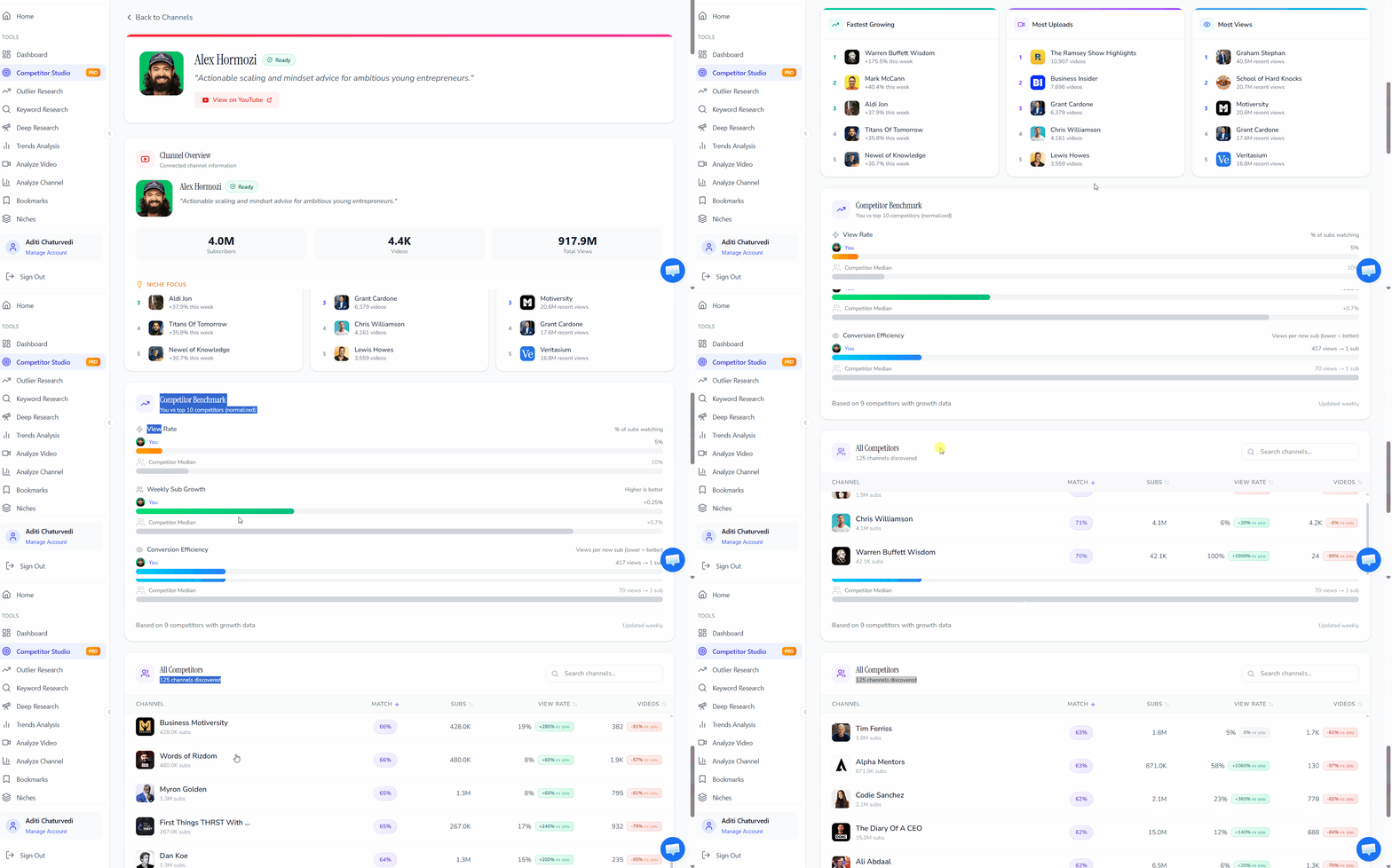
Key Takeaways
| Method | Best For | Key Strength |
|---|---|---|
| OutlierKit Competitor Studio | Discovering 1000s of niche channels at scale | Filters by sub count, upload frequency, views |
| YouTube Direct Search | Finding creators around specific topics | Free, immediate, keyword-targeted |
| Competitor Sponsorship Analysis | Finding proven brand-friendly creators | Pre-vetted creators who accept sponsorships |
| Google Site-Specific Search | Finding review-focused niche creators | Surfaces channels YouTube search misses |
| Lookalike Discovery | Scaling from one successful influencer | Highest-ROI method based on proven baseline |
TL;DR — How to Find YouTube Micro-Influencers
- 1Define your niche and audience. Know who you want to reach before searching for influencers.
- 2Use OutlierKit Competitor Studio to discover channels. Filter by subscriber range (10K–100K), upload frequency, and average views.
- 3Search YouTube directly using product-category and long-tail keywords in your niche.
- 4Vet every creator. Check engagement rate (aim for 4%+), comment quality, audience demographics, and brand safety.
- 5Analyze their outlier content. Use OutlierKit to find their top-performing videos and understand what content resonates with their audience.
- 6Budget $200–$5,000 per creator depending on format (dedicated video vs. integration vs. Shorts).
What Is a YouTube Micro-Influencer?
A YouTube micro-influencer is a content creator with 10,000 to 100,000 subscribers who maintains a focused niche and a highly engaged community. According to Pew Research, YouTube remains the most widely used social platform among U.S. adults. Unlike mega-influencers who broadcast to millions, micro-influencers build personal relationships with their viewers through consistent, topic-specific content.
YouTube micro-influencers average 4–7% engagement rates compared to 0.5–2% for creators with 1M+ subscribers. You can verify engagement metrics using tools like Social Blade. This gap exists because smaller audiences mean more direct interaction — creators reply to comments, reference their community by name, and produce content that speaks to specific needs rather than generic interests.
| Tier | Subscribers | Engagement Rate | Sponsorship Rate | Best For |
|---|---|---|---|---|
| Nano | 1K - 10K | 7 - 10% | $50 - $500 | Hyper-niche products, local businesses |
| MicroSweet spot | 10K - 100K | 4 - 7% | $200 - $5,000 | Niche campaigns, product launches, SaaS tools |
| Mid-tier | 100K - 500K | 2 - 4% | $5,000 - $20,000 | Brand awareness, broad reach campaigns |
| Macro | 500K - 1M | 1.5 - 3% | $20,000 - $50,000 | Mass market products, brand deals |
| Mega / Celebrity | 1M+ | 0.5 - 2% | $50,000+ | Global brand awareness |
Why YouTube Micro-Influencers Outperform Larger Creators
YouTube micro-influencers outperform macro and mega-influencers on three critical metrics: engagement rate, cost efficiency, and conversion rate. Data from Statista shows influencer marketing spending continues to rise year over year. Here is why brands increasingly allocate influencer budgets toward micro-creators.
Higher Engagement Rates
Micro-influencers average 5.7% engagement rate on YouTube versus 2.4% for creators with 100K+ followers. Smaller audiences mean more comments, likes, and shares per view.
Authentic Endorsements
61% of consumers believe micro-influencers provide genuine product endorsements. Their recommendations feel like a friend's advice, not a paid advertisement.
Niche Expertise
Micro-influencers build audiences around specific topics — home automation, vegan meal prep, budget travel. Their viewers are pre-qualified for niche products.
Cost Efficiency
At $200–$5,000 per collaboration, micro-influencers cost 80–90% less than macro-influencers ($20K–$50K). You can work with 10 micro-influencers for the price of one macro creator.
7 Proven Methods to Find YouTube Micro-Influencers
Method 1: Use OutlierKit Competitor Studio to Discover Niche Channels
OutlierKit’s Competitor Studio surfaces thousands of YouTube channels that match your niche based on content overlap, topic relevance, and audience similarity. Channels are classified by subscriber count, upload frequency, and average view count — letting you filter directly for micro-influencers (10K–100K subs) without manual searching.
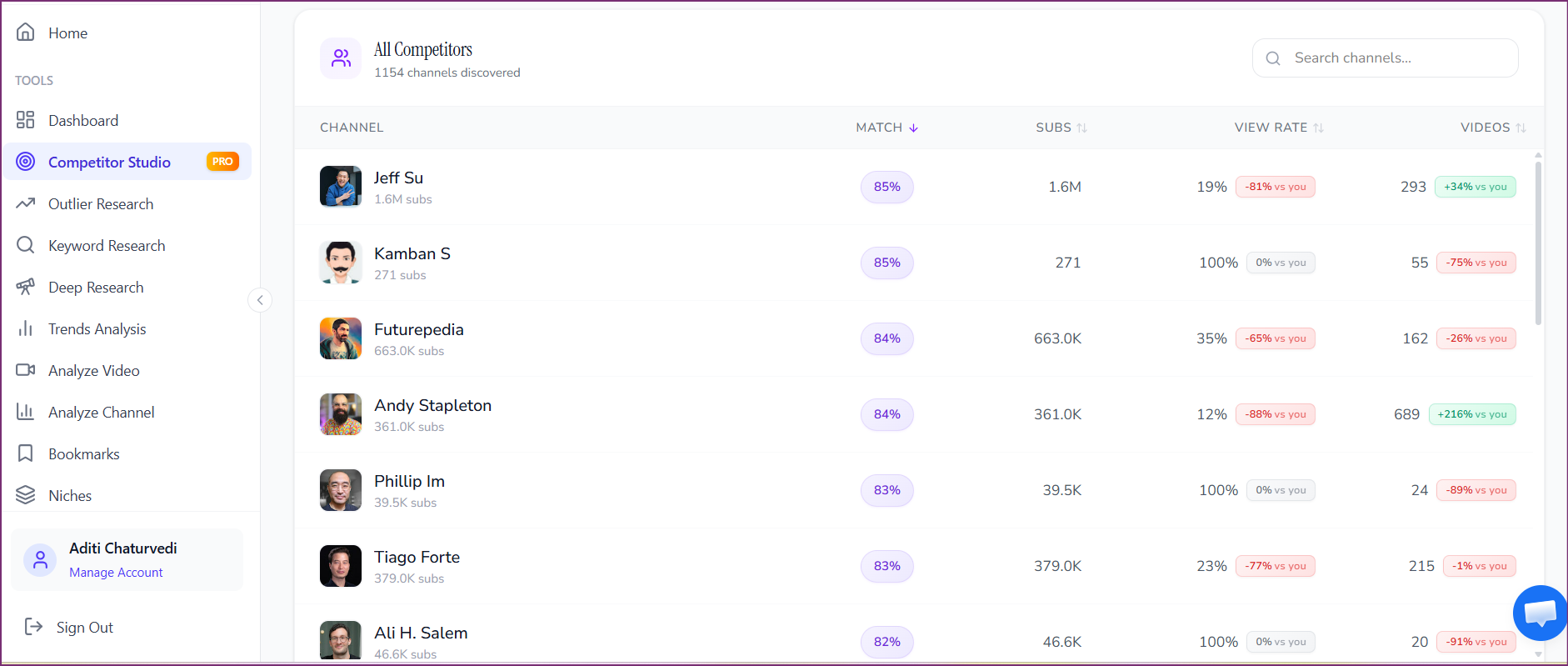
Competitor Studio discovers 1,000+ channels in any niche, classified by subscriber count, view rate, and upload frequency.
How to do it:
- 1Enter a seed channel or topic keyword into Competitor Studio
- 2Filter results by subscriber range (10,000–100,000) to isolate micro-influencers
- 3Sort by upload frequency to find consistently active creators
- 4Review average views per video to confirm real audience engagement
- 5Export matching channels into a shortlist for deeper analysis
Pro tip: Filter for channels that upload at least 2 videos per month. Active micro-influencers are more likely to accept sponsorships and deliver content on schedule.
Method 2: Search YouTube Directly with Niche Keywords
YouTube search is the simplest discovery method. Search for niche-specific terms, then filter by channel size. The key is searching for the topics your target audience watches, not generic influencer keywords.
How to do it:
- 1Search for product-category keywords like “best budget standing desk review” or “how to start dropshipping 2026”
- 2Click on channels behind the top results and check subscriber counts
- 3Use YouTube’s Shorts tab and Explore page to find rising micro-creators
- 4Search with hashtags relevant to your niche (e.g., #techreview, #veganrecipes)
- 5Check the “Channels” tab in YouTube search results for topic-aligned creators
Pro tip: Search for long-tail keywords instead of broad terms. “Best mirrorless camera for YouTube 2026” surfaces more niche micro-influencers than just “camera review.”
Method 3: Analyze Competitor Sponsorships and Collaborations
Your competitors have already done the hard work. Identify which micro-influencers they sponsor and work with. If a creator is already producing content in your industry, they likely have an engaged audience that matches your buyer persona.
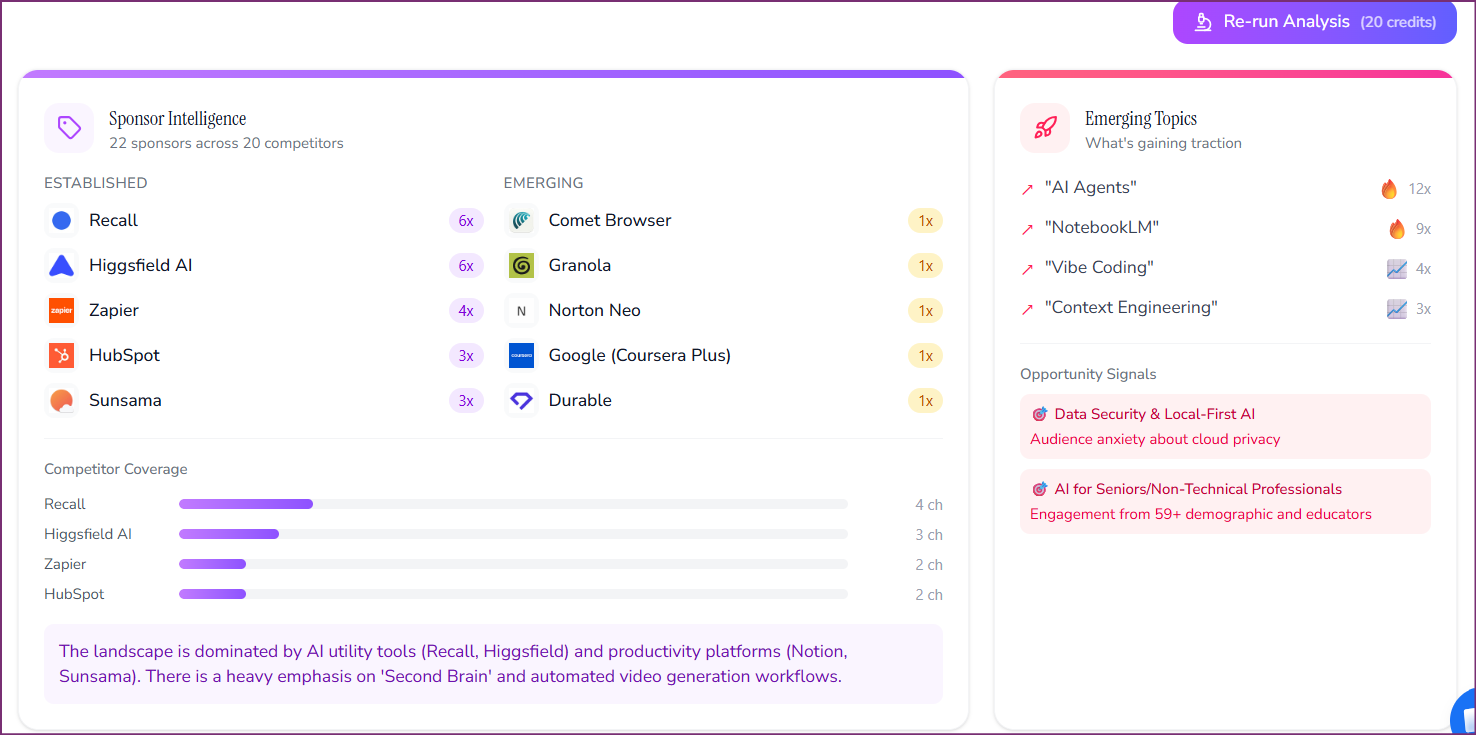
Sponsor Intelligence reveals which brands are already sponsoring creators in your niche — and which emerging sponsors are gaining traction.
How to do it:
- 1Search for competitor brand names on YouTube to find sponsored content
- 2Check the descriptions and pinned comments of competitor videos for “sponsored by” mentions
- 3Look at the “Collaborations” or “Featuring” sections on competitor channels
- 4Use OutlierKit to analyze competitor channels and find which videos mention brand partnerships
- 5Build a list of influencers who have worked with similar brands in your space
Pro tip: Creators who have worked with one brand in your industry are 3x more likely to accept a deal from another. They already understand the niche and know how to create product-focused content.
Method 4: Use Google Search with Site-Specific Operators
Google indexes YouTube content and surfaces it differently than YouTube’s own search. You can use Google’s advanced search operators to find micro-influencer content that doesn’t rank well on YouTube but still has engaged audiences.
How to do it:
- 1Search: site:youtube.com “[your product category] review” to find review-style creators
- 2Search: site:youtube.com “sponsored by” “[your industry keyword]” to find creators open to sponsorships
- 3Use Google’s “Tools > Past year” filter to find recently active creators
- 4Search blog posts like “best [niche] YouTube channels to follow in 2026” for curated lists
- 5Check Reddit threads about niche YouTube creators (r/NewTubers, r/SmallYTChannel, niche subreddits)
Pro tip: Curated blog posts and Reddit threads often list micro-influencers that tools miss. These are community-vetted creators with loyal followings.
Method 5: Explore Influencer Marketplaces and Databases
Influencer platforms aggregate creator data and make it searchable. While most focus on Instagram and TikTok, several have strong YouTube databases with filtering by subscriber count, niche, engagement rate, and audience demographics.
How to do it:
- 1Collabstr: Free to browse, filter YouTube creators by niche and subscriber count
- 2Heepsy: Search 11M+ influencers with audience quality filters
- 3Modash: Discover and filter 7.5M+ YouTube creators with detailed analytics
- 4HypeAuditor: Verify audience authenticity and check engagement quality
- 5Influencer Hero: YouTube-specific search with engagement rate calculators
Pro tip: Marketplaces are useful for initial discovery but often lack depth. After finding potential micro-influencers, run them through OutlierKit’s channel analysis to verify their content quality, audience psychographics, and identify which of their videos actually outperformed.
Method 6: Find Lookalike Channels from Your Top Performers
Once you find one successful micro-influencer, use them as a seed to discover similar creators. YouTube’s algorithm and analytics tools can surface channels with overlapping audiences.
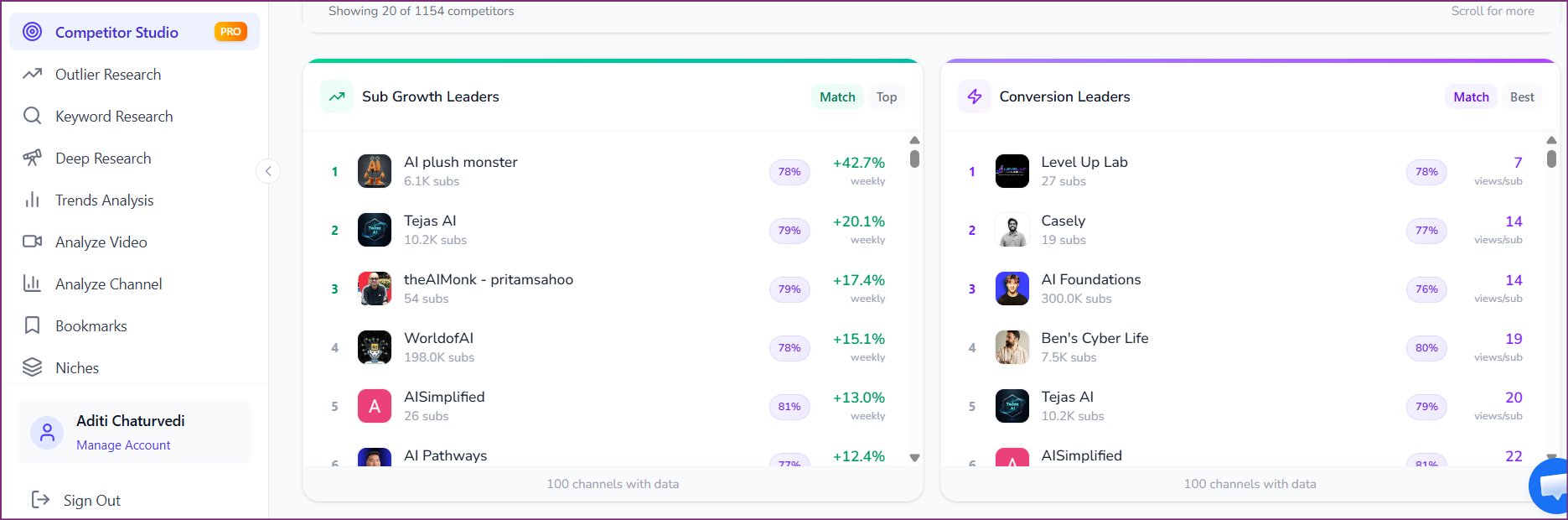
Growth and Conversion Leaders boards surface the fastest-rising channels — ideal for finding micro-influencers on an upward trajectory.
How to do it:
- 1Check the “Featured Channels” section on a successful micro-influencer’s page
- 2Look at the “Up next” and “Related channels” suggestions when watching their videos
- 3Use OutlierKit Competitor Studio with the successful channel as a seed — it finds content-similar channels automatically
- 4Check who appears in collaboration videos with your known micro-influencers
- 5Review the comment sections of your best micro-influencers — other creators often engage there
Pro tip: The “lookalike” method is the highest-ROI discovery approach because you start from a proven baseline. If one micro-influencer converts well, similar channels often perform just as well.
Method 7: Join Niche Communities and Creator Networks
The best micro-influencers are often active in niche communities — Discord servers, Facebook groups, subreddits, and industry forums. These creators are typically more approachable and have more authentic audience relationships.
How to do it:
- 1Join niche-specific Discord servers and Facebook groups where creators congregate
- 2Monitor subreddits like r/InfluencerMarketing, r/NewTubers, and niche-specific subreddits
- 3Attend virtual creator meetups and conferences
- 4Check YouTube community posts from channels in your niche for cross-promotions
- 5Use Twitter/X search for “[niche] YouTuber” or “[niche] YouTube channel”
Pro tip: Community-sourced influencers often have the strongest audience trust because their following grew organically from genuine expertise, not algorithm hacks.
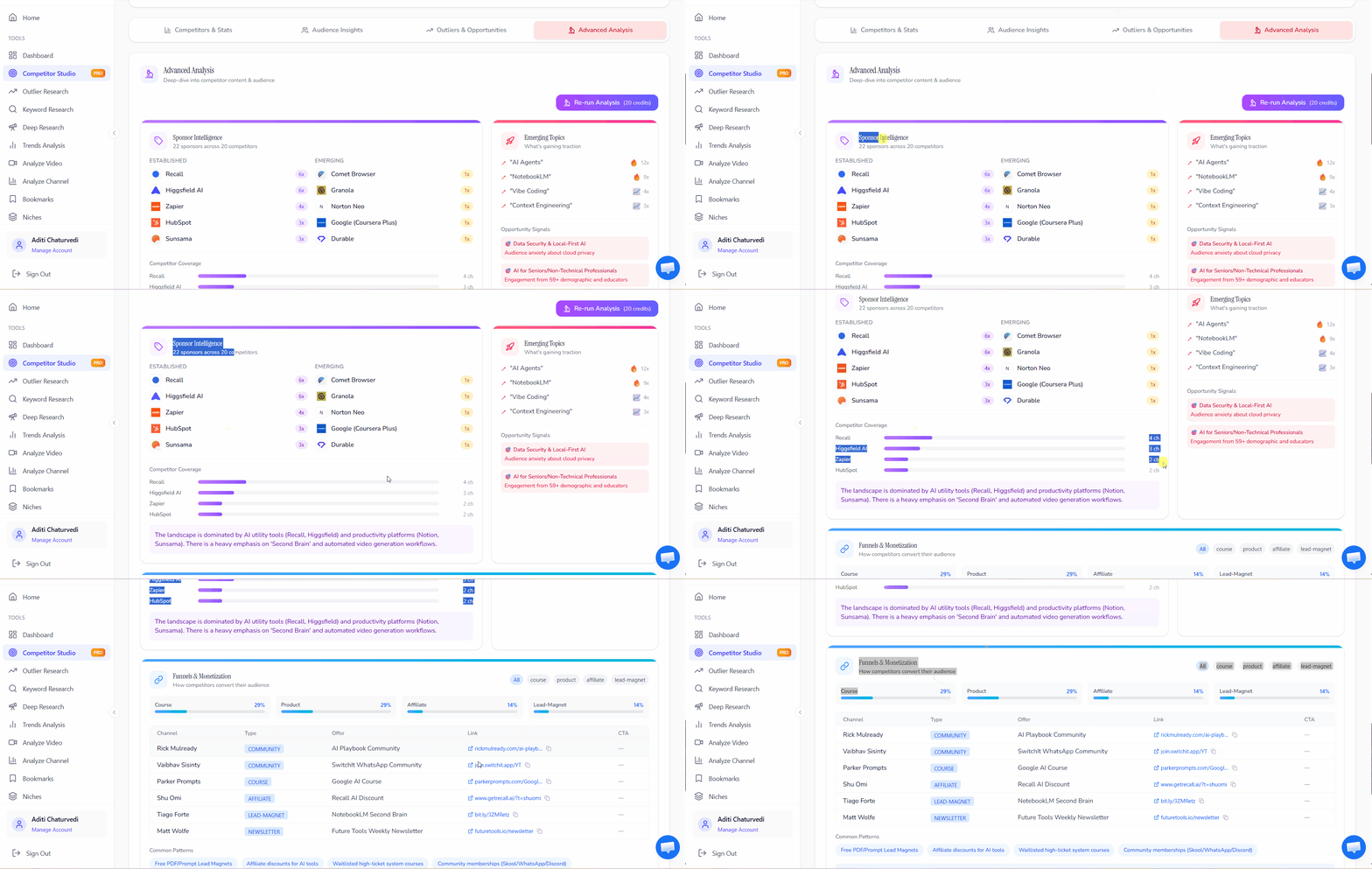
Competitor Studio deep analysis — audience insights, video content analysis, sponsor intelligence, and emerging topic detection.
How to Evaluate Micro-Influencers with OutlierKit
Finding micro-influencers is step one. The critical second step is evaluating whether a creator's audience actually aligns with your goals. OutlierKit provides three layers of analysis that go beyond surface-level subscriber counts.
1. Audience Psychographic Analysis
OutlierKit analyzes a creator's content and audience signals to build a psychographic profile — what motivates their viewers, what problems they care about, and what emotional triggers drive engagement. This tells you whether the creator's audience will resonate with your product positioning, not just whether they match demographically.
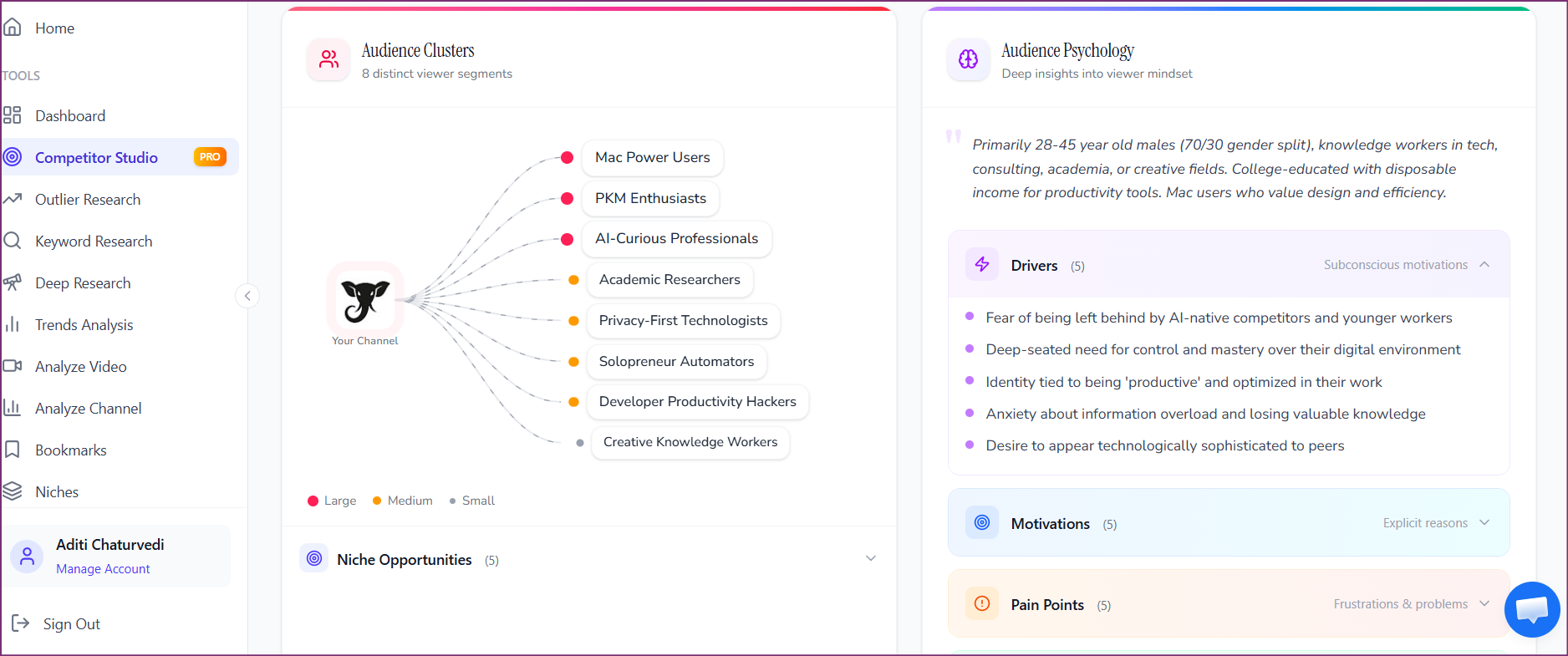
Psychographic analysis reveals audience clusters, motivations, drivers, and pain points — so you know if a micro-influencer's viewers match your buyer persona.
2. Outlier Video Detection
OutlierKit identifies which videos significantly outperformed the channel's average (3x, 5x, 10x+). These outlier videos reveal what content resonates most with the audience — and give you a blueprint for what kind of sponsored content will perform best. If a creator's outlier videos are product reviews and comparisons, a sponsorship integration will feel natural. If their outliers are vlogs and stories, a scripted ad read may feel forced.
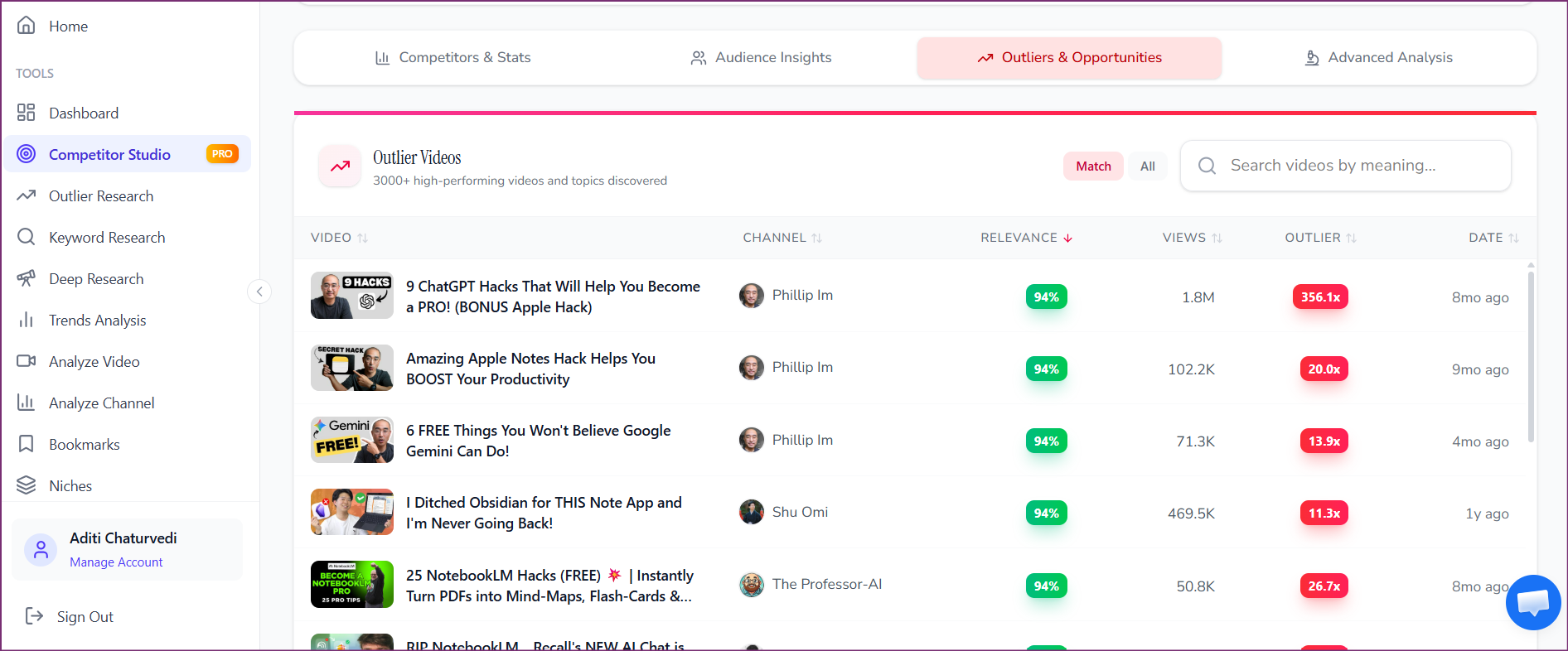
Outlier video detection surfaces the top-performing videos across all competitors — showing you which content formats drive exceptional results.
3. Content Performance Patterns
OutlierKit maps performance trends across a channel's entire video library. You can see whether the creator is growing, plateauing, or declining — and which content formats consistently perform. This data helps you negotiate smarter: partner with creators on an upward trajectory, and propose content formats that align with their audience's proven preferences.
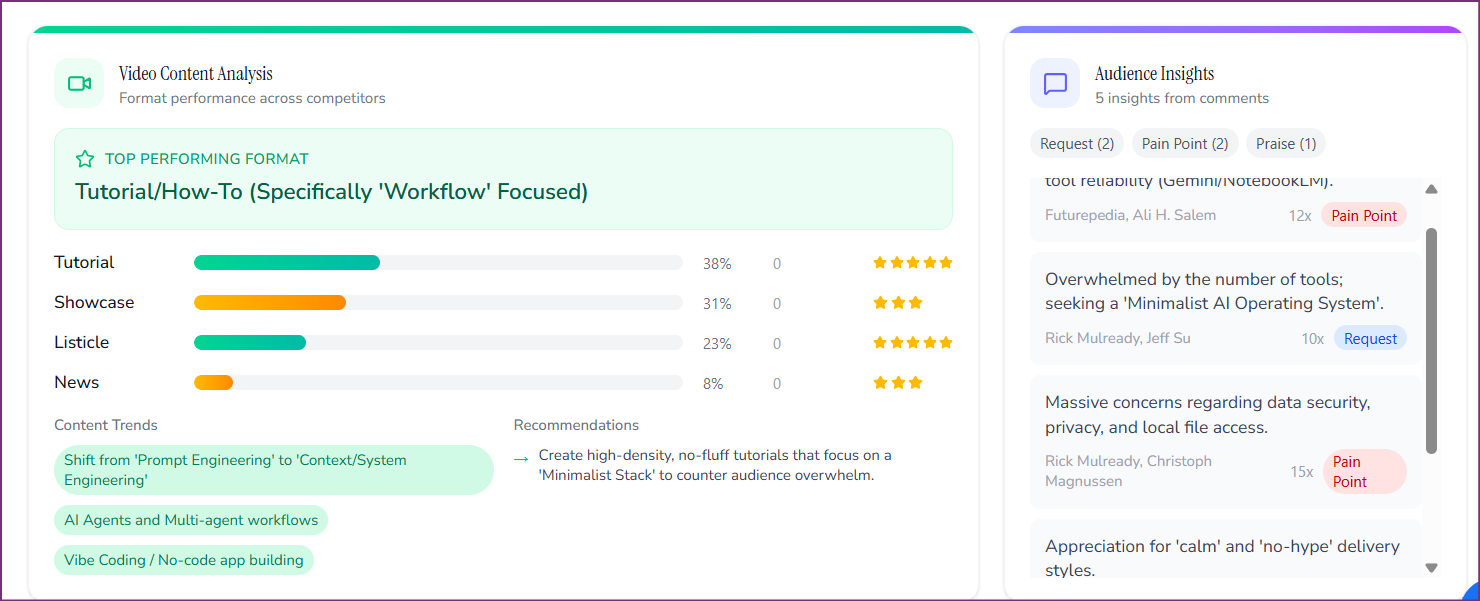
Content analysis breaks down top formats, content trends, and audience insights — so you can brief the right content type for your sponsored video.
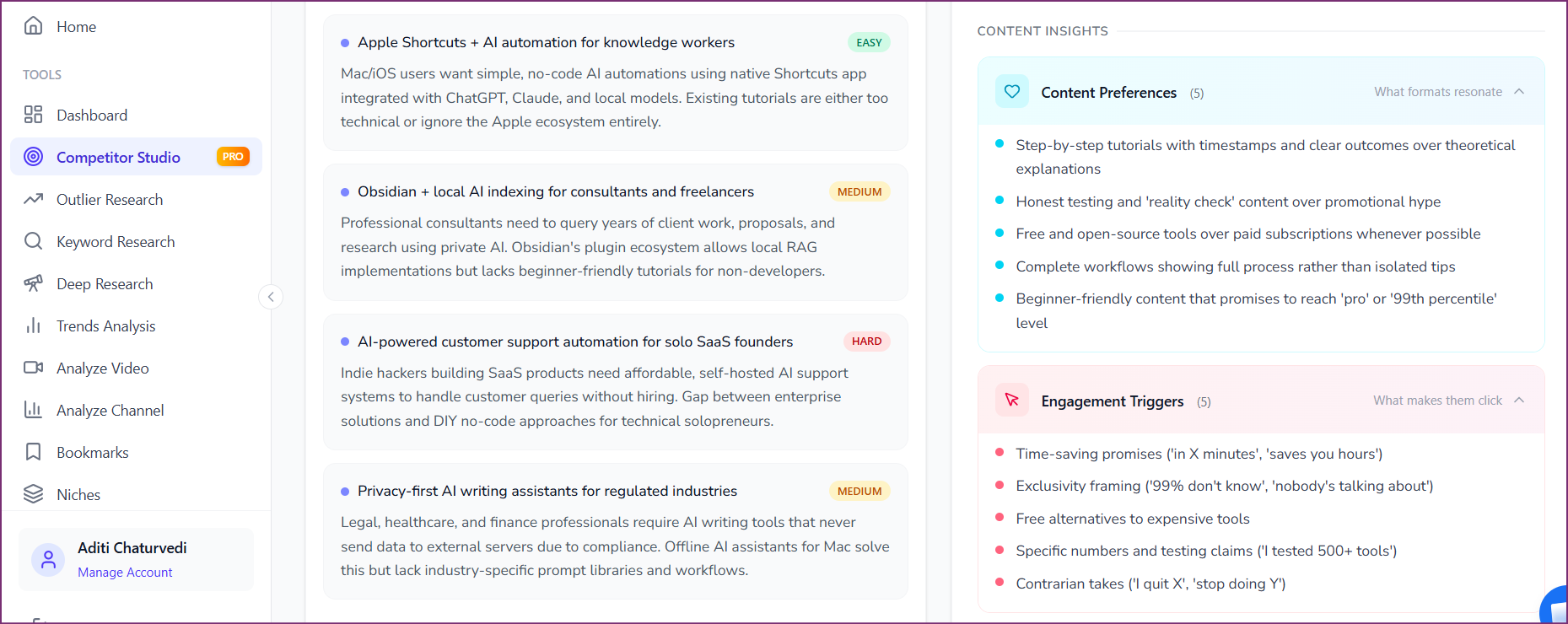
Understand what makes a micro-influencer's audience click — niche opportunities, content preferences, and engagement triggers inform your sponsorship brief.
Micro-Influencer Vetting Checklist
Use this checklist before signing any micro-influencer partnership. A creator can have the right subscriber count but the wrong audience, low-quality engagement, or brand safety risks.
Engagement Quality
- ✓Average engagement rate above 4% (likes + comments / views)
- ✓Comments are genuine conversations, not spam or bot-generated
- ✓Creator responds to comments regularly
- ✓Like-to-dislike ratio is healthy (above 95% positive)
Content Quality
- ✓Production quality matches your brand standards
- ✓Content is consistent with your brand values and messaging
- ✓Creator has a clear content niche — not random topics
- ✓Videos maintain watch time (check via OutlierKit outlier analysis)
Audience Fit
- ✓Audience demographics match your target buyer persona
- ✓Audience psychographics align with your product positioning
- ✓Geographic distribution matches your market
- ✓Subscriber growth is steady, not spikey (no bought followers)
Brand Safety
- ✓No controversial or off-brand content in recent uploads
- ✓No history of fake engagement or purchased subscribers
- ✓Creator discloses sponsorships properly (FTC compliance)
- ✓Past brand partnerships were executed professionally
YouTube Micro-Influencer Sponsorship Rates in 2026
YouTube micro-influencer sponsorship rates range from $200 to $5,000 per collaboration in 2026. Rates vary by content format, niche, audience geography, and creator demand. You can cross-reference a creator's performance data in YouTube Studio if they share access. Here is what to budget by format type.
| Content Format | Micro-Influencer Rate | What You Get |
|---|---|---|
| Dedicated Video | $1,000 - $5,000 | Entire video focused on your product. Highest conversion but most expensive per creator. |
| Integration / Mention | $200 - $1,500 | 30-90 second segment within a regular video. Best balance of cost and authenticity. |
| YouTube Shorts | $100 - $500 | Short-form vertical video. Great for awareness at low cost per impression. |
| Product Review | $500 - $3,000 | In-depth review of your product. High trust factor with niche audiences. |
| Affiliate Partnership | 10 - 30% commission | Performance-based. Lower risk; creator earns per conversion. |
Rate note: Finance, tech, and B2B niches command 40–60% higher rates than lifestyle or entertainment niches. Creators with a US/UK-dominant audience charge 20–30% more than those with global audiences due to higher advertiser CPMs in those markets.
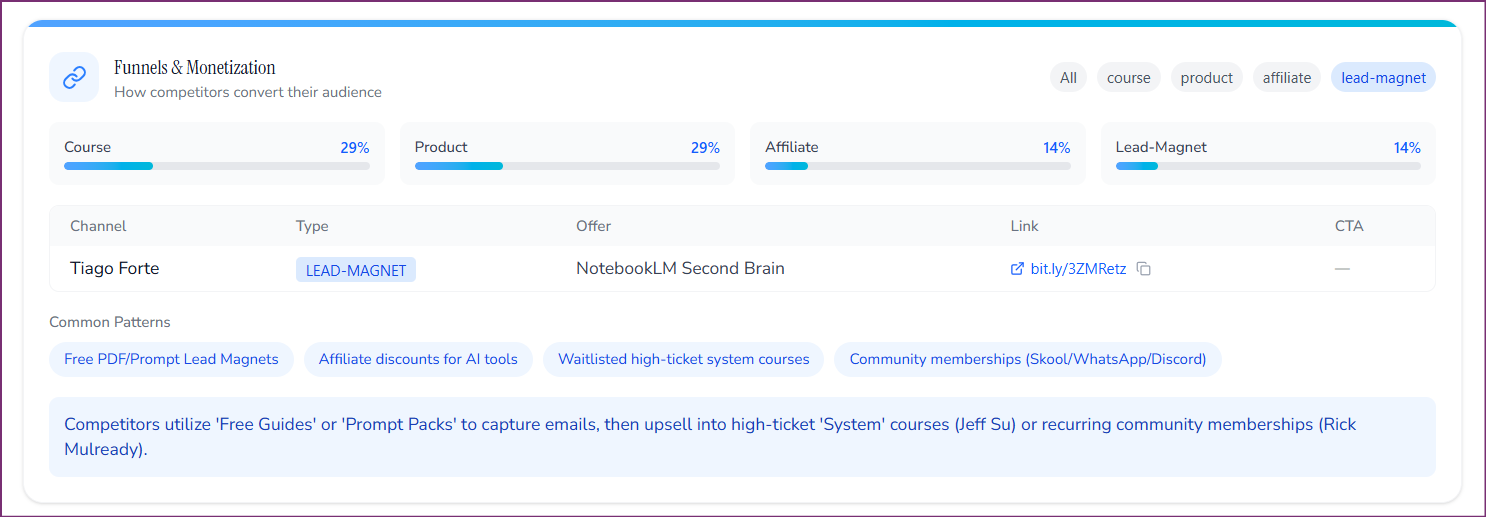
Funnels & Monetization shows how micro-influencers in your niche monetize — helping you propose sponsorship formats that align with their existing revenue model.
5 Common Mistakes When Finding YouTube Micro-Influencers
Mistake 1: Choosing by subscriber count alone
Why it fails: A 50K-subscriber channel with 500 views per video has purchased followers or lost audience interest. Subscriber count without corresponding view performance is a vanity metric.
Do this instead: Check the view-to-subscriber ratio on recent videos. A healthy micro-influencer gets 10–30% of their subscriber count in views per video.
Mistake 2: Ignoring audience psychographics
Why it fails: A tech channel with 50K subscribers might have an audience of casual viewers, not buyers. Demographics match, but purchase intent does not.
Do this instead: Use OutlierKit's psychographic analysis to understand what motivates the audience. Are they information seekers, comparison shoppers, or impulse buyers?
Mistake 3: Not checking content-brand fit
Why it fails: A micro-influencer might be in the right niche but create content that clashes with your brand tone — overly casual for a B2B product, or too polished for an indie brand.
Do this instead: Watch 3–5 recent videos before reaching out. Check their outlier videos in OutlierKit to see which content style their audience rewards most.
Mistake 4: Using only one discovery method
Why it fails: Each method surfaces different types of creators. Marketplace-only searches miss community-grown influencers. YouTube-only searches miss creators who rank better on Google.
Do this instead: Use at least 3 of the 7 methods above. Start with OutlierKit Competitor Studio for scale, then supplement with manual YouTube search and community discovery.
Mistake 5: Skipping the outlier video analysis
Why it fails: You partner with a creator without understanding what content their audience actually responds to. The sponsored video underperforms because it does not match the format or topic that drives their best results.
Do this instead: Run every shortlisted creator through OutlierKit's outlier detection. Use the patterns in their top-performing videos to brief the sponsored content format.
Frequently Asked Questions
Basics
What is a YouTube micro-influencer?
A YouTube micro-influencer is a content creator with 10,000 to 100,000 subscribers who maintains a highly engaged niche audience. Micro-influencers on YouTube average 4–7% engagement rates compared to 0.5–2% for mega-influencers (1M+ subs). Brands work with YouTube micro-influencers because they deliver higher engagement, more authentic endorsements, and better ROI per dollar spent than larger creators.
How much does it cost to sponsor a YouTube micro-influencer?
YouTube micro-influencer sponsorship rates range from $200 to $5,000 per collaboration in 2026. Dedicated videos cost $1,000–$5,000, integrations cost $200–$1,500, Shorts cost $100–$500, and product reviews cost $500–$3,000. Rates vary by niche (finance and tech pay more than lifestyle), audience geography (US/UK audiences command premium rates), and deliverable type. Affiliate partnerships typically offer 10–30% commission as an alternative to flat-fee sponsorships.
What engagement rate should I look for in a YouTube micro-influencer?
A good engagement rate for a YouTube micro-influencer is 4–7%. Engagement rate on YouTube is calculated as (likes + comments) / views × 100. Rates above 7% indicate an exceptionally loyal audience. Rates below 3% on a micro-channel may signal purchased subscribers or disengaged viewers. Always check comment quality alongside the raw percentage — genuine conversations matter more than volume.
Evaluation & Strategy
How do I verify a YouTube micro-influencer is legitimate?
Verify a YouTube micro-influencer by checking five signals: (1) Steady subscriber growth over 6+ months (no sudden spikes from purchased followers), (2) Comment quality — genuine conversations, not spam, (3) View-to-subscriber ratio above 10% on recent videos, (4) Consistent upload schedule (at least 2 videos per month), (5) Audience demographics matching your target market. Tools like OutlierKit’s channel analysis show audience psychographics and identify outlier videos to confirm genuine engagement patterns.
Are micro-influencers better than macro-influencers for YouTube sponsorships?
Micro-influencers outperform macro-influencers on engagement and ROI for most YouTube sponsorship campaigns. Micro-influencers (10K–100K subs) deliver 4–7% engagement rates versus 1.5–3% for macro-influencers (500K–1M subs). They cost 80–90% less per collaboration. And 82% of consumers are more likely to follow a micro-influencer’s recommendation because the endorsement feels personal and authentic. Macro-influencers are better only when the primary goal is broad awareness rather than conversions.
What is the best tool to find YouTube micro-influencers?
The best tool to find YouTube micro-influencers depends on your needs. OutlierKit’s Competitor Studio discovers thousands of niche-matched YouTube channels and classifies them by subscriber count, upload frequency, and view performance — making it ideal for identifying and vetting micro-influencers. Collabstr offers a free marketplace for browsing creators. Heepsy and Modash provide large searchable databases with audience quality filters. HypeAuditor specializes in detecting fake followers and verifying audience authenticity.
Campaign Execution
How many micro-influencers should I work with per campaign?
Most successful YouTube micro-influencer campaigns work with 5–15 creators simultaneously. Working with multiple micro-influencers diversifies risk (if one underperforms, others compensate), provides content variety, and allows A/B testing different messaging angles. Start with 3–5 creators for your first campaign to learn what formats and niches convert best, then scale to 10–15 for subsequent campaigns based on performance data.
How do I approach a YouTube micro-influencer for a sponsorship?
Approach YouTube micro-influencers through email (found in their About/Description section), not DMs. Personalize your pitch by referencing a specific video you watched and explain why your product fits their audience. Include: your brand name, what you’re offering (free product, flat fee, or affiliate commission), expected deliverables, and timeline. Keep the initial email under 150 words. Micro-influencers receive fewer pitches than larger creators, so response rates are typically 20–40% for well-targeted outreach.
Start Finding YouTube Micro-Influencers Today
YouTube micro-influencer marketing delivers the highest ROI of any influencer tier in 2026. Micro-influencers cost $200–$5,000 per collaboration, drive 4–7% engagement rates, and build authentic trust with niche audiences that larger creators cannot match.
The discovery process does not have to be manual. Use OutlierKit's Competitor Studio to surface thousands of niche-matched channels, filter by subscriber count and activity level, then run your shortlist through the psychographic and outlier analysis to identify which creators will deliver real results for your brand.
Key takeaways:
- 1.YouTube micro-influencers (10K–100K subs) deliver 3x higher engagement than mega-influencers at 80–90% lower cost
- 2.Use multiple discovery methods — tool-based search, direct YouTube search, competitor sponsorship analysis, and community sourcing
- 3.Always vet engagement quality over subscriber count — 4%+ engagement rate with genuine comments signals real influence
- 4.Analyze outlier videos to understand what content format your sponsored video should follow
- 5.Budget $200–$5,000 per micro-influencer depending on format type (dedicated video, integration, Shorts, or affiliate)

Find micro-influencers in your niche with Competitor Studio
OutlierKit's Competitor Studio discovers thousands of YouTube channels in any niche, classifies them by subscriber count, upload frequency, and view performance. Filter for micro-influencers, analyze their audience psychographics, and identify their outlier content — all in one tool.
Try OutlierKit FreeRelated Guides
YouTube Nano-Influencer Sponsorship Rates & Guide (2026)
Rate benchmarks for nano-influencers (1K–10K subs) by format, niche, and geography. Plus negotiation frameworks.
YouTube Marketing Strategy: Complete 2026 Guide
The full YouTube marketing playbook — channel setup, content strategy, SEO, tools, and real examples.
How to Analyze Competitors' Content Strategy on YouTube
Decode content pillars, upload patterns, title formulas, and audience engagement tactics from competitor channels.