YouTube Gaming Channel Growth Strategy: Win the Sub-Niche
The gaming growth strategy for 2026: pick a winnable sub-niche instead of a popular game. Build a named series format on top of it. Commit to one lane, stream-first or produced-first. Then mine outliers per game moment, because gaming breakouts reward speed-to-meta.
Gaming is YouTube's most crowded category. Our subscriber benchmarks by niche count 33,680 active gaming channels, the largest group of the 20 niches, with a median of 16,000 subscribers and a top 1% line of 3.93 million. Big channels cannot serve every sub-niche, so small channels still grow there. The steps below compare streamers like xQc (live channel analysis) and Kai Cenat with producers like Alan Becker and Design Doc. This is the gaming edition of the YouTube growth strategy playbook. For a worked example, read the gaming channel case study.
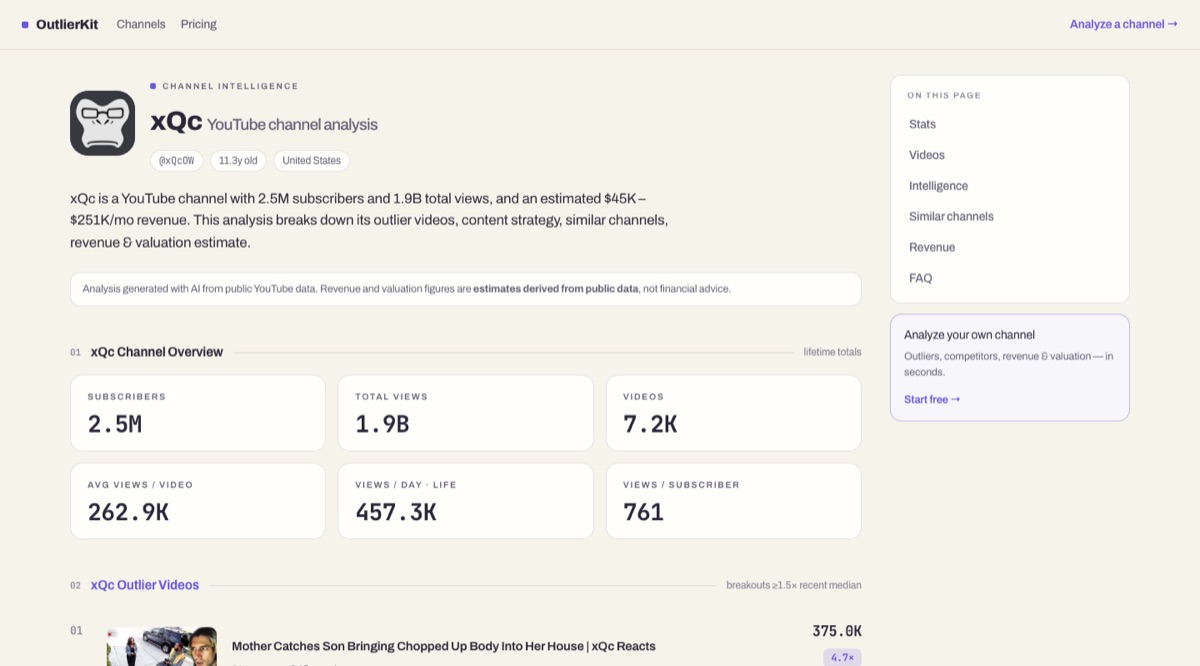
The live xQc channel analysis on OutlierKit: the stream-first gaming economy at full scale
Which gaming channels show both ways to grow?
These analyses cover stream-first and produced-first gaming channels, with outlier videos, upload cadence, and revenue estimates:
OutlierKit Channel Analysis

xQc
Gaming & live streaming
- Subscribers
- 2.5M
- Avg views
- 262.9K
- Total views
- 1.9B
OutlierKit Channel Analysis

Kai Cenat
Live streaming
- Subscribers
- 8.0M
- Avg views
- 1.5M
- Total views
- 437.5M
OutlierKit Channel Analysis

Alan Becker
Animation & gaming
- Subscribers
- 33.6M
- Avg views
- 36.1M
- Total views
- 9.6B
OutlierKit Channel Analysis

Design Doc
Game-design essays
- Subscribers
- 369.0K
- Avg views
- 265.7K
- Total views
- 39.1M
Stats are from our most recent snapshot of each channel. For live numbers, outlier videos, and up-to-date revenue estimates, run a fresh analysis on OutlierKit →
How do you grow a gaming channel in 5 steps?
Gaming is YouTube's most saturated top-level category, but many of its sub-niches are still open. 'Fortnite' is unwinnable. 'Fortnite building tutorials for controller players' has real demand and beatable competition. Before you commit, check demand, saturation, and whether small channels are breaking out right now.
Durable gaming channels run on a signature series: a named, recurring format viewers subscribe for. Jesser's challenge formats and Alan Becker's Animation vs. series follow this pattern. A series holds viewers across episodes, shows the algorithm who your audience is, and turns casual viewers into regulars.
Stream-first and produced-first channels grow in different ways. Stream-first channels (xQc, Kai Cenat) build a loyal live audience, then cut clips for reach. They need personality stamina and a clip pipeline. Produced-first channels (Design Doc, Alan Becker) build evergreen videos that keep earning views. They need editing craft and patience. Channels that try both before either one works usually stall.
Gaming outliers cluster around game moments such as updates, metas and discoveries, more than around channels. Track which video concepts break out across your sub-niche each week. When a format breaks out on another channel during a game's moment, you have about 48 hours to publish your version. Speed to the new meta works like speed on a breaking news story.
YouTube pushed live gaming hard in 2025 and 2026. It added dual-format streaming (vertical and horizontal at once), improved gifting payouts, and backed MrBeast-scale streamer events that pull mainstream attention to live. Shorts remain gaming's cheapest discovery surface, so clip your best moments into vertical with the same care you give thumbnails.
Should a gaming channel stream or make produced videos?
| Dimension | Stream-first (xQc, Kai Cenat) | Produced-first (Alan Becker, Design Doc) |
|---|---|---|
| Core asset | Parasocial relationship, live hours | Evergreen video catalog |
| Discovery engine | Clips and Shorts harvested from streams | Search + suggested on polished uploads |
| Time economics | High hours, low edit cost | Low hours on camera, high edit leverage |
| Monetization center | Gifting, memberships, sponsor reads | AdSense on evergreen views, sponsorships |
| Best for | High-energy personalities with stamina | Craft-driven creators, analysts, animators |
Frequently Asked Questions
What is the best YouTube gaming channel growth strategy for 2026?
Win a sub-niche instead of a game. Target specific intersections ('roguelike build guides', 'Minecraft redstone for beginners') where demand is real and competition is beatable. Then build a named, repeatable series format on top. Choose one lane: stream-first with a clip pipeline, or produced-first with evergreen videos. Mine outliers across your sub-niche weekly, because gaming breakouts cluster around game moments and reward speed. In 2026, add live formats and Shorts clipping as force multipliers.
Is it too late to start a gaming YouTube channel in 2026?
At the category level, yes. At the sub-niche level, no. Broad lets-plays of popular games are effectively closed to new channels. But every game update, indie release, and meta shift opens temporary gaps where small channels break out. Sub-niches like game-design analysis, speedrun explainers, and niche-genre guides still show small-channel outliers monthly. What decides it is whether you pick your spot with data or by playing whatever's popular.
Should a gaming channel stream or make edited videos?
Pick one first. Streaming builds community depth and clips cheaply into Shorts. But it demands hours of consistent live presence and personality carry. That is how xQc and Kai Cenat dominate. Produced video compounds better per hour invested. It suits analysis, tutorials, and narrative formats: the Design Doc and Alan Becker path. The mature playbook eventually combines them (stream for depth, produce for reach). But do that only after one engine is actually working.
How do gaming channels grow with YouTube's 2026 live features?
Three levers. First, dual-format streaming broadcasts vertical and horizontal at the same time. Mobile Shorts-feed viewers discover your live content with no extra work. Second, improved gifting and monetization make live revenue meaningful below mega-scale. Third, YouTube promotes marquee live gaming events, which keeps pulling mainstream audiences into live. For growing channels, the practical move is a consistent weekly stream. Harvest it into 5-10 Shorts and 1-2 produced highlights.
What gaming sub-niches are growing fastest in 2026?
The durable winners share one trait. They attach to evergreen player intent rather than a single title's popularity. Think game-design analysis, build/strategy guides for live-service games, animation-adjacent gaming content, and retro/indie discovery. Specific titles rotate too fast to list. Run niche research on current demand rather than trusting any static list, including this one.
Which smaller gaming channels broke out, and why?
These analyses cover let's plays, devlogs, and hardware and benchmark channels, with the uploads that broke out:
OutlierKit Channel Analysis

Call Me Kevin
Chaotic Gaming & Let's Play
- Subscribers
- 3.7M
- Avg views
- 1.2M
- Total views
- 2.4B
OutlierKit Channel Analysis

Dani
Gamedev Entertainment
- Subscribers
- 3.6M
- Avg views
- 4.4M
- Total views
- 297.8M
OutlierKit Channel Analysis

Bringus Studios
Cursed Tech & Retro Hardware Modding
- Subscribers
- 1.0M
- Avg views
- 971.3K
- Total views
- 158.3M
OutlierKit Channel Analysis

マフィア梶田と中村悠一の「わしゃがなTV」
Otaku Nostalgia & Unboxing
- Subscribers
- 937.0K
- Avg views
- 681.8K
- Total views
- 697.5M
OutlierKit Channel Analysis

KhrazeGaming
Action-RPG Guides & News
- Subscribers
- 648.0K
- Avg views
- 172.7K
- Total views
- 436.5M
OutlierKit Channel Analysis

Dammit Jeff
Hardware Modding & Tech Jailbreaking
- Subscribers
- 502.0K
- Avg views
- 807.9K
- Total views
- 69.5M
OutlierKit Channel Analysis

Goodgis
Indie Game Development & Creative Devlogs
- Subscribers
- 264.0K
- Avg views
- 288.5K
- Total views
- 24.8M
OutlierKit Channel Analysis

BenchmarKing
PC Gaming Performance Optimization
- Subscribers
- 163.0K
- Avg views
- 140.7K
- Total views
- 20.0M
Stats are from our most recent snapshot of each channel. For live numbers, outlier videos, and up-to-date revenue estimates, run a fresh analysis on OutlierKit →
Sources and method
The gaming channel counts and subscriber lines come from OutlierKit's subscriber benchmark across 20 niches. The channel examples come from the live OutlierKit channel analyses linked on this page. The five steps and the 48-hour window are editorial guidance drawn from those public channel patterns, not a survey OutlierKit ran.
Sources
- Subscriber benchmarks by niche: gaming channel count, median and top 1% subscriber line
- OutlierKit xQc channel analysis: the stream-first economy at full scale
- YouTube's live streaming push: dual-format streaming and gifting changes

Related reading
Find the gaming sub-niche you can win
Niche Research scores gaming sub-niches by demand and saturation; Outlier Finder catches the game-moment breakouts while the window is open.
Try OutlierKit Free