
Picking low-competition topics is honestly the one thing that changes everything for a YouTube channel. And we sort it before the script even exists. The algorithm doesn't reward effort. It rewards videos people actually want. Get the topic right, and everything after it becomes easier. We learned this the slow way by studying outlier videos on small channels you'd never expect.
So here's the whole thing, start to finish. We will cover why we pin the topic down before filming. Then the 8 steps we actually run through. And last, the mistakes that waste a whole weekend of shooting.
Why We Lock In Low-Competition Topics Before Writing a Word
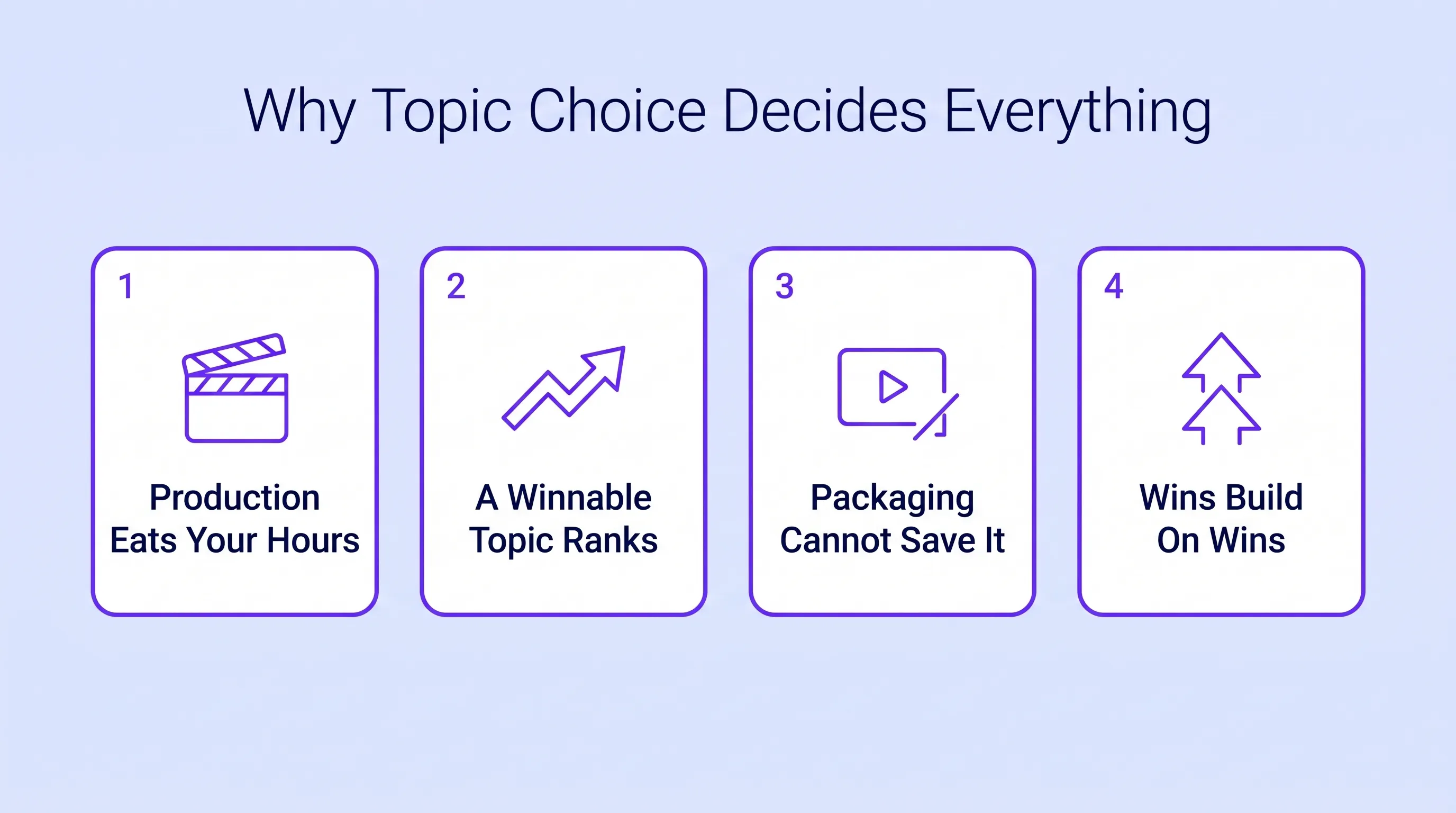
Quick why before the how. It is so tempting to just film whatever you are hyped about right now. We did that for ages. Then it kept flopping. Turns out the topic settles most of a video's fate before the camera even turns on. So it has become the starting point of our content strategy, and now we treat it as the decision that matters most.
1. The Script and Shoot Eat Your Best Hours
Look at where your week really goes when you are video blogging. Writing the thing. Setting up lights. Filming it twice because you flubbed the first take. Then a long night in the edit. Aim all that at a topic nobody wants, and you have wasted your best hours for nothing. And the topic is free to change up front but a nightmare once it is filmed.
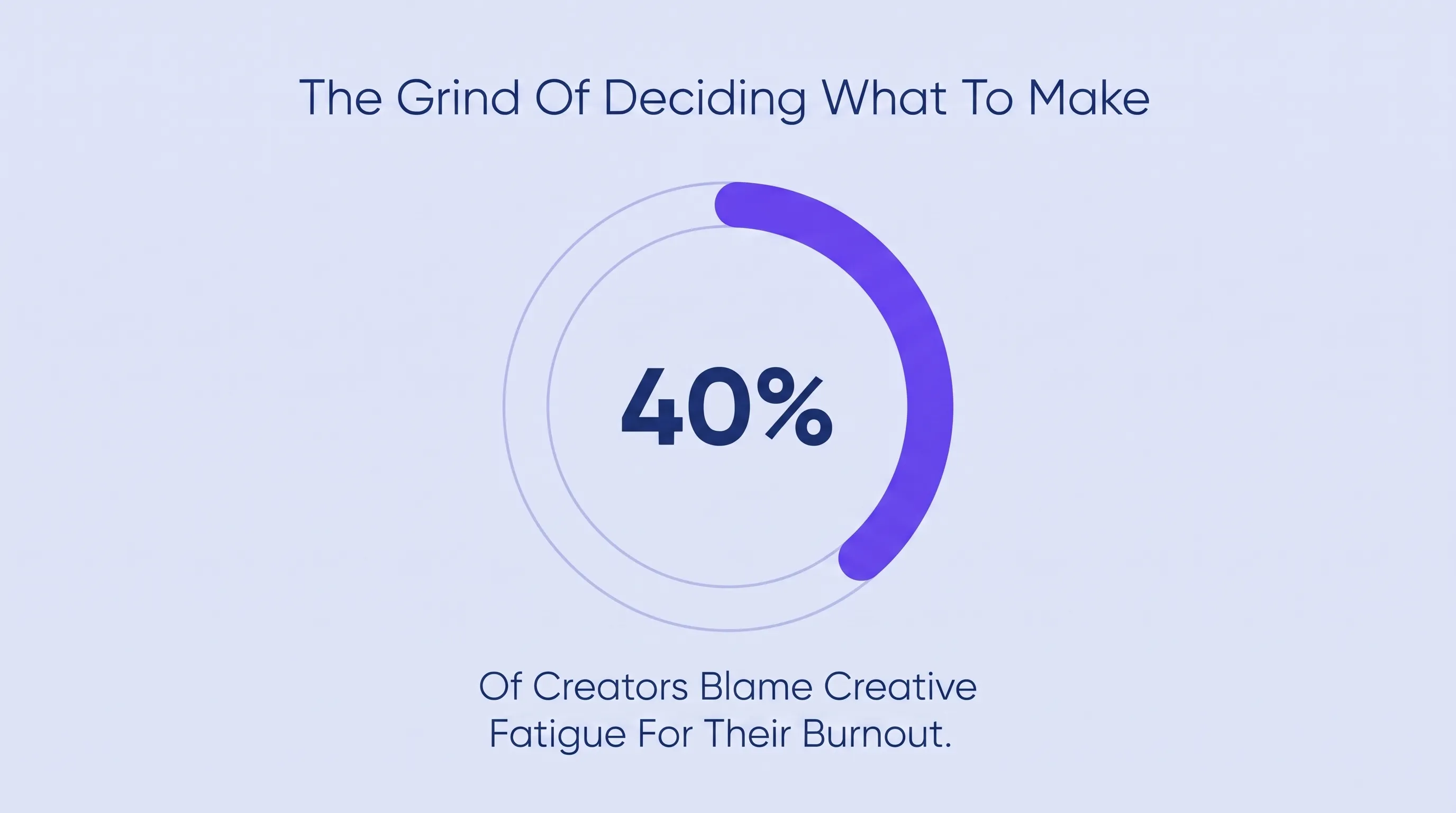
So the choice you make in five quiet minutes beforehand outweighs everything you put in later. 40% of creators blame creative fatigue for their burnout. A big portion of that is just the grind of deciding what to film next. Sort your topics early, and a lot of that weight lifts off you.
2. A Winnable Topic Does the Hard Part for You
This one still surprises people. Put a great video on a competitive topic, and it can still vanish. A hundred bigger channels are sitting on top of it. Put an average video on a quiet topic, and it can bring in massive traffic. It is one of the only decent answers out there. The topic is doing the job, not your subscriber count.
What You Are Weighing | A Crowded Topic | A Low-Competition Topic |
|---|---|---|
People searching it | Loads | Still plenty |
Strong videos already up | Dozens | Hardly any |
Your shot at the top spot | Slim | Wide open |
3. No Title or Thumbnail Rescues a Video Nobody Searches
You can write a killer title and build a thumbnail people can't help clicking. Doesn't matter. If nobody is looking for the topic, your video has nowhere to turn up. A high-quality video and a perfect package on a dead subject gets no visibility. To rank well, the search has to exist first. Packaging only decides who clicks once YouTube is already pushing your video out.
4. One Good Low-Competition Topic Feeds the Next
One winnable topic rarely stays a single video for long. When viewers find an answer to a specific question, their next question shows up right away, and your channel already has the trust to answer it. You stop chasing random viral swings and start building a connected body of work.
How We Find Low-Competition Topics Before Writing a Word
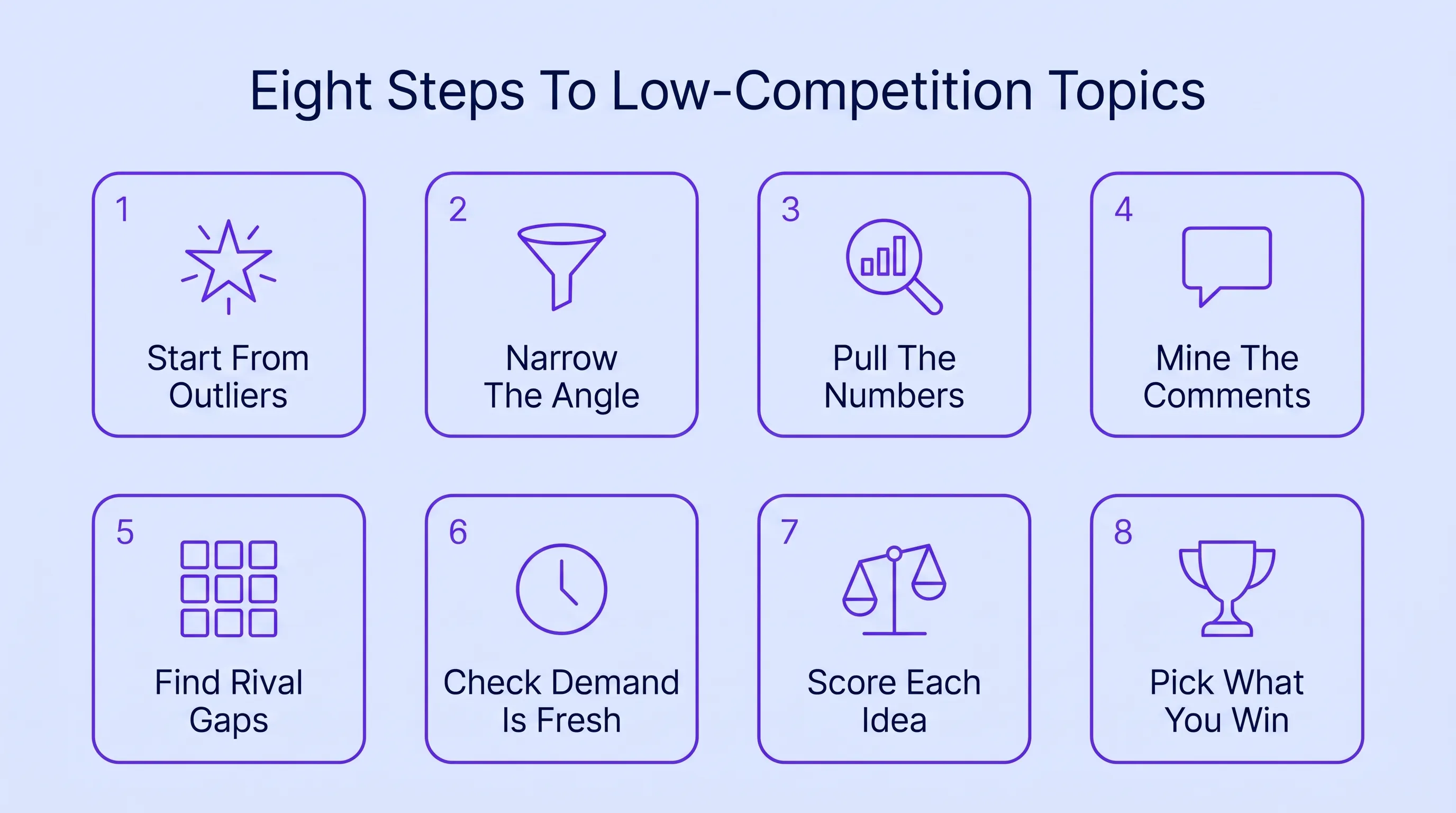
Okay, the process itself. This is the exact thing we run before we commit to filming any low-competition topics.
1. Start From Outliers on Small Channels, Not the Giants
We don't open a keyword tool first. We go looking for outliers. An outlier is just a video that did way better than its channel normally does. That is a flashing green light on a small channel. It means the topic did the work, not some huge built-in audience.
Find a handful of those on channels your size, and you have basically found topics with proven demand and nobody good in the way. You can discover similar opportunities by checking which smaller creators consistently outperform their usual view counts.
That is the untapped niche spot every small creator dreams about. This research can also help you identify profitable niches where viewers have clear interests and brands have products to sell.
Look at channels roughly your size, not the giant ones way above you
Go hunting for the videos that completely smashed their channel's usual view count
Save the topic itself rather than the exact video, since yours will be better
Round up about ten of them before you start judging any single one
2. Narrow a Crowded Topic Into a Low-Competition Angle
Most big topics are too busy to go at directly. So we chop them down. Think of something broad like meal prep. Totally brutal out there. Now get specific. Meal prep for night-shift nurses. Suddenly you are one of maybe three videos made for those exact people. The big topic brought the demand. The narrow one with less competition hands you the gap.
And narrow hardly ever means small. A tight angle tends to pull a smaller crowd that actually cares, the kind who can relate and subscribe. You are swapping a massive audience you will never win for a real one you can keep.
Start with a broad topic that clearly has plenty of demand behind it
Add a specific audience or a real situation to shrink the topic down
Keep going until the videos already up there look thin or dated
Just make sure a decent number of people still actually want that version
3. Pull the Search Numbers Behind Each Concept
Alright, gut-check time. An idea can look amazing and still have almost nobody actually searching for it. So before you fall in love, you add cold numbers after finding low-competition keywords to target. That is really all keyword research for YouTube comes down to.
Run your idea through a YouTube keyword research tool, and you get two metrics that settle the argument. One is rough search volume, which tells you how many people type that phrase. The other is a keyword difficulty score, which tells you how hidden you would be behind the competition. Some tools also suggest related queries that are worth checking.
Those numbers and suggestions matter more than they look. YouTube is the second-biggest search engine on earth after Google, so the demand you are measuring is very real. That makes SEO useful on YouTube too.
What you really want is the right balance. Moderate search volume right next to low keyword difficulty, which in plain English means real demand with hardly any good videos in your way. That combo is the whole definition of a low-competition topic worth targeting.
Pull both the search volume and the keyword difficulty for every idea
Chase the keywords with low competition where real demand still clearly exists
Bin any topic with high search volume but a wall of strong competitors
Trust proven view counts over a shiny search number when they clash
4. Mine the Comments for Questions Nobody Answered
Search numbers prove a topic has demand. Comments tell you what that demand actually sounds like, in real human words. People dump their confusion straight under videos. A question that keeps showing up with no decent answer is basically a video idea handed to you.
The richest gaps are under the top videos in your niche. You start seeing the exact intent behind each search when you break down those videos and their comments. That search intent is something no keyword tool alone ever gives you.
This gets seriously powerful if you actually sell something. Loads of product brands want a YouTube channel but have no clue what to film, so they default to a bland about-us video nobody watches.
The irony is they are sitting on the most profitable topic research technique going. It is hidden in their own sales data, blogs, and customer reviews.
Take this online mushroom supplement shop, for example. It ranks the products people buy the most. Every one shows a real review count right there. So you instantly see which products have the most engaged buyers behind them.
Now go read those reviews on the website. Buyers ask the same things on repeat. Does this actually help with focus? How long before it kicks in? Which extract is stronger? Each recurring question is a low-competition topic for that brand's channel with demand already proven by real sales.
A straight answer to something hundreds of customers asked will beat a generic brand video every time. And since almost nobody films one shop's specific products, the competition is wafer-thin. Any marketer can run it. Rank products by sales. Read the reviews. Then turn the repeat questions into your next ten videos.
Read the comments under the three biggest videos in your whole niche
Note down the exact questions that keep repeating across several different creators
Turn the single most-asked unanswered question into its very own video topic
If you sell products, mine your own customer reviews for topic ideas
5. Audit Where Your Competitors Went Quiet
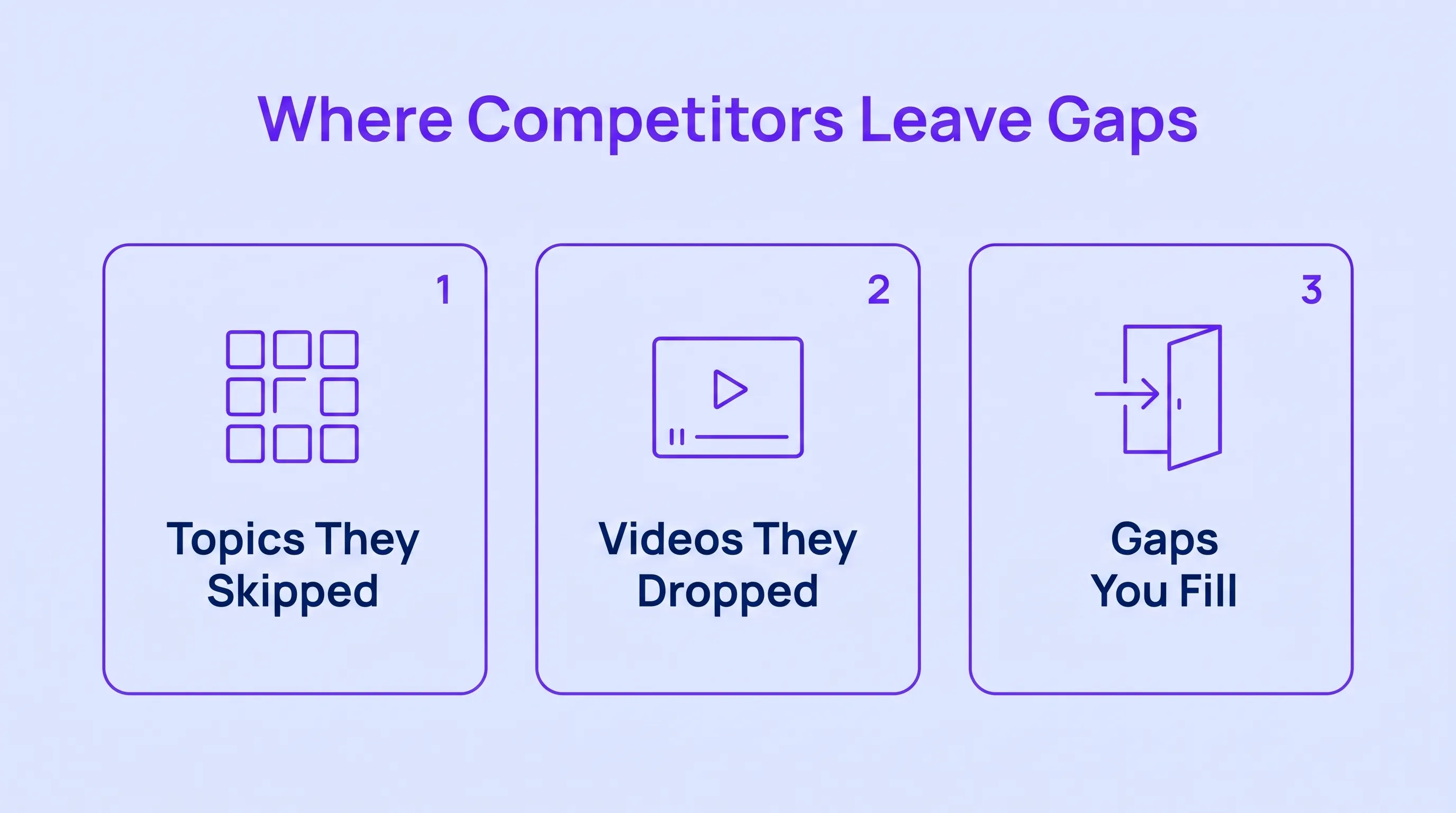
Your competitors have already done a mountain of research for you, totally free. The move is to read their channel for what is missing, not for what is there. Every topic they skipped is a little flare marking a gap they could not be bothered to fill.
Same goes for any video they tried once, then ghosted. Your competitors' unanswered topics are exactly where a smaller channel sneaks through. A quick competitor analysis pass helps you identify these gaps fast, especially on the bigger channels too busy to chase small wins.
Scan each rival channel for the obvious topics they never once covered
Spot the one-off videos they posted, then never once bothered following up
Check which of those gaps genuinely match your own channel strengths first
Move fast on gaps their bigger size makes them happy to ignore
6. Check the Demand Is Fresh, Not Fading
A topic with demand only counts if that demand is still breathing. Tons of ideas look juicy because they were massive two years back and stone dead since. You want interest holding steady or climbing, never a spike that already fizzled out.
So just because a topic was popular a while back doesn't mean people still want to watch it today. One way to stay a step ahead is to watch where a niche is heading before it even reaches search. In most markets, the press releases and product announcements are an early tell for what people will start asking about next.
Check whether interest in the topic is still climbing or already fading
Always favor steady evergreen demand over a spike that has clearly passed
Skip any topic that peaked long ago and never once came back
Jump on rising interest early, before the whole gap gets crowded out
7. Score Each Idea on Demand Versus Difficulty
By now you have a shortlist. And a shortlist is where good ideas go to die. The candidates blur together. The exciting ones win on vibes while the genuinely winnable ones slip your mind by the weekend. The real danger here is letting a gut feeling pick when the numbers can do it for you.
This stops being a notes-app job the second you scale up. Plenty of content teams run that pipeline on a planner like monday.com, and onboard a monday.com partner to swap all those scattered spreadsheets for one workspace that acts as a single source of truth.
Give every shortlisted topic both a demand score and a difficulty score
Rank the whole list so the easiest wins rise right up top
Keep all your candidates in one place, not scattered across random apps
Drop any idea that scores badly on both counts at the same time
8. Select the One You Are Built to Make Better
The last call is not just which topic wins on paper. It is which one you can genuinely turn into the best video out there. Your own experience is the tiebreaker. A topic where you have real stories or hard-won detail is one where you can out-make the current top ones in the search results.
Betting on a topic where you have no edge is just how you add another forgettable upload to the pile. So the goal is to pick where you are strongest, then put your energy into actually making it great.
Once a team grows past one person, many keep their video production hub on SharePoint. And with ShortPoint’s SharePoint AI Builder, you can create a complete, on-brand page in minutes just by describing what you want or dropping in a mockup.
Pick the topic where your own experience gives you a real edge
Only commit when you can genuinely beat the current best video out there
Keep your whole team's research and briefs together in one shared place
Spend your very best hours on the one angle only you own
3 Mistakes That Send You After the Wrong Low-Competition Topics

One last heads-up before you go run this on your own channel. These three have bitten us more than once. Every single one feels totally reasonable while you are doing it, which is exactly why they keep catching smart creators out.
1. Picking Topics You Find Interesting Instead of Ones That Win
This is the big one. And it wears a brilliant disguise. You tell yourself passion will carry the video. So you film the thing you personally find fascinating and skip the demand check completely. The damage is slow and easy to miss. You waste a whole weekend on something only you wanted. It flops. And bit by bit, you decide YouTube just is not for you.
How to Fix: Run the demand check first, before you let yourself get attached to anything. Keep a separate list for the passion projects. Only greenlight one once a genuinely relevant topic is already filmed and scheduled. A topic that excites you and has the numbers behind it is your green light. Excitement on its own is not.
2. Copying a Competitor's Winner With No Fresh Angle
Spotting a proven hit feels like striking oil, so the urge is to remake it as close to the original as you can. The trouble is the original already exists and already won. A near-copy just loses to it. Viewers have zero reason to pick your version over the one already ranking with all the views and comments.
How to Fix: Only touch a proven topic if you can bring something genuinely new. A different angle, a fresh audience, or a sharper take. Ask what the original got wrong or left out, then build your whole video around that gap. If you are honest and the answer is you would just be remaking it, walk away. Find a quieter topic instead.
3. Researching Forever and Never Hitting Record
This one seems the most productive, which is exactly what makes it lethal. You keep hunting the perfect topic, tweaking the shortlist, and running one more tool, all while calling it research. Really, it is fear in a lab coat. Nothing gets filmed. The channel stalls. All that lovely data rots in a spreadsheet.
How to Fix: One useful tip. Add a hard deadline to the research and treat it like it is real. Decide up front how many ideas you need, then stop dead the moment you hit that number. A decent video out this week will teach you more than a perfect one still trapped in a spreadsheet next month. So set the date and go hit record.
Conclusion
The whole magic of low-competition topics is that a small channel can genuinely win, as long as the real thinking happens before the camera rolls. Those eight steps boil down to one habit. Prove the demand. Find the gap. Then only commit where you can be the best answer. Do that, and the shoot becomes far more predictable.
Doing all this by hand works. It is just slow, which is exactly why we built OutlierKit. It serves up the outliers on small channels and the comment gaps without the manual digging, so your hours go into making videos. Try the first few steps on your next idea, then come see what we built.
Share this post