
Peter Yang YouTube channel analysis
Peter Yang is a YouTube channel with 111.0K subscribers and 4.7M total views, and an estimated $1K – $4K/mo revenue. This analysis breaks down its outlier videos, content strategy, similar channels, revenue & valuation estimate.
Analysis generated with AI from public YouTube data. Revenue and valuation figures are estimates derived from public data, not financial advice.
Peter Yang Channel Overview
lifetime totalsPeter Yang Outlier Videos
breakouts ≥1.5× recent median




Peter Yang Top Videos
biggest ever 
Acquire or replicate if you want to own the developer-adjacent 'vibe coding' and AI agent niche. The channel has outstanding momentum (1.3x) and a high hit-rate (31%) driven by highly actionable, time-bound tutorials on trending developer tools like Claude Code and OpenClaw.
Peter Yang Niche & Positioning
The definitive hands-on guide for builders, product managers, and non-technical founders learning to build autonomous AI employees and ship apps using modern LLM workflows.
Peter Yang Content Strategy
A highly technical, tutorial-first strategy blending evergreen build-along guides for AI agents (Claude Code, OpenClaw) with timely news-jacking of major LLM model drops.
Peter Yang Outlier Playbook
the repeatable breakout formulaBreakouts happen when Peter covers a newly hot AI product/model/agent at the moment viewers are searching for it, then turns it into a fast, hands-on, outcome-driven demo. The strongest combination is: Claude/OpenClaw/ChatGPT/Meta Muse-style tool + time-boxed tutorial + 5-10 real use cases + a tangible personal/work payoff. The best examples are “Claude Design: Everything You Can Build in 16 Minutes (5 Real Use Cases),” “Master OpenClaw in 30 Minutes (5 Real Use Cases + Setup + Memory),” “How I Use ChatGPT Work and GPT-5.6 to Do Everything,” and “Meta’s Muse AI Agent Saved Me $800+ a Year on My Bills.” Guest episodes only break out when the guest is either the creator/power user of the tool
Use a search-friendly tool/model name first, then promise a complete compressed transformation: “[Tool/Model] + Everything You Need to Know / Everything You Can Build / Master / Full Tutorial + in [15-40] Minutes + ([5-10] Real Use Cases / Setup / Memory / Beginner Tutorial).” Alternate winning patt
- 1Pick the next high-search AI launch or agent that fits this audience: Claude Design, Claude Code, OpenClaw, ChatGPT Work/GPT-5.6, Claude Opus/Sonnet, Meta Muse, Grok Bot, or a similar tool with fresh
- 2Build the episode around a complete demo, not discussion: show setup, memory/context, and 5-10 real workflows. Prioritize outcomes that viewers immediately want: build an app, ship a game, automate a
- 3If using a guest, book the tool creator or a visible power user and force the format into a live walkthrough: Peter Steinberger-style “how the creator runs his life,” Nat Eliason-style “build a busine
- 4Title it with the winning packaging: “Full Tutorial,” “Master,” or “Everything You Need to Know/Can Build,” include the exact product name, a 15-40 minute time promise, and a number of real use cases.
- 5Open with the payoff in the first minute: show the finished app/business automation/game/savings result first, then reverse-engineer the workflow step by step. The breakout videos sell a concrete resu
Peter Yang Performance Drivers
Peter Yang Topic Clusters
Peter Yang Growth Opportunities
untapped whitespace- Launch a dedicated 'Vibe Coding' series targeting non-technical founders, as videos featuring zero-to-one app builds consistently drive high engagement.
- Create deep-dive comparison videos pitting open-source agent frameworks (like OpenClaw and Hermes) directly against proprietary enterprise tools to capture high-intent B2B search traffic.
- Develop a recurring 'AI Employee' case study format, profiling real businesses that have successfully replaced or augmented specific roles with automated agentic workflows.
- Introduce short, highly-sharable 'micro-tutorials' (under 10 minutes) focusing on single-feature updates or specific Claude Code skills to capture top-of-funnel audience segments.
How Replicable Is Peter Yang
While the screen-share tutorial format and title structures are highly systematic and repeatable, the channel's success relies heavily on Peter's deep product management background and his direct access to high-profile tech founders and AI creators.
Peter Yang Content Risks
- Extreme platform and tool dependence, as a significant portion of the channel's views relies on the ongoing popularity and search volume of specific third-party tools like Claude Code and OpenClaw.
- Rapid content obsolescence, where technical tutorials and model comparison videos can become completely outdated within weeks due to the breakneck pace of AI software updates.
- High reliance on guest authority, making the channel vulnerable to production bottlenecks if access to top-tier AI founders and engineers slows down.
Who Watches Peter Yang
estimated audienceEstimated from public channel data — titles, descriptions, metadata and co-watched channels. Not YouTube Analytics. high confidence
Peter Yang's audience is a highly motivated cohort of 'builders'—ranging from software engineers and product managers to non-technical solo founders. They are early adopters of AI technology who watch this channel to learn how to bypass traditional software development bottlenecks using 'vibe coding' and agentic workflows. They value highly practical, screen-share-heavy tutorials that teach them how to build real apps, automate their careers, and deploy AI employees to gain massive professional leverage.
Highly male-skewed with a notable minority of female product managers and tech p
Concentrated in major global tech hubs, heavily weighted toward the United States.
What Peter Yang's Audience Cares About
- Keeping up with the overwhelming pace of daily AI model releases and tool updates
- Fear of career disruption or obsolescence in product management and engineering
- Technical barriers preventing non-coders from building fully functional software
- Inefficient corporate workflows, meeting fatigue, and administrative overhead
- To build and launch software products independently without hiring expensive dev teams
- To automate tedious work tasks to reclaim personal time and increase output
- To transition into high-leverage AI-native roles within the tech industry
- To achieve financial independence through solo-run AI businesses
Fast-paced, highly digital, remote-friendly, and optimization-oriented. They spend their free time building side projects, testing new AI tools, and reading tech newsletters.
- Step-by-step tutorials on building autonomous AI agents using frameworks like OpenClaw
- Vibe coding guides for non-technical founders to build and ship SaaS apps using Claude Code and Cursor
- In-depth comparisons of new LLM models for real-world coding and productivity tasks
- Interviews with product leaders at top AI companies about internal workflows and product strategy
- Tactical guides on automating daily workflows, meetings, and personal productivity using AI tools
Prefers Long-form, detailed deep dives (typically 20 to 50 minutes) videos, pragmatic, builder-focused, optimistic, educational, and highly authoritative..
Inferred from: Co-watch clusters feature prominent AI builder channels (Riley Brown, Nick Saraev) and elite tech industry publications (The Pragmatic Engineer). · Video titles focus heavily on hands-on developer tools like Claude Code, OpenClaw, Cursor, and Replit Agent. · Guest interviews feature high-profile tech leaders from Figma, OpenAI, Anthropic, Linear, and Vanta.
The audience is tightly clustered around practical AI tools, agentic workflows, Claude/ChatGPT updates, and hands-on AI engineering, with minimal spillover into unrelated mainstream niches.


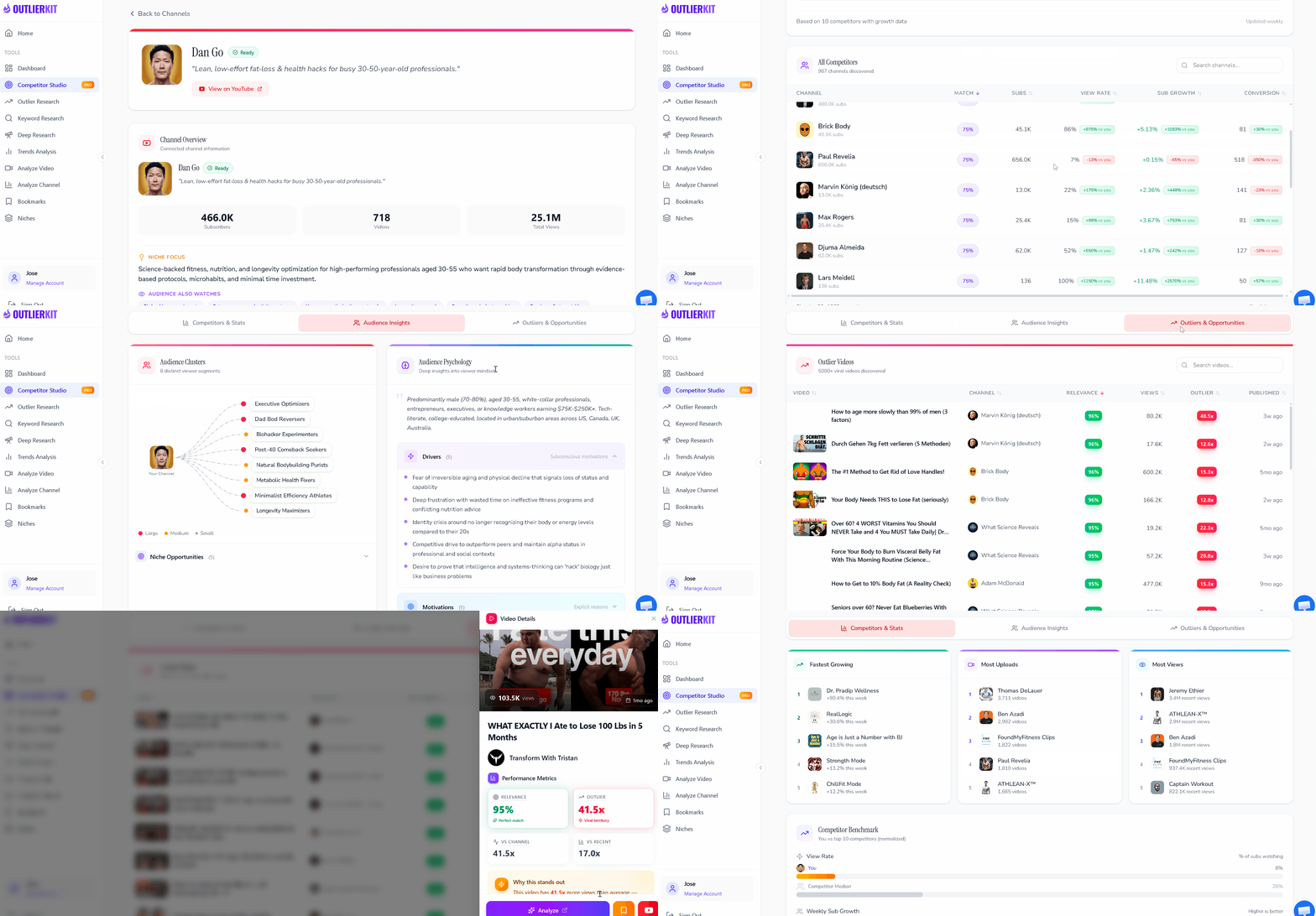
Track your whole niche in Competitor Studio
These are just the closest channels. Competitor Studio maps 1,000+ direct & adjacent channels in your niche — with outlier detection and ongoing tracking.
- Track 1,000+ direct & adjacent competitors
- Outlier video detection
- AI-powered video insights
Peter Yang Revenue & Valuation
from public dataWe estimate your channel's current valuation to be between $26,481 and $134,738, establishing a baseline floor of $20,370 with medium confidence. This valuation is anchored in your current revenue streams, though addressing key operational gaps offers illustrative potential to significantly elevate your market value.
Estimates derived from public data (earnings history + comparable channels). Not an offer, appraisal, or financial advice.
Frequently asked questions about Peter Yang
- How many subscribers does Peter Yang have?
- Peter Yang has 111.0K subscribers on YouTube, built up over roughly 13.1 years on the platform. Its videos average about 15.3K views each.
- How many views does Peter Yang have?
- Peter Yang has accumulated 4.7M total views across 306 uploads, averaging roughly 978 views per day since launch.
- How many videos has Peter Yang posted?
- Peter Yang has published 306 videos on YouTube, with recent uploads averaging about 34:18 in length.
- How engaged is Peter Yang's audience?
- Over its lifetime, Peter Yang has averaged about 42 views for every subscriber, a sign of how far its videos travel beyond the core subscriber base. On a per-video basis it draws roughly 15.3K views.
- How much money does Peter Yang make?
- Peter Yang's estimated YouTube revenue is $1K – $4K per month, including advertising and sponsorships (ad revenue alone is an estimated $862 – $1K per month). These are estimates derived from public data, not exact earnings.
- What is Peter Yang's channel worth?
- Peter Yang's YouTube channel is estimated to be worth $26K – $135K, benchmarked against comparable channels. This reflects the value of the channel as a media asset, not the creator's total net worth.
- What is Peter Yang's most popular video?
- Peter Yang's most-viewed video is "Claude Design: Everything You Can Build in 16 Minutes (5 Real Use Cases)", with 397.0K views — roughly 23.4× the channel's typical video.
- What is Peter Yang's biggest recent breakout video?
- Peter Yang's biggest recent breakout is "Claude Design: Everything You Can Build in 16 Minutes (5 Real Use Cases)", which pulled 397.0K views — about 23.4× the channel's recent median.
- What kind of content does Peter Yang make?
- Peter Yang is best described as AI Agent Engineering & Vibe Coding. The definitive hands-on guide for builders, product managers, and non-technical founders learning to build autonomous AI employees and ship apps using modern LLM workflows.
- Does Peter Yang post Shorts or long-form videos?
- Peter Yang publishes primarily long-form videos (about 100% of recent uploads), averaging around 34:18 in length.
- What topics does Peter Yang cover?
- Peter Yang's catalogue spans Claude Code & Design Tutorials, AI Agents & OpenClaw Automations, Vibe Coding & Solo App Development, LLM Model Comparisons & Product Launches and AI Product Management & Career Strategy. These recurring themes make up the bulk of the channel's uploads.
- Who watches Peter Yang?
- Peter Yang's audience skews 25-34, highly male-skewed with a notable minority of female product managers and tech p and based concentrated in major global tech hubs, heavily weighted toward the united states.. Peter Yang's audience is a highly motivated cohort of 'builders'—ranging from software engineers and product managers to non-technical solo founders. They are early adopters of AI technology who watch this channel to learn how to bypass traditional software development bottlenecks using 'vibe coding' and agentic workflows. They value highly practical, screen-share-heavy tutorials that teach them how to build real apps, automate their careers, and deploy AI employees to gain massive professional leverage. These are estimates inferred from public channel data, not YouTube Analytics.
- What is Peter Yang's audience interested in?
- Viewers of Peter Yang tend to be interested in AI Agent Engineering, Vibe Coding & Solo SaaS Development, Product Management & Tech Career Strategy, Developer Productivity Tools (Cursor, Claude Code, Replit) and Workflow Automation & Personal OS Setup. Estimated from the channel's content and the channels its viewers co-watch.
- What channels are similar to Peter Yang?
- Channels with audiences similar to Peter Yang include Riley Brown, Sandeep Swadia, Pat Simmons, Nick Saraev and Austin Marchese. The audience is tightly clustered around practical AI tools, agentic workflows, Claude/ChatGPT updates, and hands-on AI engineering, with minimal spillover into unrelated mainstream niches.
- How often does Peter Yang post?
- Peter Yang uploads about 2.3 videos per week (roughly 9.9 per month).
- Is Peter Yang still active on YouTube?
- Yes — Peter Yang is actively posting. Its most recent upload was 1 day ago.
- How long has Peter Yang been on YouTube?
- Peter Yang has been active on YouTube for about 13.1 years, growing to 111.0K subscribers over that time.
How this analysis was made
- Source: public YouTube channel & video data (120 recent videos sampled).
- Outlier videos: uploads with ≥1.5× the channel's recent median views.
- Revenue & valuation: estimated from public earnings signals and comparable channels — ranges, not exact figures.
- Last updated: 10/11/2026.