
Koo Psychology YouTube channel analysis
Koo Psychology is a YouTube channel with 111.0K subscribers and 7.0M total views, and an estimated $4K – $12K/mo revenue. This analysis breaks down its outlier videos, content strategy, similar channels, revenue & valuation estimate.
Analysis generated with AI from public YouTube data. Revenue and valuation figures are estimates derived from public data, not financial advice.
Koo Psychology Channel Overview
lifetime totalsKoo Psychology Outlier Videos
breakouts ≥1.5× recent median








Koo Psychology Top Videos
biggest ever



Koo Psychology is a highly scalable, faceless educational channel that leverages deep-seated human desires for self-validation and generational identity. By utilizing a highly repeatable 'The Psychology of [X]' title formula, the channel achieves massive leverage on evergreen search and psychological curiosity, though it currently faces a temporary upload pause (last upload 32 days ago) despite strong 30-day momentum.
Koo Psychology Niche & Positioning
A faceless, essay-style channel diagnosing the hidden traumas, behavioral quirks, and generational identities of everyday people.
Koo Psychology Content Strategy
An almost entirely evergreen catalog focused on timeless psychological archetypes, childhood trauma, and generational identity studies that continue to accumulate views years after upload.
Koo Psychology Outlier Playbook
the repeatable breakout formulaA narrated identity-psychology explainer that makes a huge audience feel personally decoded, especially overlooked age cohorts. The biggest repeatable winner is generational psychology: Xennials born 1976-1985 who “don’t fit in,” people who grew up in the 1990s, Gen X, Baby Boomers, Millennials, and Generation Jones. The hook is not clinical education; it is recognition: “this is why your generation feels emotionally strange, burned out, nostalgic, detached, or misunderstood.” No guest is needed. Breakouts happen when the topic combines a broad self-label with a painful identity wound, e.g. Xennials caught between analog childhood and digital adulthood, 90s nostalgia as trauma response, Gen
“The Psychology of [large identity group/cohort]” + optional clarifier that names the wound: “Why [specific group] [doesn’t fit in / can’t process sadness / seems emotionally cold / is secretly burned out].” Best examples: “The Xennial Psychology - Why People Born 1976-1985 Don’t Fit In,” “The Psych
- 1Prioritize underserved cohort topics over narrow clinical ones: make videos on “The Psychology of Elder Millennials,” “The Psychology of 80s Kids Who Became Parents,” “The Psychology of 90s Kids Raisi
- 2Attach each cohort to one clear emotional wound or identity contradiction: Xennials don’t fit in, 90s kids use nostalgia as a trauma response, Gen X learned emotional self-reliance, Boomers can’t apol
- 3Use the winning format: “The Psychology of…” explainer with a broad opening that names the viewer directly, then unpack 5-7 formative forces from childhood era, parenting style, economy, technology, s
- 4Package with precise labels and date ranges when possible. “Xennials born 1976-1985” massively outperformed broader “Zillennials” and “Gen Z,” so use specific cohort boundaries like “People Born 1965-
- 5Release these as a connected generational run instead of isolated uploads: follow a breakout like “90s Nostalgia is Actually a Trauma Response” with adjacent cohort videos such as “The Psychology of 9
Koo Psychology Performance Drivers
Koo Psychology Topic Clusters
Koo Psychology Growth Opportunities
untapped whitespace- Launch structured cohort-specific mini-series (e.g., a 3-part deep dive into 'The Gen X Midlife Crisis') to build episodic anticipation and serial viewership.
- Monetize the highly self-reflective audience by selling digital products like shadow-work journals or psychological coping guides tailored to the specific profiles discussed.
- Repackage the long-form, essay-style audio tracks into a podcast format for distribution on Spotify and Apple Podcasts to capture passive, audio-only listeners.
- Introduce community-driven diagnostic tools, such as self-assessment quizzes linked in the descriptions, to build an off-platform email list.
How Replicable Is Koo Psychology
The channel relies on a highly systematic, faceless script-and-voiceover format using stock footage, meaning production can be easily outsourced and does not depend on a specific personality or exclusive guest access.
Koo Psychology Content Risks
- Formulaic Title Fatigue: Over-reliance on the 'The Psychology of People Who...' template risks desensitizing the audience, leading to a drop-off in click-through rates over time.
- Platform Policy Changes: YouTube's evolving policies regarding 'repetitive content' or automated stock-footage channels could threaten monetization if the visual presentation lacks unique creative edi
- Scientific Credibility Backlash: Lacking peer-reviewed citations or professional credentials in the videos could expose the channel to community backlash or platform de-prioritization for medical/ment
Who Watches Koo Psychology
estimated audienceEstimated from public channel data — titles, descriptions, metadata and co-watched channels. Not YouTube Analytics. high confidence
The Koo Psychology audience is composed of highly introspective adults—predominantly Millennials, Xennials, and Gen Xers—who seek to understand their personality quirks, heal from childhood family dysfunction, and navigate complex relationship dynamics. They value deep self-awareness and are motivated to break toxic generational cycles.
Slightly female-skewed, attracting individuals focused on emotional healing and
Primarily English-speaking Western nations, led by the United States.
What Koo Psychology's Audience Cares About
- Carrying unresolved childhood emotional neglect
- Friction with emotionally unavailable or Boomer parents
- Habitual conflict avoidance and over-explaining
- Feeling isolated, misunderstood, or chronically burnt out
- To decode and validate their own behavioral quirks
- To heal from past family dysfunction and set healthy boundaries
- To understand the psychological roots of their relationship patterns
Introspective and quiet, often identifying as introverts, deep thinkers, or 'the therapist friend' who prefers solitude or deep, meaningful connections over superficial socializing.
- Why Xennials and Millennials Struggle to Connect with Boomer Parents
- The Long-Term Effects of Being the 'Glass Child' in a Dysfunctional Family
- How Introverts Use Solitude as a Defense Mechanism Against Burnout
- The Psychology Behind Why We Attract Partners Who Mimic Our Childhood Trauma
- Why Former Gifted Children Experience Chronic Underachievement in Adulthood
Prefers Long-form (15 to 25 minutes) videos, analytical, empathetic, validating, and deeply reflective.
Inferred from: High-performing videos focusing on Xennial, Millennial, and Gen X generational psychology · Co-watch channels centered on childhood trauma recovery (Patrick Teahan, Jerry Wise) and introverted personality analysis · Video titles targeting specific behavioral coping mechanisms like over-explaining, conflict avoidance, and isolation
The audience is deeply concentrated in a specific ecosystem of self-diagnostic psychology, childhood trauma recovery, and personality trait analysis, with very few external outliers.


Track your whole niche in Competitor Studio
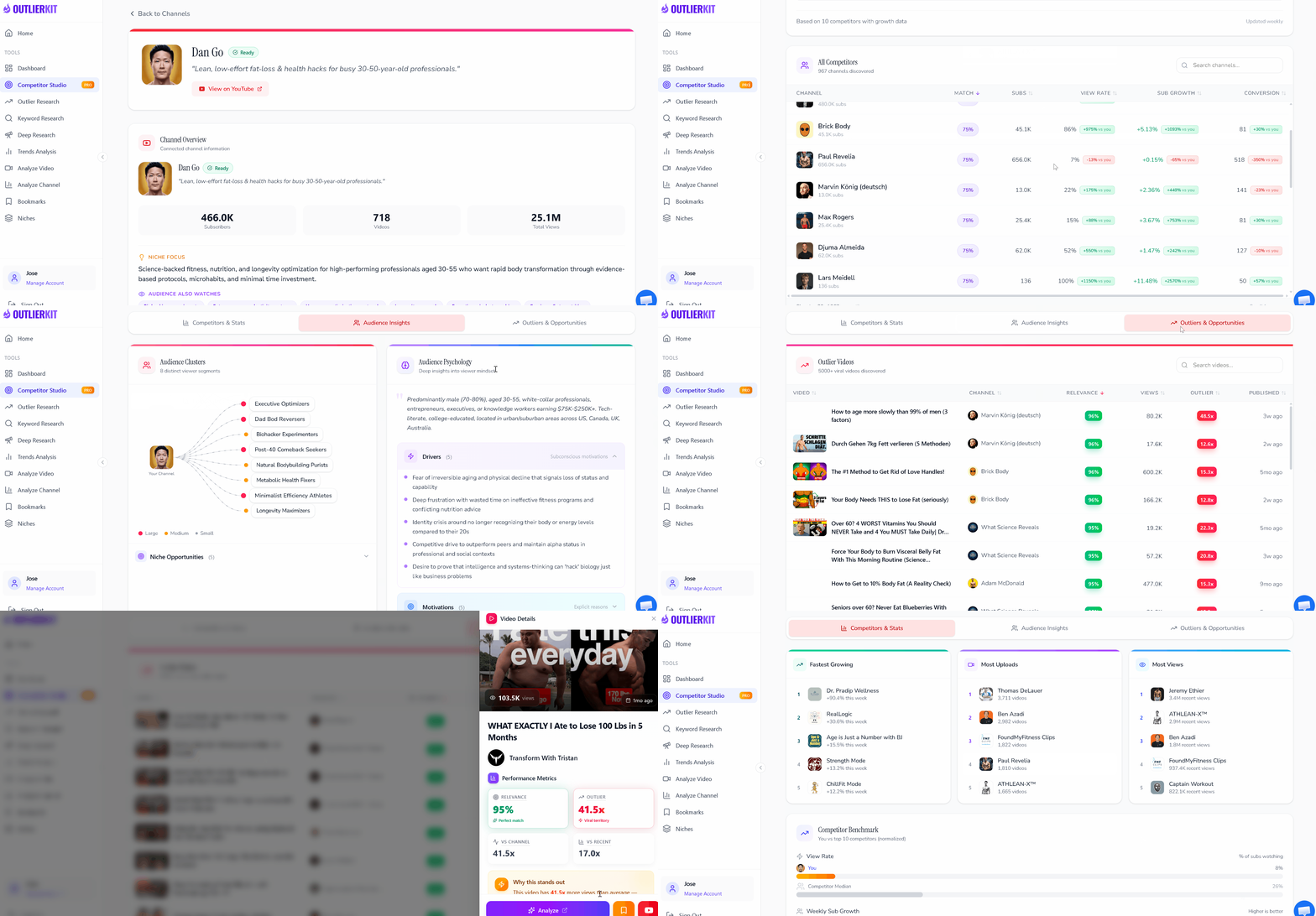
These are just the closest channels. Competitor Studio maps 1,000+ direct & adjacent channels in your niche — with outlier detection and ongoing tracking.
- Track 1,000+ direct & adjacent competitors
- Outlier video detection
- AI-powered video insights
Koo Psychology Revenue & Valuation
from public dataBased on your current performance, your business commands an estimated valuation of $71,556 to $363,133, with an absolute floor of $55,042, evaluated at a medium confidence level. This valuation is heavily driven by your strong catalog leverage, though executing key growth levers could potentially elevate this asset value significantly in the future.
Estimates derived from public data (earnings history + comparable channels). Not an offer, appraisal, or financial advice.
Frequently asked questions about Koo Psychology
- How many subscribers does Koo Psychology have?
- Koo Psychology has 111.0K subscribers on YouTube, built up over roughly 0.8 years on the platform. Its videos average about 50.4K views each.
- How many views does Koo Psychology have?
- Koo Psychology has accumulated 7.0M total views across 138 uploads, averaging roughly 24.1K views per day since launch.
- How many videos has Koo Psychology posted?
- Koo Psychology has published 138 videos on YouTube, with recent uploads averaging about 20:18 in length.
- How engaged is Koo Psychology's audience?
- Over its lifetime, Koo Psychology has averaged about 63 views for every subscriber, a sign of how far its videos travel beyond the core subscriber base. On a per-video basis it draws roughly 50.4K views.
- How much money does Koo Psychology make?
- Koo Psychology's estimated YouTube revenue is $4K – $12K per month, including advertising and sponsorships (ad revenue alone is an estimated $3K – $4K per month). These are estimates derived from public data, not exact earnings.
- What is Koo Psychology's channel worth?
- Koo Psychology's YouTube channel is estimated to be worth $72K – $363K, benchmarked against comparable channels. This reflects the value of the channel as a media asset, not the creator's total net worth.
- What is Koo Psychology's most popular video?
- Koo Psychology's most-viewed video is "The psychology of people who cut off contact with their families", with 948.0K views — roughly 155.4× the channel's typical video.
- What is Koo Psychology's biggest recent breakout video?
- Koo Psychology's biggest recent breakout is "The Xennial Psychology - Why People Born 1976-1985 Don't Fit In", which pulled 782.0K views — about 128.2× the channel's recent median.
- What kind of content does Koo Psychology make?
- Koo Psychology is best described as Pop-Psychology & Generational Analysis. A faceless, essay-style channel diagnosing the hidden traumas, behavioral quirks, and generational identities of everyday people.
- Does Koo Psychology post Shorts or long-form videos?
- Koo Psychology publishes primarily long-form videos (about 100% of recent uploads), averaging around 20:18 in length.
- What topics does Koo Psychology cover?
- Koo Psychology's catalogue spans Generational & Cohort Psychology, Childhood Trauma & Toxic Parenting Dynamics, Personality Profiles & Behavioral Quirks, Relationship, Marriage & Divorce Dynamics, Mental Health, Coping Mechanisms & Addictions and Pet & Animal-Related Human Psychology. These recurring themes make up the bulk of the channel's uploads.
- Who watches Koo Psychology?
- Koo Psychology's audience skews 35-44, slightly female-skewed, attracting individuals focused on emotional healing and and based primarily english-speaking western nations, led by the united states.. The Koo Psychology audience is composed of highly introspective adults—predominantly Millennials, Xennials, and Gen Xers—who seek to understand their personality quirks, heal from childhood family dysfunction, and navigate complex relationship dynamics. They value deep self-awareness and are motivated to break toxic generational cycles. These are estimates inferred from public channel data, not YouTube Analytics.
- What is Koo Psychology's audience interested in?
- Viewers of Koo Psychology tend to be interested in Generational cohort history, Childhood trauma recovery, Introversion and personality typing, Relationship and divorce dynamics and Self-directed emotional healing. Estimated from the channel's content and the channels its viewers co-watch.
- What channels are similar to Koo Psychology?
- Channels with audiences similar to Koo Psychology include Turn Wiser, Apex Psychology, MindToAct, Psychology Hidden Mind and Mr. Inkblot. The audience is deeply concentrated in a specific ecosystem of self-diagnostic psychology, childhood trauma recovery, and personality trait analysis, with very few external outliers.
- How often does Koo Psychology post?
- Koo Psychology uploads about 4 videos per week (roughly 17 per month).
- Is Koo Psychology still active on YouTube?
- Yes — Koo Psychology is actively posting. Its most recent upload was 32 days ago.
- How long has Koo Psychology been on YouTube?
- Koo Psychology has been active on YouTube for about 0.8 years, growing to 111.0K subscribers over that time.
How this analysis was made
- Source: public YouTube channel & video data (120 recent videos sampled).
- Outlier videos: uploads with ≥1.5× the channel's recent median views.
- Revenue & valuation: estimated from public earnings signals and comparable channels — ranges, not exact figures.
- Last updated: 9/25/2026.